Blame the operator
Changing the filter by calendar can hide the water-treatment failure that loaded it
A dirty cartridge is frequently treated as routine consumption. This guide distinguishes normal pressure-drop progression from upstream breakthrough, chemistry change, media failure, and an incorrectly interpreted differential pressure.
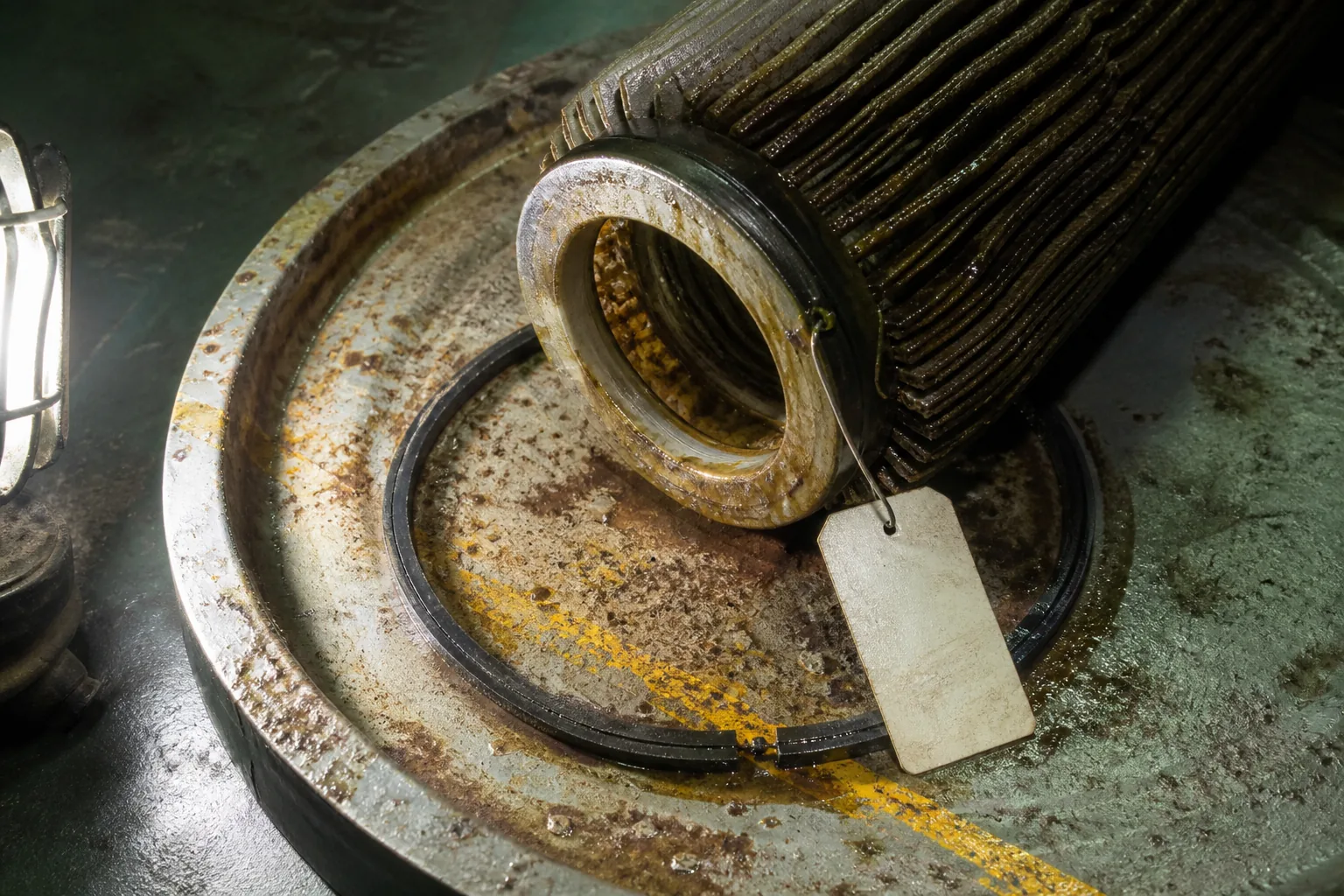
What to do when a water-treatment filter blocks early and the response is simply to change it again
At 05:55 the water-treatment room has acquired a small stack of used filter elements and an opinion about them.
The current element blocked well before its planned change date.
Housing differential pressure is high.
Production needs water.
Somebody has a fresh carton, a wrench, and a work order whose principal achievement is the phrase “replace filter.”
The carton opens.
The old element goes into a disposal bag.
The new one goes in. The pressure drop falls.
The work order closes with the administrative serenity of a parking ticket paid online.
Then the new element begins loading early as well.
A filter element is a treatment barrier.
It is not a household consumable with a more elaborate invoice.
Its pressure drop records what water and flow have done to it.
Its outlet quality records whether it still performs the duty the treatment train assigned to it.
Change it before those facts are captured and flow returns, but the best witness to the loading has gone out in the bag.
Exhibit A
Treat the removed element, its housing data and the upstream water record as one exhibit.
Do not discard the element before its orientation, condition and disposal route are recorded.
Do not reset the differential-pressure trend and call the new value a baseline without keeping the old one.
Do not increase a chemical dose, bypass a pretreatment unit, or put a different element in the housing merely because the first explanation has become inconvenient.
Before anyone touches the next element, capture:
- filter type, media or element identity, rating, housing and installed configuration;
- actual flow, inlet and outlet pressure, calculated differential pressure, and the condition and calibration status of the pressure instruments;
- inlet and outlet turbidity, solids, and applicable chemistry or microbial indicators;
- change date, run hours, throughput, cartridge or media condition, photographs and disposal record;
- upstream clarification, dosing, oxidation, backwash, source-water blend and recent source-water changes;
- downstream water-quality requirement, any breakthrough evidence, and whether off-spec water could have reached its header;
- sample locations, methods, analyser calibration, current operating flow, and the history of previous comparable runs.
Take an inlet sample and an outlet sample before the housing is disturbed, where the procedure permits it.
Mark their locations.
“Water sample” has the same evidentiary force as “part number.” It looks decisive on a form and may describe almost nothing.
The used element, the sample bottles, the trend printout, the chemical-delivery record and the work order are the file.
The loss is not the cartridge
There are two losses.
The obvious one is the element, the labour, the disposal, and perhaps a short interruption in water supply.
The storeroom can calculate that part without difficulty.
The larger loss is the treatment function the element was protecting.
A filter might be upstream protection for ion exchange, membrane treatment, disinfection, a boiler-water header, a process-water header or potable storage.
Those duties have different downstream consequences, which is why a clean-looking outlet is an unusually weak release criterion.
The question worth asking is not “Was the filter changed on time?”
It is “Does the treatment barrier still deliver the required water quality at the actual flow and source-water condition?”
That puts differential pressure in its proper place.
Pressure drop is a hydraulic observation.
It rises as solids narrow flow paths.
It does not prove that particles are retained.
Nor does a low pressure drop prove the outlet is acceptable.
A filter can be hydraulically blocked while still retaining particles.
It can pass particles at an entirely ordinary differential pressure.
It can be physically damaged beneath a clean-looking surface.
The gauge has a useful job.
It is not the whole inquiry wearing a threaded connection.
Published turbidity criteria make the point without licensing anyone to copy them into every controller.
One framework lists 0.3 NTU for conventional and direct filtration, 1.0 NTU for slow sand and diatomaceous earth, and 0.1 NTU for membrane units, with an objective of striving below 0.1 NTU on individual filters.
Those are performance and control criteria inside that framework.
They are not generic settings for a site with another duty or another jurisdiction.
Read pressure drop and outlet quality as separate witnesses
The most common short-run story is surface sealing.
Headloss rises steeply soon after restart.
Throughput falls at constant driving head.
Early effluent may still look acceptable.
Solids are concentrating in the first few centimetres of media instead of being stored through the depth.
A two-hour run in that pattern is not high efficiency.
It is an unusually expensive way to use the top of a filter.
Look outward first.
Poor coagulation produces sticky pin floc.
Failed clarification delivers more solids than the filter was meant to accept.
An algal or raw-water event overwhelms a bed designed for settled water.
A rapid rate increase delivers more solids per square metre and raises shear at the loaded surface.
Replace the element under unchanged conditions and its successor is simply asked to receive the same evidence.
The opposite pattern is worse, because it looks less dramatic.
Rising outlet turbidity or particle count at normal differential pressure points to breakthrough or bypass.
A rate surge can push particles through media.
A crack, a void, a stratification error, a low-density channel, a damaged underdrain, a missing seal, a valve lineup error or media loss can all provide a less resistive route.
The pressure gauge stays entirely composed while the barrier stops doing its work.
One cited study saw particle removal fall from 5.5 log to 2.1 log while turbidity stayed below 0.1 NTU.
That is the reason not to treat a single neat outlet value as a declaration of innocence.
The required downstream water quality, the particle or microbial duty, the sample point and the credible bypass path all belong in the result.
Time is evidence too.
An outlet peak in the first 15 min after backwash is a ripening problem, not necessarily end-of-run breakthrough.
The bed has been expanded and cleaned.
Residual wash solids and an open capture condition can reach the first filtrate before the normal capture condition reforms.
Slow start, filter-to-waste and delayed start are the available controls.
A daily average is no substitute for a time-aligned trace.
A barrier that performs later may still have sent unqualified early water downstream.
Confirm the numbers before they explain the plant
The differential-pressure calculation needs an inlet reading, an outlet reading, their locations, and instruments that agree with the actual hydraulic condition.
A declining differential pressure at constant flow can mean a channel opened, a valve bypassed, or an instrument failed.
It is not automatically welcome news from a clean filter.
Then establish actual flow and online area.
Filtration rate is flow divided by bed area.
A flow of 100 m³/h on 20 m² of online bed is 5 m³/m²·h.
Take one 5 m² cell out of service and the remaining loading becomes 6.67 m³/m²·h at the same plant flow.
A calendar does not know that a parallel unit is out of service, that demand has moved, or that a source blend has changed.
The published ranges make the category error plain.
Rapid gravity filtration runs at 4 to 20 m³/m²·h. Roughing filters and slow sand run one and two orders of magnitude slower.
Those are different capture regimes.
They are not a menu of interchangeable operating rates.
A rate can look ordinary in one process and be an instruction to change the other process’s failure mode.
For gravity filters, one cited wastewater practice puts normal terminal headloss at 2.4 to 3.0 m of water, while noting that the economical endpoint depends on influent and rate.
That is a useful warning against running until flow stops.
It is not a universal cartridge-change differential pressure.
The approved endpoint belongs to the housing, the media, the downstream duty, the hydraulic grade and the operating procedure actually in front of the operator.
Ask the treatment train what it changed
Call the people who own raw water, clarification, chemical dosing, the filter supply and the downstream header.
Do that before inventing a new replacement interval.
Give them the captured samples, the trend, the actual flow, the removed-element condition, the differential-pressure readings, the upstream changes and the exact water-quality duty.
Then ask what changed upstream of the barrier.
Was an oxidation condition altered?
Did coagulant dose, polymer aid, mixing or source blend change?
Did clarification performance shift?
Was a pretreatment unit bypassed?
Did the water get colder, raising viscosity and changing wash expansion?
Has a pump or valve changed the flow history?
Is the filter now being asked to remove a load the train used to remove earlier?
Ask the supplier a stricter question than “what should the change interval be?”
Ask whether the element or media construction, rating, material and operating rate suit the water characteristics and the duty.
The answer has to include what enters the housing and what the outlet must protect.
A size, a brand name and a reassuringly familiar carton are not a treatment selection method.
For granular media, effective size makes the trade visible.
Slow sand uses 0.15 to 0.30 mm effective sand. Rapid gravity sand commonly uses 0.5 to 1.0 mm. One tertiary-wastewater study found coarser media necessary again, with run-length benefit as size rose, provided the washing kept up.
Smaller media offers more collector surface, but raises clean-bed resistance and plugs faster.
Larger media accepts more solids, but needs suitable floc, depth or polishing.
Those figures belong to their stated processes.
They do not turn every early cartridge change into an excuse to buy a coarser element.
The same discipline applies to multilayer media.
Anthracite, silica sand and garnet have different specific gravities, so they re-stratify differently after an upward wash.
A layer of coarse anthracite over a deeper bed of finer sand is a designed sequence, not a decorative layer cake.
An incorrect density-size combination, fines, a shallow top layer, media loss or an ineffective wash changes run length and breakthrough together.
Correct one thing, then make the next run comparable
Do not change the whole train because one element loaded early.
The sequence is deliberately dull:
Retain the removed element and capture inlet and outlet data → verify differential-pressure measurement and actual flow → compare loading with historical throughput and water quality → inspect clarification, dosing, pretreatment and source changes → select or correct media and operating rate with supplier evidence → install the verified element → retest pressure drop, outlet quality and breakthrough over a controlled interval.
If wash performance is part of the cause, treat wash intensity as a balance rather than a display setting.
Very weak washing leaves mudballs, compacted deposits and residue.
Very strong washing carries media out, alters layers and overwhelms troughs.
Maximum hydrodynamic shear in commonly used sand sits at a particular expanded porosity, and deep-bed examples run washes of a quarter of an hour or more.
Those observations explain why “wash harder” and “wash less” are not diagnoses.
Check media depth rather than judging the surface.
An annual check is the usual advice, with restoration once the change across a filter exceeds 50 mm.
A 50 mm loss reduces contact depth and changes distribution.
It also records an excessive wash rate or a trough problem.
The missing medium has not retired.
It has relocated, generally without improving the plant’s filtration.
If the barrier cannot be restored
Sometimes the evidence points past an element change.
A damaged underdrain.
A bypass valve.
Lost media.
A treatment duty that no longer matches the source. A residual stream that has been treated as somebody else’s future problem.
At that point the train has become an estate rather than a work order.
Calculate the whole exposure: replacement elements or media, sampling, supplier review, clarification or dosing correction, washwater, downtime, off-spec water, downstream equipment risk, waste characterization, transport, and the receiving route for spent material.
The original cartridge is a modest creditor in that proceeding.
Water treatment has the irritating habit of keeping its removed material.
Filter washwater, spent media, ion-exchange beads, membrane concentrate, sludge and cleaning solutions all concentrate what was taken from the source.
A drinking-water approval does not authorize their discharge.
The destination follows wastewater, solid-waste, hazardous-waste, radioactive-waste, land-application and receiving-facility requirements.
A train with a beautiful outlet and nowhere permitted for its residuals is not a finished treatment decision.
It is a future meeting with several people carrying folders.
The autopsy nobody schedules
The satisfying story is that an operator missed a filter-change interval.
It provides a culprit, a new calendar and an unchanged barrier.
The better question is how repeat early loading was possible.
Did the CMMS define filter replacement as a completed PM even when run hours or throughput were abnormal?
Did it record only a change date, and not actual flow, pressure drop, inlet quality, outlet quality and cartridge condition?
Did the work order omit the sample location and the test method?
Did purchasing substitute a media or element grade without the supplier’s evidence?
Did an upstream dose, source blend, clarification condition or bypass change without ever being linked to filter performance?
Was a differential-pressure transmitter unverified?
Did operations take a parallel unit out of service and leave the same calendar interval in place?
Did the plant keep an outlet turbidity average but not the first 15 min after restart?
Did the downstream header acquire a different release criterion after a production change?
Did anyone connect the rapidly growing element consumption to the chemical-delivery or source-water record?
The system had told everyone that the filter was consumable inventory.
It is difficult to blame people for reading the form correctly.
Controls that outlast a carton
Link every filter change to a mandatory inlet and outlet sample and an actual differential-pressure reading.
The record should also require actual flow, run hours, throughput, element identity, condition, upstream changes, downstream duty, sample method and disposal route.
Make the CMMS flag an early change as an investigation rather than a completed PM.
Define early against the verified operating baseline for that filter duty.
Do not invent a generic number because the database finds blank fields aesthetically distressing.
Put the capture fields on the job screen where the housing is opened.
Tie the filter record to the dosing, backwash, source-water and downstream-quality trends.
Require a stated disposition for the removed element, and an owner for any upstream correction.
None of that is a memo about care.
It is a workflow that refuses to let evidence become garbage before breakfast.
Closing the estate
The correct response to an early-loaded filter is not complicated, although it does delay the gratifying sound of a housing being closed.
Freeze the evidence.
Keep the removed element, the pressure record, the actual flow, the inlet and outlet data, the upstream history and the downstream duty in one file.
Separate high pressure drop from breakthrough.
Verify the instruments and the loading.
Correct the upstream cause, or the mismatched medium.
Install a verified element.
Retest the barrier over a controlled interval.
A filter that blocks early is not failing.
It is reporting, at its own expense, on something upstream that nobody has yet agreed to measure.
Asked on the floor
- Why does a filter block early even when the outlet water still looks acceptable?
- A filter can block early because solids seal the influent face rather than being stored through the available medium. Poor coagulation can create sticky pin floc, failed clarification can deliver excessive solids, and an algal or raw-water event can overwhelm a filter designed for settled water. Early acceptable outlet quality does not make a two-hour run normal; it can be the signature of surface sealing.
- Does a normal differential pressure prove that the filter is still removing particles?
- No. A filter can pass particles while differential pressure remains ordinary. An abrupt outlet turbidity or particle-count rise after a flow change can indicate hydraulic breakthrough, while a crack, void, media loss, damaged underdrain, missing seal, or valve lineup error can create a bypass path. Differential pressure describes hydraulic resistance, not complete barrier performance.
- What has to be recorded before a loaded filter element is thrown away?
- The record includes filter type, media or element identity, rating, housing, actual flow, inlet and outlet differential pressure, inlet and outlet turbidity, solids and applicable chemistry or microbial indicators, change date, run hours, throughput, element condition, disposal route, upstream operations, dosing, backwash, recent source-water changes, sample locations, methods, analyser calibration, and downstream quality requirement.
- Can low turbidity prove that a treatment filter is doing its job?
- No. Turbidity is an important operating and performance indicator, but it does not fully describe particle retention or the required downstream water quality. In one EPA-cited study, removal declined from 5.5 log to 2.1 log while turbidity remained below 0.1 NTU. A low outlet number must be interpreted with the filter duty, sample point, and release criterion.
- Why does the flow rate matter when a filter is changed?
- Flow determines hydraulic loading and solids delivery per unit filter area. A 100 m³/h flow on 20 m² of online bed is 5 m³/m²·h, but removing one 5 m² cell changes the remaining loading to 6.67 m³/m²·h. A similar calendar interval can therefore represent a different operating duty, and rapid rate changes can force particles through media.
- What does a dirty filter immediately after backwash or restart mean?
- A poor outlet in the first 15 minutes after backwash is a ripening pattern, not necessarily ordinary end-of-run breakthrough. A newly expanded bed can release residual wash solids before its working capture condition reforms. Filter-to-waste, delayed start, and slow start can control initial breakthrough, but the time-aligned outlet trace is needed to distinguish a weak wash from an excessively aggressive one.
- How does the wrong media make a filter change happen too often?
- Smaller effective media has more collector surface and can improve fine-particle capture, but it also has less void volume, higher clean-bed resistance, and faster plugging. Larger media accepts more solids but may need coarser influent floc, greater bed depth, or downstream polishing. Media size, density, layer depth, and wash method must suit the influent and required treatment duty.
- What is the difference between high pressure drop and breakthrough?
- High pressure drop indicates increasing hydraulic resistance as pores narrow, while breakthrough indicates that particles are reaching the outlet through a changed retention path. Surface sealing can create rapid pressure rise with initially acceptable outlet water. Conversely, a bypass, channel, flow surge, or damaged media arrangement can produce rising outlet turbidity at ordinary differential pressure. The two signals are related but not interchangeable.
- Can an early filter change be closed as routine preventive maintenance?
- No. An early change is evidence that the barrier has not delivered its expected run under the recorded operating conditions. The job should retain the removed element, verify the differential-pressure measurement and actual flow, compare inlet and outlet water data with historical throughput, inspect pretreatment and dosing, and retest the new element over a controlled interval. Closing it as routine erases the investigation trigger.
- What water-quality limits apply to a filter outlet?
- The applicable limit depends on the treatment duty, jurisdiction, and downstream header. Health Canada lists treated-water turbidity limits of ≤0.3 NTU for conventional and direct filtration, ≤1.0 NTU for slow sand and diatomaceous earth filtration, and ≤0.1 NTU for membrane units in its framework. Those values are not universal plant setpoints; the site must identify its binding release criterion.
- Why does filter disposal belong in the same investigation as filtration performance?
- A removed filter element, spent media, washwater, or concentrated residual can contain materials removed from the source water. Residual routes are controlled by wastewater, solid-waste, hazardous-waste, radioactive-waste, land-application, and receiving-facility requirements rather than by the filter change alone. The element condition and disposal record can also preserve evidence of what the treatment barrier was receiving.