Encode everything
Duplicate part records are not extra inventory
Five material numbers can represent one bearing, or one number can conceal five non-equivalent variants. This reference problem treats duplicates as a governed evidence problem before inventory arithmetic is trusted.
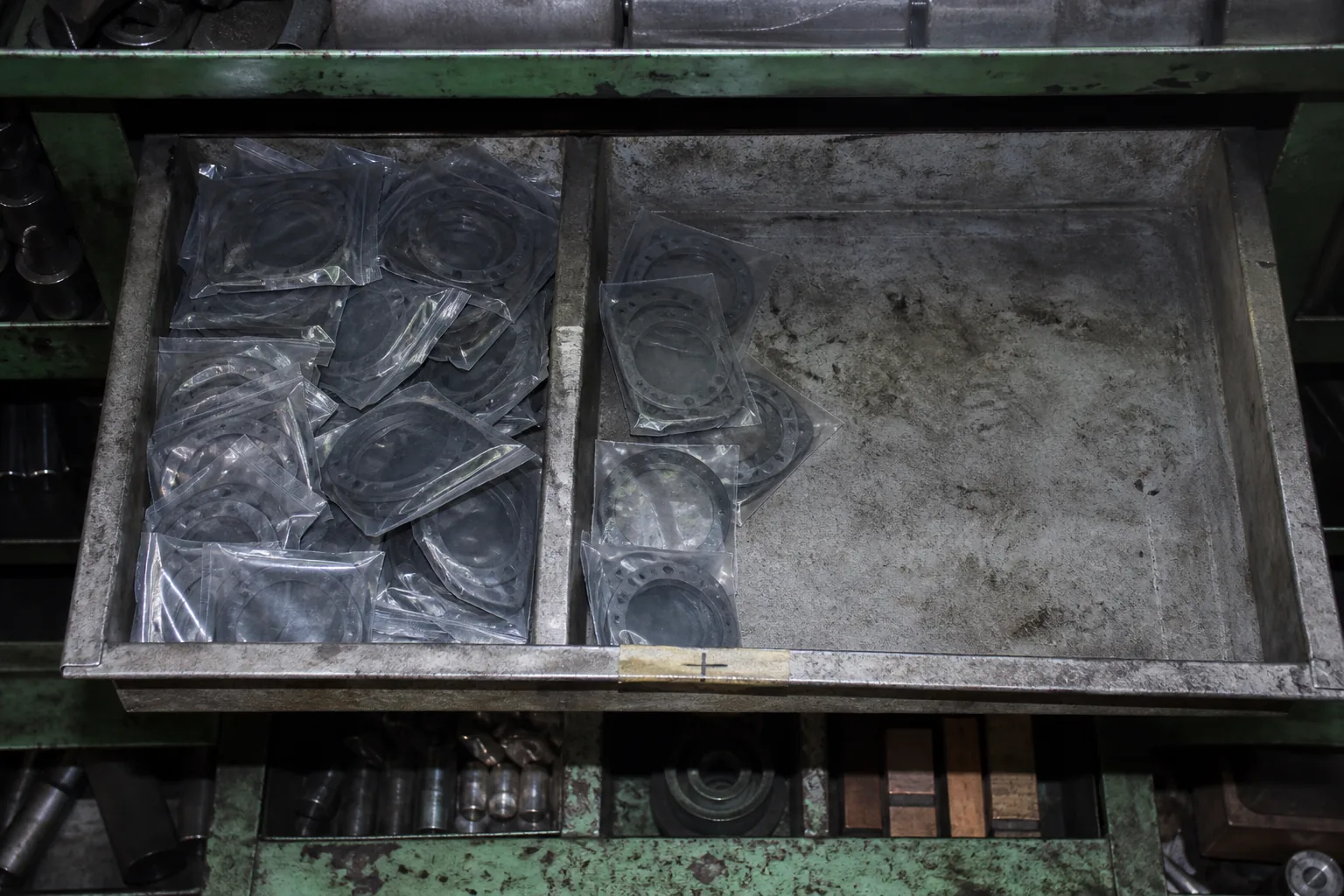
What to do when the storeroom has several records that may represent the same spare part
There is a recurring moment in the store.
The count says there are five bearings.
The shelves say there are three boxes.
And the machine has already made it clear that it would like an answer before breakfast.
The material master supplies five numbers.
The labels supply two more.
One box has a manufacturer number.
Another has an internal number.
A third says only “MOTOR BRG.”
The class on all of them says bearing, which is comforting and about as decisive as classifying a wolf and a golden retriever as mammals.
The instinct is to merge the records.
A duplicate record is not extra inventory.
It is a claim that two pieces of evidence describe one controlled item.
Sometimes the claim is correct.
Sometimes one number conceals several non-equivalent revisions, conditions, packages or restrictions.
The work is not housekeeping.
It is a small identity investigation, conducted beside a shelf that has started keeping its own accounts.
Exhibit A
Treat the candidate records and the physical material as one exhibit.
Do not start moving stock between bins because the descriptions look like cousins.
Do not issue the cleaner-looking box under a different number to make the count reconcile.
Do not delete an old record because it has zero quantity.
It may be a legitimate history.
A supersession.
A repair route.
Or the only surviving explanation for a restricted item sitting in a cage.
Capture:
- every internal material number, manufacturer number, issuer, exact description and revision;
- unit of issue, package quantity, label photographs, condition, on-hand balance, location, lot and shelf-life;
- product-classification code, scheme, version, level, source and assignment evidence;
- asset use, equipment, assembly, approved alternative and restriction;
- purchase history, supplier record, receiving documents, and any physical markings linking carton to catalogue.
The faded labels are now accounting records.
Keep them.
This matters most where a part has acquired names at different points in its career.
A machine builder may use an assembly number.
The original maker may use a manufacturer part number.
The store may use an internal material number.
A distributor may use a stock-keeping unit.
None of those is inherently false.
They answer different questions.
The error begins when the catalogue treats them as proof that the objects are equal.
Identity is not a category
The question that matters is not “Are these both in the bearing class?”
It is “Do these records identify the same issuer-defined, revision-defined item, in the same releasable condition and unit of issue, for the same approved use?”
Until that has an answer, the stock arithmetic is decoration.
Classification has a proper job.
A commodity scheme is a purchasing and expenditure hierarchy.
Its eight-digit code is four two-digit pairs: segment, family, class, commodity.
It can roll spending up and down a tree.
It cannot specify a bearing’s seal arrangement, approval or revision.
A property dictionary makes the distinction even more visible.
Its fourth level identifies a product or service class, and that class can connect to properties, units, permitted values and application classes.
A class can say “this is a valve.”
The dictionary can say 25 mm, 16 bar, and a stated body material.
Neither statement identifies a particular orderable variant without the maker’s number and configuration evidence.
An industry scheme is more emphatically the wrong witness.
It classifies an establishment by production activity, across levels from two digits to six.
Neither its sector nor its national industry code establishes whether a supplier’s carton contains the required spare.
A supplier’s industry code has no more authority to identify a bearing than the name of its loading dock.
Classification supports aggregation. Identity supports issue.
The two must travel together without pretending to be one another.
A description is a witness, not a verdict
The descriptions invite confidence.
“6205 bearing.”
“6205 sealed bearing.”
“Motor bearing.”
“Spare for Mixer.”
Those lines may describe one physical item.
They may also describe items with a different seal arrangement, a different issuer, a different revision, or a package holding more than one issue unit.
The description field exists so a tired person can recognise an item.
It is not a database that has been asked to become a crime lab.
Critical facts need their own structured homes.
Manufacturer name and exact manufacturer number.
Issuer.
Revision.
Exact variant description.
Unit of issue and packaging.
Condition.
Lot and shelf-life.
Lifecycle state.
Used-on asset and assembly.
Approved substitutions.
Restrictions.
And the evidence supporting each relationship.
The source has to be explicit, because its strength varies.
A manufacturer declaration is primary evidence for a product property.
An approved test report, certificate or controlled engineering record can support it.
Distributor-enriched data can be useful, and it needs a provenance flag, because it may have been copied from an older revision or inferred from a product family.
That last distinction is usually where the morning becomes expensive.
A catalogue family page shows that options exist.
It does not prove which option is the unit in the hand.
A bare number is a loose fastener in a spreadsheet.
Condition is part of identity at issue
The store does not issue an abstract part.
It issues a part in a condition.
A 1.5 m hydraulic hose marked new, with a certificate present, is not equivalent in control terms to one marked removed serviceable.
The dimensions may agree perfectly.
The release decision does not.
If the system collapses both into “replacement,” the technician inherits an argument that should have been settled before the shutdown began.
The same rule applies to repairables.
A removed gearbox routed to inspection and repair must not reappear as new stock because the bin field was more hospitable than the process.
If an 11 kg gearbox from lot A25 is installed on a recorded date, that relationship has value later, in failure analysis, recall activity and warranty work.
A merger that erases lot, condition or disposition has reduced an apparent duplicate by converting traceability into literature.
Obsolete material deserves similar restraint.
A preserved spare can stay physically intact and become unusable when the plant it was bought for changes its controls.
“Obsolete” can mean historical.
Or restricted.
Or repairable, unsupported, pending disposition.
It never means “safe to merge with the current number.”
The count is not the stock
Quantity becomes unreliable the moment the unit of issue drifts.
Suppose one record says each and another says package.
A nominal balance of 20 can mean 2 packs, when the package holds 10 units.
Consolidating those records without a declared conversion does not create eighteen extra parts.
It creates a future shortage with unusually persuasive typography.
Shutdown planning gives the same lesson in better lighting.
A scope needing 16 gaskets plus a 10% approved contingency requires 17.6 items before rounding.
If the supplier sells packs of 5, the order is 20 units, with 2.4 units of identifiable residual stock.
“About eighteen” does not tell the store what it can issue, reserve, stage or return.
So a controlled duplicate decision compares the actual unit of issue, package quantity and conversion rule before it sums any balances.
It also keeps reservation separate from physical issue.
A job needing 2 bearings and 400 g of grease needs on-hand quantity, condition and location confirmed before a 6-hour shutdown starts.
A number available in theory, but reserved elsewhere, expired in preservation, or trapped inside the wrong package, is not readiness.
Five material records do not improve a recovery package if none of them preserves the relationship between the item, its tool, its software, its procedure and its acceptance test.
Compatibility is not equality
Two records may not be duplicates and still have a useful relationship.
That relationship needs a name.
The same manufacturer number under a legacy internal alias is not the same claim as a manufacturer supersession.
A direct alternate is not the same claim as an alternate requiring configuration, a restriction, an adapter or a particular equipment revision.
And A → B is not A ↔ B.
Compatibility is directional, because a newer or higher-capacity item can sometimes replace an older item while the reverse substitution stays improper.
Which is why the decision set needs more than merge or ignore:
Candidate queue → compare identity and issuer → compare attributes and revision → reconcile condition, lot, location and unit of issue → decide merge, alias, separate or supersession → attach evidence → govern demand and stocking records.
A merge says the records represent one controlled item.
An alias preserves more than one identifier for that item.
A separate decision says the differences are material.
A supersession says the relationship has a direction and conditions.
Each one needs the source document, its revision, the decision owner and a review status.
A two-word approval note has never solved an outage.
It has merely scheduled an archival problem.
Demand is evidence, not permission
Duplicate records quietly fracture demand.
Each can acquire its own supplier list, purchase history, reorder point, safety stock and forecast.
The organisation sees several small requirements where the physical estate holds one larger population.
Purchasing negotiates separately.
Inventory policy holds separately.
The actual buying leverage disappears somewhere between the material master and the purchase order.
Aggregation does not excuse blind arithmetic either.
A seal issued every 3 months, after a known 9,000-hour maintenance interval, is planned consumption.
The same seal issued 6 times in 30 days, after a pump alignment change, may be a failure mechanism.
Raising maximum stock from 2 to 8 would make the catalogue look well supplied while asking the storeroom to finance an unresolved machine problem.
History itself has terms and conditions.
A seal averaging 0.10 failures per pump-year over 5 years can consume at 0.40 after a temperature change from 60 °C to 95 °C.
Zero issues in the preceding 36 months do not prove that a 400 kg gearbox will not fail next month.
A duplicate cleanup can improve the demand record.
It cannot turn a thin history into a forecast guarantee.
Nor does one-at-a-time demand cover common-cause events.
A power disturbance can damage 4 identical 480 V drives in a single 10-minute event.
Flooding, contaminated lubricant, a defective batch and a supplier problem can all do the same work, without the courtesy of arriving one at a time.
Separate records hide common quantity.
A merged record must not hide common exposure.
Not inside the part number
When the master becomes embarrassing, institutions attempt a seventeen-character cure.
Every digit begins carrying product family, material, voltage, revision, package, condition, location, and perhaps a small moral lesson.
Then a classification release changes.
Or a product variant changes.
Or a new acquisition arrives with a number system that regards the elegant design as an administrative attack.
Commodity schemes are versioned.
Property dictionaries publish new releases, and classes get moved, split or joined.
Industry schemes use named vintages.
A classification assignment without source and version is a fragile assertion.
An intelligent internal number made to encode that assignment is a fragile assertion with hyphens.
The repair is not a longer identifier.
It is a record that keeps the identifier stable while storing class, version, attributes, unit, condition, used-on evidence, alternatives, lifecycle state and restrictions separately.
Where a code cannot be supported down to its leaf, keep the broader assertion that is actually true.
Do not invent the final two digits.
False precision has excellent filing manners and very poor recovery time.
A catalogue that can refuse a question
A mature store catalogue answers separately.
What is it?
Who makes it?
What exact number and revision identify it?
What class and release are assigned?
Which attributes matter?
Where is it used?
What can replace it, and what can it replace?
What restrictions apply?
What condition and lifecycle state does it have?
And what evidence supports all of that?
It can also reject the lazy question.
“Can these records be merged because both say bearing?” becomes “What evidence establishes identity, revision, issuer, unit of issue, condition and approved use?”
Less convenient for an afternoon.
Considerably kinder to the next shutdown.
Closing the estate
Duplicate part records are not extra inventory.
Freeze the candidate records.
Preserve the labels, source documents, classifications, package facts and condition.
Compare identity before compatibility.
Condition before balance.
Evidence before the merge.
Then decide whether the proper relationship is merge, alias, separate record or controlled supersession.
A storeroom with five records for one bearing is untidy.
A storeroom with one record for five different bearings is the one that cannot issue a part at four in the morning.
Asked on the floor
- Can two material numbers be merged because they describe the same bearing?
- No. Similar descriptions create a duplicate candidate, not a merge decision. The review compares the issuer, exact manufacturer part number, revision, unit of issue, condition, asset use, and restrictions. A bearing identified only by dimensions can differ in seal arrangement, approval, or application. Merging before those facts are compared can issue the wrong variant and remove the record needed to explain the error.
- Why is a product class not enough to prove that two spare parts are the same?
- A product class groups items for catalogue, purchasing, or reporting purposes; it does not establish identity or interchangeability. An eCl@ss class can associate products with the same technical vocabulary, but tolerances, interfaces, approvals, configuration, and performance still determine whether two actual products can replace one another. A UNSPSC commodity also supports spend aggregation, not an engineering specification for a particular spare.
- What needs to be checked before duplicate store records are merged?
- The review records all internal numbers, manufacturer numbers and issuers, exact descriptions, revisions, units of issue, packaging, condition, location, lot, shelf-life, asset use, approved alternatives, restrictions, purchase history, supplier records, and label photographs. It then compares issuer, exact manufacturer number, revision, unit of issue, condition, and used-on evidence before an authorised merge, alias, separation, or supersession decision is signed off.
- Can a store issue treat removed-serviceable stock as the same as new stock?
- No. A store record needs a visible condition and release restriction at issue. A 1.5 m hydraulic hose marked new with a certificate present is not equivalent in control terms to one marked removed serviceable. Repairable material also needs an inspection and repair route that prevents it from becoming indistinguishable from new stock. Condition is part of the stock claim, not a description preference.
- How can unit of issue make an inventory balance look larger than it is?
- A unit-of-issue change can create a false balance when a system counts eaches but the store holds packages. A nominal balance of 20 can represent only 2 packs when the package contains 10 units. Shutdown planning has the same problem: a requirement for 17.6 gaskets supplied in packs of 5 requires 20 units, leaving 2.4 units of identifiable residual stock under an explicit issue rule.
- What evidence belongs with a product-classification assignment?
- A controlled classification assignment includes an internal record identifier, scheme name, scheme version or vintage, selected class, class level, source reference, assignment date, and confidence or review status. For a physical product, the record also keeps manufacturer name, manufacturer part number, exact description, and source document or revision. The code and version are controlled values; the title alone is not sufficient evidence.
- Does an eight-digit classification code identify the exact spare part?
- No. An eight-digit UNSPSC code represents segment, family, class, and commodity, with a separate business-function level available for commercial role. An eight-digit eCl@ss code identifies a product or service class and can link to a technical dictionary. Neither code replaces the manufacturer part number, revision, variant attributes, condition, or approved-use evidence required to identify a specific spare.
- Why must the classification version be stored with the code?
- Classification meanings move over time. UNSPSC is published as a versioned code set, eCl@ss publishes a new release each year, and NAICS uses named vintages such as 2022 and 2017. A correctly stored code can be reported under the wrong parent if assignment and hierarchy files use different versions. Version, source, and level make the assignment auditable and prevent a current label from rewriting an older record.
- Should obsolete stock be deleted when duplicate records are cleaned up?
- No. Obsolete stock can remain a valid historical, restricted, repairable, or preservation-controlled record. A stored 2018 controller may still require legacy configuration software, a compatible interface, a licence, and a qualified operator; its existence does not make it usable in every current installation. The proper decision can be separate, superseded, restricted, or held for disposition rather than deleted or merged into current stock.
- How do duplicate records damage reorder points and supplier leverage?
- Each duplicate can carry a separate supplier list, purchase history, reorder point, and demand stream. The organisation then forecasts the same physical requirement as several smaller demands, holds separate safety stock, and negotiates purchases as if the common quantity did not exist. A seal issued six times in 30 days after a pump alignment change may indicate a failure mechanism; raising maximum stock from 2 to 8 can hide that signal instead of restoring reliability.
- Is a supplier's NAICS code evidence that it can make the required part?
- No. NAICS classifies business establishments by production activity, not individual products, and a directory code can be broad or out of date. A manufacturer’s NAICS classification does not prove that it produces a particular orderable variant, holds the necessary approval, or can supply the required revision. Product identity needs manufacturer, part-number, revision, configuration, and source evidence of its own.
- What should the final store catalogue be able to answer about a spare part?
- A controlled catalogue separately answers what the item is, who makes it, which manufacturer number identifies it, which class applies, which attributes matter, where it is used, what it can replace, what can replace it, which restrictions apply, which lifecycle state it has, and what evidence supports each relationship. It also retains condition, unit of issue, location, lot, and shelf-life where those change the issue decision.