Judge by appearance
Adding compressor capacity is not a repair for a leak-driven air bill
The compressor room often answers falling pressure with more compressor. This guide makes the leak, pressure setpoint, and duty cycle visible before capital equipment is asked to subsidize them.
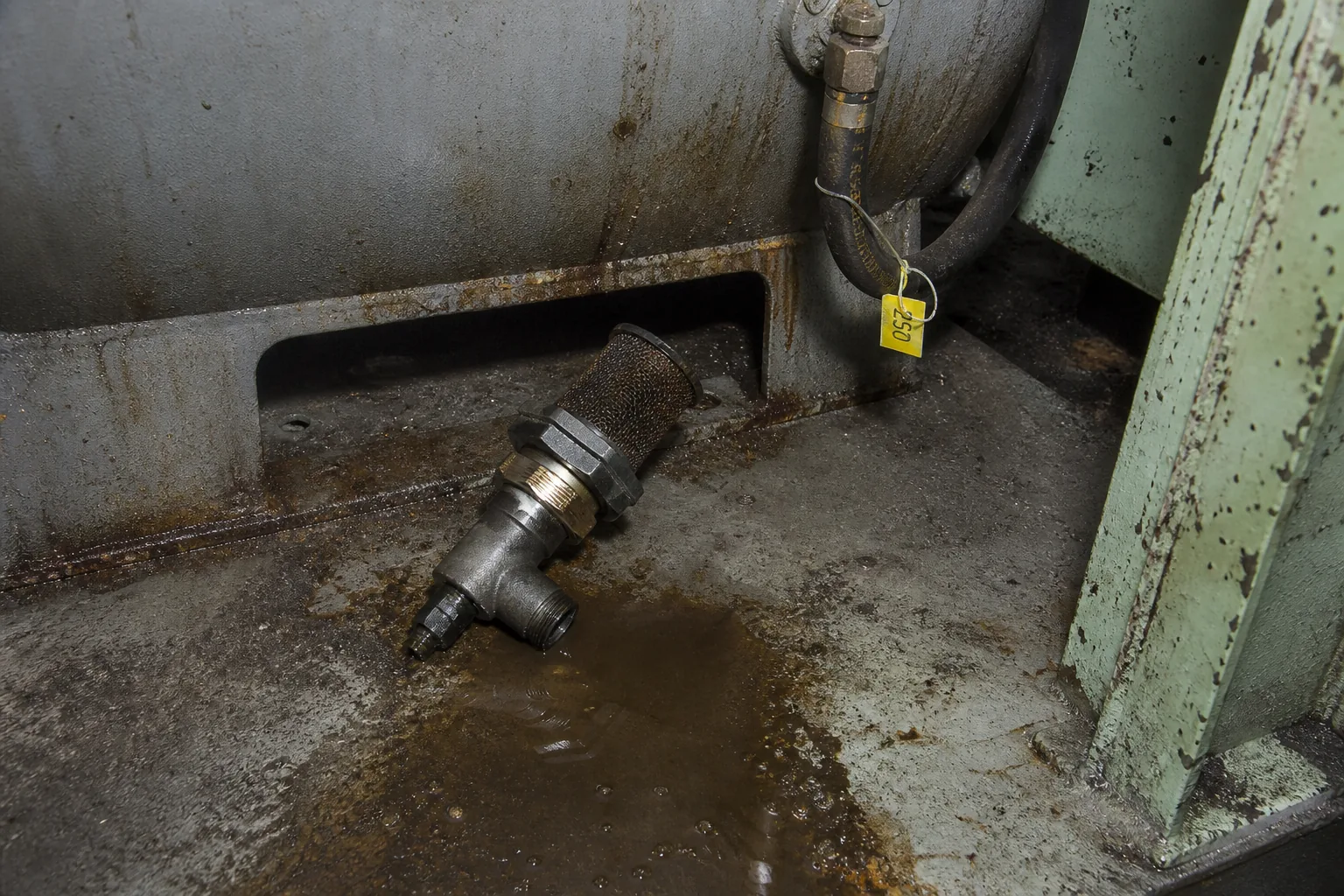
What to do when plant air pressure is falling and the proposed fix is a larger compressor
At 07:20 the compressor room wants capacity.
The lead package is loaded.
The header gauge is low.
A production machine at the far end of the building is slow, a temporary hose has acquired a semi-permanent address, and someone has opened a quotation for a larger compressor with the confidence of a person ordering a larger bucket for a leaking roof.
The available move is to buy the capacity.
It is the only move on the list that guarantees the problem will still be here next year, running continuously, at a higher rating.
A compressor does not know whether the air it produces is turning cylinders, escaping through a coupling, being lost across a dirty filter, or leaving a regulator set higher than the machine needs.
It sees flow and pressure.
It bills the plant accordingly.
The low gauge has supplied a fact.
It has not supplied a diagnosis.
Exhibit A
Treat the compressor room and the critical pneumatic user as one exhibit.
Do not raise the setpoint.
Do not force a standby machine on line.
Do not close a leak tag because somebody tightened something.
Do not approve a new package while the existing duty cycle is the only witness.
And do not begin at the compressor merely because it is the largest object in the room.
Capture:
- compressor type, capacity-control method, run hours, loaded time, unloaded time and current duty cycle;
- compressor discharge, receiver and header pressure, with gauge locations and control-band setpoints;
- pressure upstream and downstream of treatment, regulator outlet pressure, and pressure at the critical end use during the busy production condition;
- recent loads, temporary hoses, nozzle changes, open blowing, regulator changes and equipment out of service;
- off-shift pressure decay, leak-survey locations, and every open tag with its location, detection method, estimated flow, repair owner and closure evidence;
- air-treatment condition, drain operation, filter differential pressure, and pressure dew point where air quality matters;
- energy data, including measured package kW, and the operating hours assigned to the air bill;
- service history: cooler condition, inlet filter condition, oil level, separator differential pressure, and any high-temperature or control alarms.
Take the readings together, under a stated production condition.
A pressure record without location, flow state and timestamp cannot show whether the compressor is short or the path is restricted.
The leak tag, the controller trend, the drain record and the temporary-hose register are the account nobody has read yet.
The air bill has two columns
There are two losses.
The visible one is low header pressure, a loaded compressor and a proposal to buy capacity.
Everyone can see the machine and the quotation.
They have physical presence, which is a great comfort to a capital committee.
The larger loss is delivered-air function.
Compressed air is useful only when the required pressure, flow and quality arrive where the pneumatic work happens.
The question that matters is not “Does the compressor room have enough capacity?”
It is “Does the critical end use receive the required air, at its required pressure and condition, while measured demand stays within the existing supply’s delivered performance?”
That separates an air-short plant from a plant that has bought a large, continuous, nonproductive air user.
The distinction begins with location.
If discharge pressure is below the normal control range while the package stays loaded, then insufficient output, a restricted inlet, internal loss, or total demand beyond capacity are all still live.
If discharge pressure is normal and the remote user is low, investigate distribution restrictions, filters, regulator setting, hoses, fittings and leaks before opening the compressor’s financial file.
The compressor room cannot usefully answer for a pressure loss it did not create.
A low gauge is not a flow map
Every restriction consumes pressure margin.
Long tube.
Sharp fitting.
Partially closed valve.
Filter.
Regulator.
Directional valve.
Speed controller.
Exhaust silencer.
And the temporary hose that arrived for a weekend and has since acquired voting rights in the utility system.
At one point of use, a 12 m run, two elbows, a shut-off valve, an FRL assembly, a manifold, two speed controllers, tube and silencers all sit between the take-off and the work.
None of them looks large enough to deserve a project name.
Together they decide the pressure at the actuator.
Air is compressible, which makes the point-of-use reading more important rather than less.
A 1.0 m length of 8 mm bore tube holds about 0.050 L.
A small cylinder that has to move quickly must fill its own volume and the volume of the path behind it.
A large valve cannot compensate for an undersized elbow fitting at the cylinder port.
A fast inlet is equally wasted if an exhaust silencer leaves pressure on the other side.
For short pneumatic motions, a pressure-drop-per-metre rule borrowed from water service is not proof of anything.
Flow chokes as the downstream-to-upstream pressure ratio falls, so further downstream reduction stops yielding proportionate flow.
ISO 6358 supplies a steady-state method for component flow characteristics, and a companion part addresses system characteristics from components and piping.
The particular machine needs its actual inlet pressure, pressure rise, route and valve data.
Not a header gauge with ambitions.
Pressure loss is also a system bill.
A screening rule puts 2 psi of pressure drop at about 1% of capacity.
The apparent cure is to raise discharge pressure.
Near 100 psig, each 2 psi rise costs about 1% more full-flow energy.
Where 30% to 50% of demand is unregulated, the penalty runs nearer 1.6% to 2% per 2 psi, because leakage and open blowing rise with it.
That is how an ignored local restriction sends an invoice to every unrelated air user in the building.
Measure the ghost load
Leaks are purchased flow with no production attached.
Poorly maintained systems lose 20% to 30% of capacity and power to leakage.
A well-maintained one stays below 10% of compressor output.
Those are system benchmarks rather than a verdict on any single connector.
They are still impolite enough to a capacity proposal that the proposal should wait for a test.
Choose an off-shift period.
Isolate intentional demand.
Understand the compressor controls before using loaded time as evidence.
On a load/unload machine, leakage is estimated as 100T/(T + t), with T loaded minutes and t unloaded minutes.
A machine loaded 2 min and unloaded 8 min with no intended demand estimates 20% leakage.
That test does not work during normal production.
Legitimate intermittent users stay open, so loaded time becomes a mixture of leaks, useful demand, and whatever the building has quietly decided to do at night.
No formula sorts those out afterwards.
A pressure-decay test is the other route, where total system volume, start and end pressure, time, temperature stability, calibrated gauges and test boundary are all known.
One published form is (V × (P1 - P2) / T × 14.7) × 1.25, with the 1.25 factor correcting for falling leak flow as pressure decays.
Its worked case turns 100 ft³ falling from 100 psig to 50 psig in 10 minutes into about 43 cfm of free-air leakage.
The point is not to import that result into another plant.
The point is to make the local loss measurable before spending capital to supply it forever.
Then survey.
Couplings, hoses, tubes, fittings, regulators, open condensate traps, shut-off valves, pipe joints, disconnects and thread sealants are the ordinary locations.
A repair campaign records component tag, location, detection method, estimated flow, pressure, discovery date, responsible crew, repair date and verification result.
The most useful tag is not the one marked closed.
It is the one followed by a lower measured off-shift loss.
Air treatment is capacity wearing work clothes
Treatment equipment is usually treated as décor attached to the real machinery.
That is financially convenient and technically false.
Bulk liquid water needs removal before fine elements whose service life would otherwise collapse.
A drain stuck closed retains liquid.
A drain stuck open is a compressed-air leak with a maintenance sticker on it.
A filter protecting a precision valve is not a substitute for a drainage path that removes accumulated liquid.
The order of treatment follows the contaminants, not the catalogue photography.
At operating flow, record pressure before and after filters and regulators.
A clean coalescing filter can show 2 psi of pressure drop and a dirty one 6 psi.
That extra 4 psi has been associated with about 2% of annual compressed-air energy cost.
Those values are not a universal replacement trigger.
They are a reminder that a neglected element does an excellent impression of a supply shortage.
Wet air is not a housekeeping concern either.
Refrigerated dryers commonly target a 35 to 39 °F pressure dew point.
A desiccant system can target around -40 °F, but a heatless pressure-swing dryer may consume 10% to 18% of rated flow as purge.
That purge is a real compressor load.
Starving it to improve the apparent air balance leaves the off-line bed wet, which is a brief and costly way to improve a dashboard.
And pressure dew point has to be measured at representative pressure and flow.
A room-temperature hygrometer and a wet receiver drain are not competing laboratory methods.
Call outward before buying inward
Once the capture is complete, give the compressor supplier or a qualified air-system specialist the actual evidence.
Flow basis.
Site condition.
Delivered-flow data.
Pressure profile.
Demand states.
Package kW.
Control sequence.
Receiver and distribution arrangement.
Air-quality target.
Dryer purge.
Leak result.
Critical-user readings.
Then ask what capacity remains once leaks and artificial demand are removed.
Ask for power-versus-flow curves, not a nameplate horsepower.
Ask how the existing control mode behaves across its real turndown, and whether a base-and-trim sequence makes sense after the demand profile has been corrected.
Flow labels need an interpreter.
Actual flow is measured at a stated point.
Standard flow is corrected to stated standard conditions.
Free air delivery is corrected to explicitly stated inlet conditions.
A 100 cfm statement can therefore describe several different air masses when reference pressure, temperature and humidity are missing.
Comparing a piston’s theoretical displacement with another package’s free air delivery is a particularly expensive way to compare unlike things.
Control behaviour matters as much.
A fixed-speed screw, unloaded and doing no useful work, may still consume 15% to 35% of full-load power.
Simple inlet modulation on a lubricant-injected screw usually reaches only about 40% of full capacity before unloading, with unfavourable part-load power.
A variable-speed drive may help variable demand.
Its minimum speed, cooling, drive losses and possible high-speed operation belong on its actual curve.
Reciprocating, screw and centrifugal machines should not be offered one generic capacity story.
A reciprocating machine with low output may show valve or ring evidence.
A screw can be restricted at the inlet or internally short of capacity.
A centrifugal machine has inlet-density, guide-vane and map-limit conditions, surge included, which are not cured by ordering a larger screw.
The method is to identify the installed machine’s behaviour and test it against measured demand.
Not to hold a referendum on compressor species.
Shrink the claim before it is made permanent
The early steps shrink the capital claim before the plant makes it permanent.
Measure source and critical-end-use pressure and demand → isolate intentional demand for an off-shift leak test → tag and repair the largest verified leaks → remove inappropriate uses and correct regulator settings → service drains, filters and dryer performance → verify pressure drops through the critical path → re-evaluate storage and compressor control → add capacity only against measured residual demand → retest pressure stability and energy per delivered-air volume.
This is slower than forcing another compressor online before the morning meeting.
It is also the only route that distinguishes a shortage of delivered capacity from a shortage of inquiry.
Where several machines remain necessary after the repairs, put stable demand on base machines and let one appropriately sized trim machine follow the change.
The target is all active base compressors fully loaded, except one trim unit.
Several compressors hunting in the same pressure band make the room sound industrious while producing an unflattering power curve.
If the residual demand really is larger
Sometimes the measured result is unpleasant.
Leaks repaired.
Pressure drops corrected.
Treatment serviceable.
Inappropriate uses removed.
And the critical point still lacks air while the package sits loaded below its normal control pressure.
The compressor room is no longer a leak survey.
It is an estate.
The question is no longer whether a new package can be purchased.
It is what delivered flow, at what discharge pressure, site conditions, air-quality burden, control range and duty profile has to be purchased without recreating the same deficit at a larger scale.
State the requirement at the critical end use.
Then trace pressure back through the regulators, hoses, filters, dryer, receiver and compressor.
State maximum working pressure, normal control pressure and safety-relief setting separately.
They are three different limits, even when the quotation can be made to look shorter by letting them share a row.
Specify site ambient, elevation, cooling conditions, electrical supply, maintenance clearance and package configuration.
Where energy and capacity matter, the acceptance-test reference, instruments, tolerance, gauge-versus-absolute pressure and exact package configuration all belong in the file.
Specific power is the electrical input needed to deliver 100 cfm at a stated discharge pressure.
It is useful only when the conditions match.
Calculate the estate: package, receiver or storage, electrical work, treatment, dryer purge, distribution correction, controls, installation, commissioning, energy, maintenance access, and the cost of the next leak campaign.
A plausible compressor quotation is one creditor among many in that proceeding.
How a low gauge became a capital request
There is a final temptation: blame the operator who reported the low pressure, the technician who opened the bypass, or the contractor who installed the temporary hose.
It produces a name and no correction.
The better question is how the expansion became possible.
Did the air bill report kWh without measured package kW, run hours and loaded/unloaded state?
Did the proposal show compressor flow without a delivery basis, discharge pressure or site condition?
Were receiver and header gauges recorded while the critical machine’s regulator outlet was missing from the log?
Did a shift have authority to raise pressure but no requirement to record the new regulator setting?
Did leak tags end at work-order closure, without a verified pressure-decay improvement?
Did a dryer purge disappear from the demand estimate because it was filed under treatment rather than supply?
Did filter service happen by calendar while differential pressure went unrecorded?
The useful clue is often in the consumables record.
A sudden run of replacement filter elements, drain complaints, temporary hoses or thread sealant is not a maintenance department’s private weather.
It is the opening paragraph of the air-bill investigation.
The institution had told its people that a low header gauge means more compressor, and they believed it.
Controls that arrive before the quotation
Install a weekly off-shift pressure-decay check with a defined boundary, stated pressures, elapsed time and a named owner for the result.
Give every leak a tag: location, discovery date, repair owner, repair date, and verified closure by repeat measurement.
Keep the source, treatment and critical-user pressure readings on the same sheet.
Give the production change process a field for new pneumatic loads, temporary hoses, nozzle changes and regulator settings.
Then make the capacity-request form refuse a total flow number without its reference conditions, pressure profile, demand profile, package power curve, leak result and residual-demand calculation.
A blank for “compressor size” is not a control.
It is a small invitation to build another witness.
Closing the estate
The correct response to falling plant-air pressure is not complicated, although it does postpone a very satisfying purchase order.
Freeze the setpoint.
Capture pressure at the source and at the critical end use.
Measure the off-shift loss.
Repair and verify the leaks.
Restore the pressure path and the air-treatment function.
Read the duty cycle and the power curve.
Then, and only then, buy capacity against the demand that remains.
A leak costs a plant the same amount every hour, quietly, for years.
A compressor bought to cover it costs that amount plus interest, and comes with a maintenance contract.
Asked on the floor
- Can a bigger compressor fix low air pressure at one machine?
- Not necessarily. When compressor discharge pressure is normal but a remote machine has low pressure, the first suspects are distribution restrictions, clogged filters, regulator setting, undersized piping, hoses, fittings, and leaks. A larger compressor can raise the header while leaving the local restriction in place. Pressure must be measured at the critical end use under demand before compressor capacity is treated as the deficiency.
- How much compressed air can leaks waste?
- Poorly maintained compressed-air systems can lose 20–30% of compressor capacity and power to leaks. A well-maintained system should be below 10% of compressor output. The figure is a system benchmark, not a prediction for one fitting. Leaks create continuous demand with no productive output, reducing pressure stability and making unnecessary compressor expansion appear reasonable.
- How is an off-shift compressor leak test calculated?
- For a load-unload compressor with intentional demand isolated, leakage percentage is estimated as 100T divided by T plus t, where T is loaded minutes and t is unloaded minutes. A compressor loaded for 2 minutes and unloaded for 8 minutes estimates 20% leakage. The method is invalid during normal production because intermittent legitimate air users make loaded time ambiguous.
- Can pressure decay be used to measure compressed-air leakage?
- Yes, provided the test boundary, total system volume, calibrated gauges, temperature stabilization, starting pressure, ending pressure, and elapsed time are defined. The DOE pressure-decay method expresses free-air leakage as (V × (P1 − P2) / T × 14.7) × 1.25, with volume in ft³, pressure in psig, and time in minutes. The 1.25 factor accounts for falling leak flow during decay.
- Why does raising compressor pressure make the air bill worse?
- At approximately 100 psig, each 2 psi rise in compressor discharge pressure increases full-flow energy by about 1%. Where 30–50% of demand is unregulated, the total penalty can be about 1.6–2% per 2 psi because leakage and open blowing also increase. These are screening figures; compressor curves and the actual demand profile govern the local result.
- Does an unloaded screw compressor still use much power?
- Yes. A fixed-speed screw compressor cycling between load and unload can use 15–35% of full-load power while unloaded and producing no useful air. That makes unloaded runtime an energy and control signal, not harmless spare capacity. The decision to add a compressor needs power-versus-flow curves and a measured demand profile rather than an average flow or a nameplate horsepower.
- What pressure readings should be captured before approving another compressor?
- The record needs header or receiver pressure, compressor discharge pressure, pressure upstream and downstream of treatment, regulator outlet pressure, and pressure at the critical end use during the busy production condition. It also needs recent load changes and the route through hoses, fittings, valves, filters, regulators, and silencers. A header reading alone cannot establish the pressure available where the air performs work.
- Can a dirty filter look like a compressor capacity problem?
- Yes. A clogged final filter or a loaded treatment element creates pressure drop at the point of use and can make a correctly operating compressor appear under-capacity. One DOE example gives 2 psi pressure drop for a clean coalescing filter and 6 psi when dirty; its additional 4 psi is associated with 2% of annual compressed-air energy cost. Both upstream and downstream pressure readings are needed.
- Are drains and dryers part of available pneumatic capacity?
- Yes. Failed automatic drains, blocked moisture separators, and overloaded dryers can deliver liquid water or wet air that floods filters and reduces usable air quality. Refrigerated dryers commonly target 35–39 °F pressure dew point. A desiccant system can target about −40 °F, but a heatless pressure-swing dryer may consume 10–18% of its rated flow as purge, which is real compressor demand.
- What does CFM mean when comparing compressor capacity?
- CFM without reference conditions is ambiguous. Actual cubic feet per minute is measured at a stated point, standard cubic feet per minute is corrected to a stated standard condition, and free air delivered is a compressor’s delivered flow corrected to explicitly stated inlet conditions. A selection comparison needs delivered flow, discharge pressure, site conditions, and the same flow basis for every package.
- How should a multi-compressor station be controlled after leaks are repaired?
- The measured residual demand should be assigned to stable base machines and one appropriately sized trim machine. DOE guidance targets all active base compressors fully loaded except one machine that follows changing demand. Several compressors operating inefficiently in the same pressure band waste energy and obscure whether the plant has a capacity problem or a control-sequence problem.
- Where are compressed-air leaks most often found?
- Common compressed-air leak locations include couplings, hoses, tubes, fittings, regulators, open condensate traps, shut-off valves, pipe joints, disconnects, and thread sealants. A useful leak record identifies the component tag, location, detection method, estimated flow, pressure, discovery date, responsible crew, repair date, and verification result. A closed work order is not proof that the measured loss fell.