Blame the operator
A boiler low-water alarm is not a nuisance alarm until the water record says so
Repeated alarms invite bypasses and informal resets. This guide keeps water chemistry, level control, firing condition, and protective function together until the cause is known.
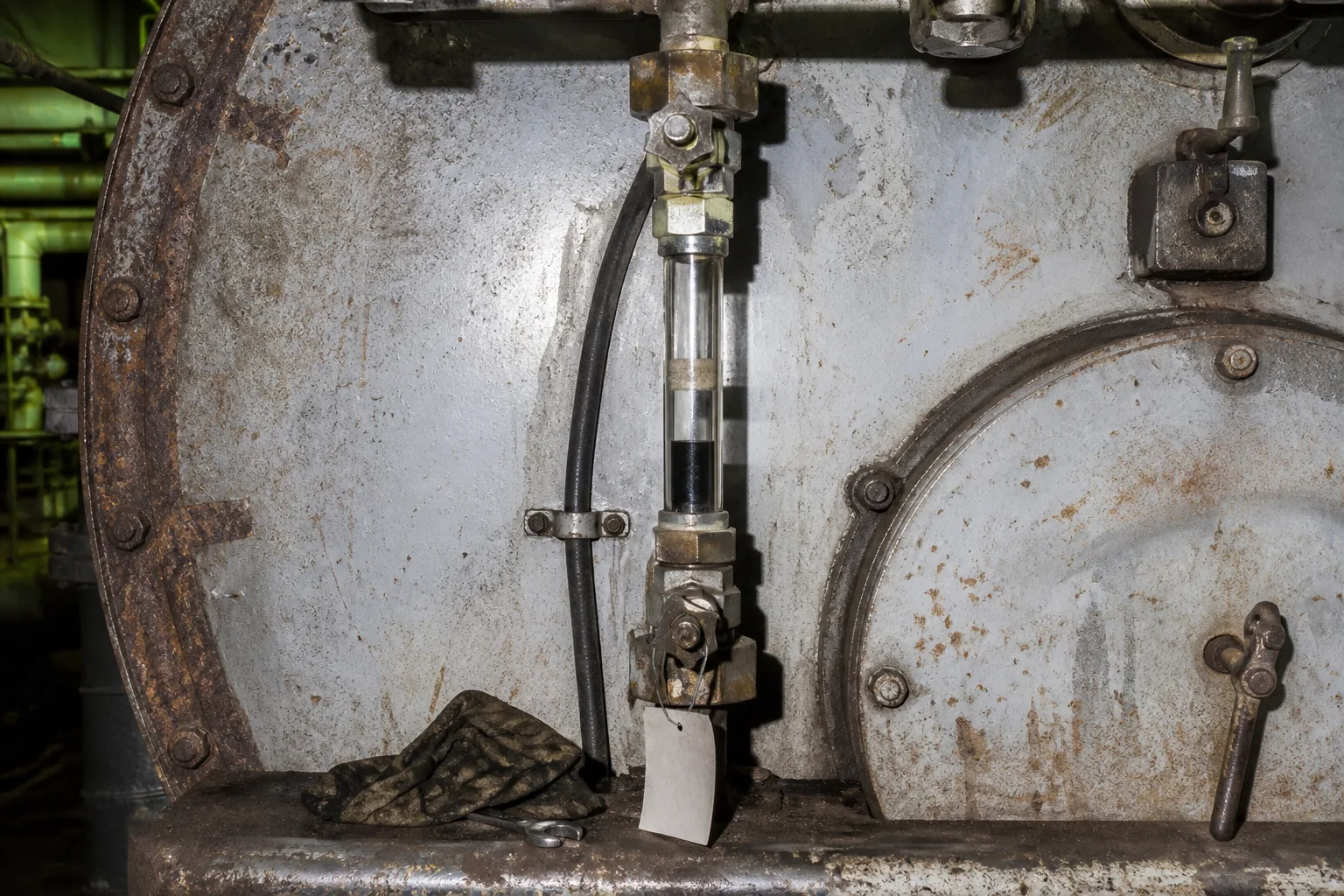
What to do when a boiler low-water alarm recurs and the crew calls it a bad sensor
At 05:10 the low-water alarm has returned.
Yesterday it was reset, the level recovered, and the sensor acquired a personality.
This morning the burner is available, the plant wants steam, and an informal bypass has acquired the solemn status of a production plan.
The available move is to defeat the alarm and fire the boiler.
It is the one move on the list that puts the investigation inside a pressure vessel.
A low-water alarm is part of a protective chain. Its job is to stop firing when liquid water is no longer removing heat where the boiler needs it removed.
Repetition makes the interruption annoying.
It does not make the alarm false.
The question that matters is not “Can the boiler be made to run?”
It is “Does the boiler still have verified water level, feedwater, circulation and heat removal while it fires?”
Until that has an answer, the bypass is not a repair.
Exhibit A
Put the boiler in its safe state under the applicable procedure.
Do that before anybody resets, bypasses, drains, blows down, adjusts a controller, or wipes a gauge glass clean enough to erase the only useful clue.
A recovered indicated level does not close the file.
It certainly does not justify defeating the low-water protective function.
Capture:
- boiler type, normal firing rate, current firing condition and load;
- the level trend, alarm sequence, trip sequence, reset history and every manual intervention;
- gauge-glass condition, independent approved level indication and low-water-cutoff test history;
- feedwater-pump status, feedwater controls, condensate return, makeup rate and blowdown record;
- water-treatment readings, sample points, conductivity and chemistry history, with method and time;
- recent maintenance, control changes, burner trips and changes in steam demand;
- inspection history, tube condition, and any scale, sludge, pitting or distortion evidence;
- evidence of foaming, priming, carryover, wet steam, or unusual water from the steam outlet.
Preserve the time-stamped alarm and trend records before the control system rolls them over.
Photograph the gauge glass, the control indication, the feedwater equipment, and whatever is found at the marked sample points.
The work order, the treatment log, the condensate record and the bypass authorization are the only account of what this boiler has been doing.
The visible alarm is the modest creditor
Lost steam and a delayed process are the visible loss.
The larger loss is heat-transfer function.
Liquid water at the inside surface carries heat away.
Remove that cooling while firing continues, through low drum level, blocked feedwater, a failed level-control chain, a circulation restriction or a steam blanket, and metal temperature rises far faster than a panel thermometer suggests.
At 100 psig, water saturation temperature is about 171 °C.
Furnace-side metal left without cooling can rise well above that within minutes.
Pressure supplies the opening force after strength has been lost.
Loss of cooling is what makes the metal unable to carry it in the first place.
The physical evidence differs by boiler.
In a firetube unit, low water can overheat the crown sheet or furnace top, leaving sagging, bulging or discoloured plate.
In a watertube, the evidence may be a swollen tube, a thin-edged rupture, or a local fish-mouth opening.
Those signatures point the inspection at the place where heat removal stopped being real.
The alarm is not protecting a number on a screen. It is protecting cooled metal.
Do not diagnose level by appearance
A clear gauge glass and a cooperative transmitter can still be incomplete evidence.
A plugged tube, a poorly distributed circulation path, or deposits in a lower header can starve one surface while the drum reading stays perfectly acceptable.
Trace the water path to the affected surface.
Do not end the trace at the last recorded level.
Hardness salts, iron oxides and process contamination deposit on water-side surfaces.
The deposit adds thermal resistance, so the wall runs hotter at the same heat flux.
A 1 mm deposit is not a harmless film when the original tube wall may be only a few millimetres thick.
It can be the first layer of a tube overheating sequence while the bulk water temperature remains entirely polite.
Scale changes metal temperature, corrosion risk, local flow and remaining strength.
Replacing a tube without investigating feedwater and deposits is replacing a smoke detector after a fire.
Nor does a stable-looking level mean a stable water surface.
Foaming is an unstable layer sustained by dissolved solids, oils or a treatment upset.
Priming is bulk water pulled into the steam take-off by high level, low operating pressure or sudden load.
Both produce fluctuating level evidence, and both carry boiler water and solids into steam.
Carryover then leaves deposits on superheaters, valves, traps, heat exchangers and product-contact equipment.
A liquid mass fraction of 0.02 in wet steam is a contamination problem, not merely lost heat.
And replacing a separator does not cure foaming caused by process oil returning in the condensate.
Call outward before resetting inward
Bring the designated release authority, the water-treatment provider and the boiler or control specialist into the same conversation before any return to firing.
A 150 psig nameplate establishes the pressure boundary.
It does not prove that each connected header and valve is suitable at saturated-steam temperature.
Give them the captured sequence.
Not a summary composed after the reset.
Ask which independent level-verification method applies.
Ask whether the cutoff test is valid for the condition found.
Ask what inspection is required, and who holds release authority.
An entry reading 10,000 lb/h without outlet pressure and feedwater temperature is not a usable duty statement.
Neither is a chemistry result without its sample point, time, method and operating state.
Classification belongs in that call.
The code distinguishes power boilers from low-pressure heating boilers, and the latter covers low-pressure steam heating, hot-water heating, hot-water supply and potable-water heaters.
That is context.
The governing edition and jurisdiction supply the procedure.
Pressure and duty change the water condition that is acceptable.
Industrial watertube guidance moves boiler-water silica from about 150 mg/L at the low-pressure end to 1 mg/L at the high-pressure end.
Maximum solids in steam move from 1.0 to 2.0 mg/L down to 0.1 mg/L across the same span.
The maker, the treatment programme, the steam use and the governing code set the limits.
Conductivity is useful precisely because it is not an oracle.
A shift from 100 to 160 µS/cm at 25 °C shows a changed dissolved-ion condition only when method and sampling context are comparable.
It cannot name the ion mixture without chemical confirmation.
The water record needs a location and a clock
This is where a boiler-room log becomes very certain about almost nothing.
A conductivity value copied into a row looks like evidence.
It may be a useful clue.
It is not yet a conclusion.
Boiler water, feedwater, condensate return and steam are not interchangeable witnesses.
So keep the sample point with the result.
Keep the time, the method, the calibration status and the operating state with it too.
A result taken at low load before a demand change is not automatically comparable with one taken after makeup, a condensate-return change or a blowdown.
The number has not become dishonest.
It has lost the circumstances that made it interpretable.
Read the records as a sequence.
Did demand rise before the level began to fluctuate?
Did makeup rise before the conductivity departure?
Did the condensate-return condition change before the foaming, or did the blowdown response arrive only after the value had already moved?
Those comparisons do not pronounce a cause.
They decide which water path deserves inspection, before somebody orders a sensor because it is the only item on site with a visible fault code.
Where carryover is suspected, put the boiler-water and steam evidence in one file with the time-stamped demand changes.
High conductivity in sampled steam, water at the steam outlet, or downstream deposits point somewhere different from a quiet boiler-water result.
And a treatment upset cannot be ruled out because the panel recovered after a reset.
Use the approved sampling plan and the treatment provider’s method.
The task is to preserve a representative condition, not to produce a reassuring number before the next shift arrives.
The repair ladder
The least destructive route keeps the facts attached to the repair.
Place the boiler in its safe state → preserve alarms, trends and water records → verify level by independent approved methods → check feedwater, controls, condensate, makeup and blowdown → review representative treatment results → inspect for scale, foaming, carryover, circulation or mechanical faults → repair and function-test the protective chain → return under controlled firing → monitor level and water quality.
The arrow chain is an order of proof.
Independent level results, feedwater response, and scale or treatment evidence each redirect the investigation.
Test the protective chain under the applicable procedure.
Record firing rate against its approved range.
At 10 MMBtu/h, a 10:1 burner turns down to 1 MMBtu/h while a 4:1 burner stops at 2.5.
Return under controlled firing.
Keep the level trend, the feedwater response, the conductivity and chemistry results, and the name of the release authority.
If metal may have seen the furnace without water
Sometimes the evidence points past a control repair.
Discoloured or sagged firetube plate.
A swollen watertube.
A thin-edged rupture.
A fish-mouth opening.
Hard adherent scale at high-heat-flux areas.
Under-deposit pitting hidden beneath brown or black material.
A 50 °C rise in stack temperature at unchanged firing rate justifies fireside and gas-flow inspection alongside the water-side evidence.
That is an investigation trigger, not a universal alarm limit.
The boiler has left the category of control fault.
It is now an estate.
Calculate inspection, tube or plate repair, pressure-boundary assessment, treatment correction, condensate investigation, downstream carryover cleanup, retesting, lost production, and the cost of a repeat event.
The false sensor, if one ever existed, ranks last among those creditors.
Do not grind, clean or replace inspection evidence before competent review.
Hard white or tan scale, porous brown or black under-deposit corrosion product, and a sharp-edged pit are three different accusations.
How the bypass became a production plan
There is a final temptation: blame the operator who reset the alarm, the person who called it a bad sensor, or the water-treatment technician nearest the logbook.
The boiler room keeps its habits and gains a scapegoat.
The better question is how the bypass was possible.
Did the alarm history sit apart from the conductivity and chemistry records?
Did the log omit independent level verification, or feedwater-pump status?
Could a treatment sample be recorded without its point, time, method or boiler operating state?
Did the condensate return change without anyone connecting it to foaming, carryover or makeup demand?
Was blowdown recorded but never compared with conductivity?
Was low-water-cutoff test history in a binder rather than in the response package?
Were scale, tube condition and downstream carryover separated because the paperwork had filed them in different departments?
The procurement and treatment record is unusually candid on this point.
A change in water-treatment consumption.
An unplanned rise in makeup.
A changed condensate return.
A blowdown pattern that no longer agrees with the conductivity history.
Any of those can put the opening paragraph of the incident report in a document nobody consulted during the reset.
Controls that a reset cannot defeat
Keep one boiler event log.
Every low-water alarm enters beside the independent level verification, the feedwater status, the conductivity result, the chemistry sample point and time, the blowdown record, the firing condition, the manual intervention and the named release authority.
Make the entry impossible to complete with “reset” alone.
Put the capture list at the boiler and in the response workflow.
Tie the low-water event to the treatment and condensate-return records.
Require a documented repair and function test before controlled firing.
That control keeps a tired person from having to decide, alone and at speed, whether a safety function has become inconvenient.
Closing the estate
A recurring low-water alarm is not evidence of a bad sensor until the water, level, feedwater, control and firing record says so.
Place the boiler in its safe state.
Preserve the trends and the treatment record.
Verify level independently.
Check feedwater, controls, condensate, makeup, blowdown and chemistry.
Repair and function-test the protective chain.
Return under controlled firing, and monitor the water and level record.
An alarm that keeps returning is not being difficult.
It is the only part of the plant still reporting a condition that nobody has agreed to look at.
Asked on the floor
- Why is a recurring low-water alarm not automatically a bad sensor?
- A recurring low-water alarm can represent a real loss of level, blocked or inadequate feedwater, failed level-control chain, circulation restriction, or a steam blanket that removes cooling while firing continues. A bad indication remains possible, but it is not established by repetition. Independent approved level verification and the alarm, firing, feedwater, and water-treatment record are needed before the protective function is judged faulty.
- What should be captured before a boiler low-water alarm is reset or investigated?
- The preserved record includes boiler type, firing rate, load, level trend, alarm sequence, gauge-glass condition, independent level indication, low-water-cutoff test history, feedwater-pump status, condensate return, makeup rate, blowdown record, treatment readings, sample points, conductivity and chemistry history, maintenance, control changes, trips, manual interventions, inspection history, tube condition, and evidence of foaming or carryover. Alarm and trend data are part of the evidence, not administrative debris.
- Why does low water damage boiler metal so quickly?
- Liquid water removes heat from the inside surface of a boiler tube or heated plate. Low level, circulation loss, a blocked feedwater path, or a continuing burner can remove that cooling, so metal temperature rises much faster than a panel temperature suggests. At 100 psig, water saturation temperature is roughly 171 °C, while exposed furnace-side metal can rise far higher in minutes.
- Do firetube and watertube boilers show the same low-water damage?
- No. A low-water event in a firetube boiler can overheat the crown sheet or furnace top, leaving sagging, bulging, or discoloured plate. In a watertube boiler, loss of cooling commonly leaves a swollen tube, thin-edged rupture, or local fish-mouth opening after creep reduces strength under internal pressure. Both patterns require investigation of cooling loss, not a pressure-only explanation.
- Can a boiler have an acceptable drum level and still lose cooling at a tube?
- Yes. Flow starvation can be local. A plugged tube, poor circulation distribution, or deposits in a lower header can damage one flow path while the recorded drum level appears acceptable. The investigation therefore follows the damaged tube's water path and operating history as well as the last level reading. A normal bulk indication does not prove local heat removal remains adequate.
- Why does a small amount of scale matter on a boiler tube?
- Scale adds a low-conductivity layer between the heat source and the water, raising wall temperature at the same heat flux. A 1 mm deposit is not automatically harmless when an original tube wall may be only several millimetres thick. The resulting hot metal can creep, bulge, or split, while bulk-water temperature still appears normal. Deposit and feedwater cause need correction together.
- Can foaming make a boiler level indication misleading?
- Yes. Foaming is an unstable surface layer sustained by dissolved solids, oils, or treatment upset. Priming is bulk water pulled into the steam take-off by high level, low pressure, or sudden load. Both can accompany fluctuating level evidence and carry boiler water and dissolved solids into steam. The condition needs boiler-water, steam, demand, and level-control evidence rather than a sensor reset alone.
- Why does wet steam matter if the boiler is still making pressure?
- A boiler can make pressure while exporting water and boiler solids with steam. Carryover can deposit material on superheaters, valves, traps, heat exchangers, and product-contact equipment, and entrained droplets can erode pipes, fittings, and valves at high velocity. A liquid mass fraction of 0.02 in 1 kg of wet steam is a contamination problem, not merely a small loss of heat content.
- Can conductivity alone prove what caused a boiler-water problem?
- No. Conductivity can indicate a change in dissolved-ion condition, but it does not identify the ion mixture without chemical confirmation. A useful result also retains the sample point, time, method, and operating state, because water leaving a process point and water at another location are not interchangeable evidence. Comparable trends are stronger than isolated values only when the method and sampling context remain stable.
- Are boiler-water limits the same for every boiler?
- No. Boiler-water and steam-purity limits depend on pressure, duty, boiler design, steam use, boiler maker, treatment programme, and applicable code. A suggested industrial watertube table steps boiler-water silica from 150 mg/L at its low-pressure end to 1 mg/L at its high-pressure end, while maximum solids in steam move from 1.0–2.0 mg/L to 0.1 mg/L. Those values illustrate the direction, not a universal setpoint.
- What does a low-water cutoff repair need before the boiler returns to service?
- The protective chain needs documented repair and function testing under the approved procedure, with level verified by independent approved methods and the correct feedwater, control, blowdown, and treatment condition established. Return occurs under controlled firing while level and water-quality results are monitored. A reset that restores a panel indication without proving the protective chain only restores uncertainty.
- Who decides whether a boiler can be released after a low-water event?
- Release authority belongs to the named person or organization established by the owner’s procedure and the applicable boiler jurisdiction, insurer, manufacturer, and operating requirements. U.S. OSHA 29 CFR 1926.29 recognizes current valid certification by an insurance company or regulatory authority for a specified construction provision, but it does not replace state, provincial, insurer, or local boiler rules.