Judge by appearance
A conveyor belt that tracks badly is not cured by pulling one side harder
Tracking correction is commonly improvised at the take-up because the belt visibly drifts. The guide separates belt tension, pulley condition, structure, loading, and drive alignment before a torn belt or damaged bearing makes the diagnosis for everyone.
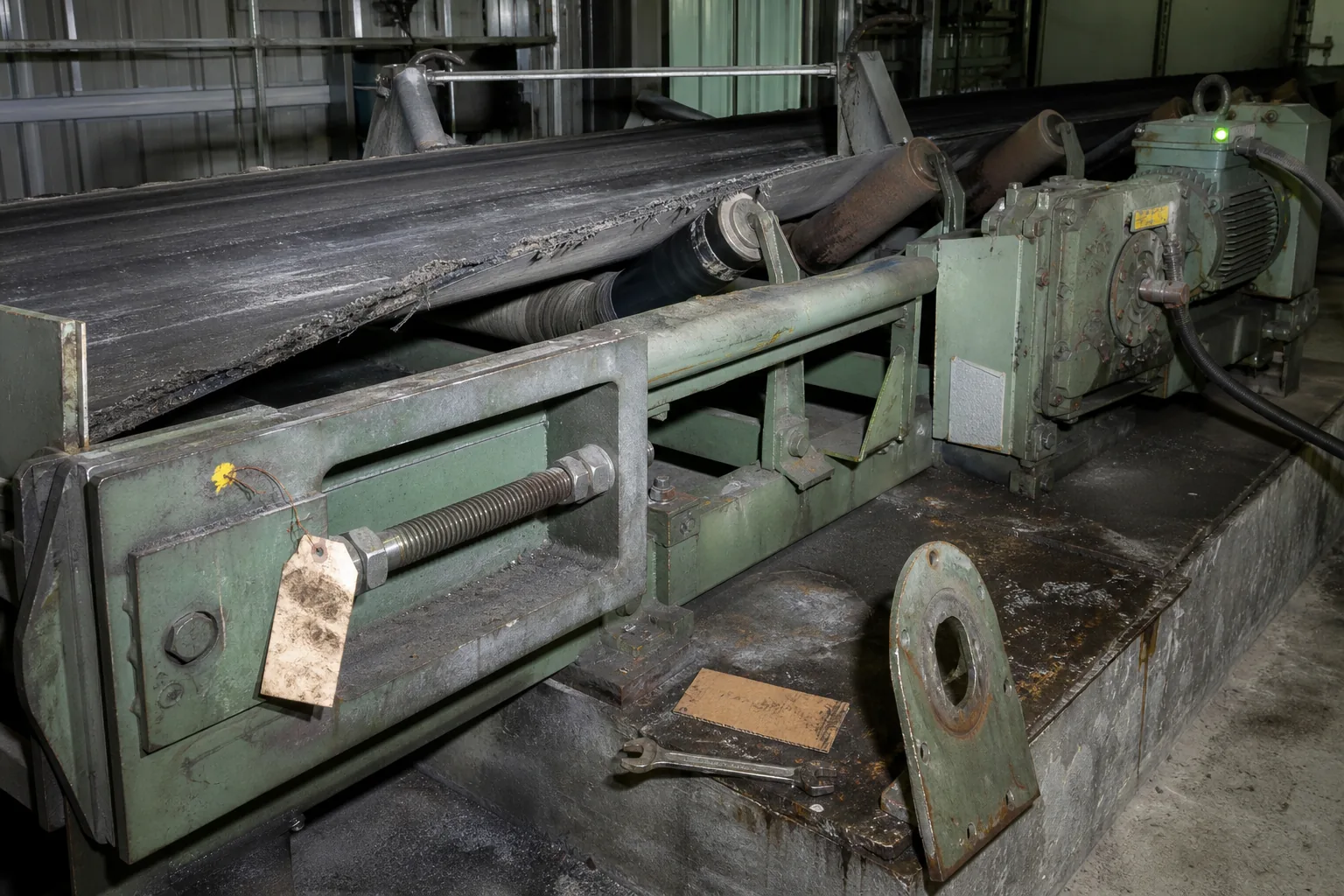
What to do when a conveyor belt walks to one side and production wants an immediate adjustment
Consider the scene at 6:30 a.m.
The belt on a bulk conveyor is rubbing the left-hand structure below the loading zone.
A dark stripe has appeared on the frame.
Material is decorating the floor in the particular pattern that makes a small tracking problem look like a cleaning problem, right up until a belt edge, a skirt or a bearing sends an invoice.
Somebody is already at the take-up with a wrench.
The proposal is familiar.
Pull the wandering side harder until the belt returns to the middle.
It has the compact logic of a rule invented beside a moving machine.
The conveyor does not have a side that needs discipline.
It has a belt path created by pulleys, idlers, frame, loading, carryback, belt construction and tension.
The take-up is part of that system.
It is not its steering wheel.
An adjustment may centre the belt for the next few minutes.
It may also add bearing and shaft load, make a cupped belt less co-operative, and conceal the transfer condition that pushes the belt sideways whenever production returns to normal.
The line then gets a second incident, which is the sort of productivity improvement nobody puts in a capital request.
Exhibit A
Stop before the belt path is improved into uselessness.
Do not wind one take-up side in.
Do not train a row of idlers until the belt sits politely while empty.
Do not wash the dirty pulley, throw out a damaged roller, or trim the frayed edge before the condition has been recorded.
A clean conveyor is a fine thing.
It is not necessarily a better witness.
Nothing gets adjusted until the belt has finished giving evidence.
Capture:
- belt type, width, splice, age if known, and the location and pattern of edge damage;
- tracking direction and belt path, empty and loaded, at start and at steady speed;
- pulley, idler, take-up and drive-alignment readings, including take-up position through its travel;
- tension-setting record, and evidence of slip such as black rubber dust, hot pulley surfaces or belt speed below pulley surface speed;
- loading-point position, material arrival, skirt condition, and where the spillage begins;
- buildup on drive, tail, snub and take-up pulleys, plus carryback beneath the return run;
- structure level, squareness, roller condition, and any seized, worn or hot rotating component;
- recent belt, pulley, idler, transfer-chute, guard or structural work.
Photograph the damaged edge beside a 100 mm rule.
The record then distinguishes a 2 mm nick from a 40 mm tear, which is more useful than the traditional description: some damage on the side.
Photograph the splice and mark its position.
A repeat interval is evidence.
It should not be allowed to wander off with the shift handover.
Start the path inspection immediately after the high-tension zone where the belt leaves the drive pulley, then work upstream of the visible wander.
The strongest effect of an idler adjustment lands about 5 to 8 m downstream of it.
So the place where the belt finally objects is not the place it received the instruction.
The belt, the dirty pulley, the loading chute and the take-up setting are one file.
Keep them together.
The visible loss is not the belt edge
There are two losses.
The visible one is a frayed edge, spillage, a few damaged idlers, and the time spent watching a belt approach steel with bureaucratic inevitability.
A 10 mm worn strip along one edge looks modest until it is recognised for what it is: a record of persistent lateral contact.
The larger loss is the conveyor’s function.
A conveyor exists to move a specified burden, at its required capacity and route, without the belt climbing a pulley, rubbing the structure, spilling at the transfer, or loading the drive outside its limits.
The question that matters is not “Can the belt be made to look centred?”
It is “Does the conveyor carry its actual load within an acceptable belt path, tension and drive-load condition?”
That removes the false comfort of an empty run.
Bulk capacity is Qᵥ = A v, so loaded cross-sectional area and belt velocity make the flow.
A belt run at 1.5 m/s rather than 3.0 m/s changes more than tonnes per hour.
Doubling the speed doubles horizontal discharge velocity and moves the material trajectory at the head.
The transfer and its loading-centre condition are part of the tracking system, whether or not the take-up has been invited to the meeting.
Drive tension is not an independent cure either.
Conveyor drive power follows P = Tₑv/η.
An effective tension of 8,000 N at 2.0 m/s needs 16 kW at the pulley, and about 17.8 kW at 90% efficiency.
Effective tension is the difference that produces useful drive force.
It is not an instruction to make every part of the belt path tighter than it was designed to be.
Read the path before naming the culprit
The repeat pattern has an address.
If the belt wanders at the same position once every revolution and then returns, suspect a crooked splice or belt camber.
A splice that is not square makes the belt wander by the same amount every time it passes the tail pulley.
That is a far more precise finding than “belt out of alignment,” and it does not improve because the take-up operator develops stronger feelings about one side.
A steady pull to one side through the whole route points elsewhere: frame, pulley or idler squareness.
A drift that appears when the take-up moves points at a take-up that is not aligned through its travel.
Those are geometric conditions.
An adjustment that hides their effect is still an adjustment made on top of them.
An erratic drift is a different witness again.
Buildup changes a pulley’s local effective diameter, so the dirty section reaches the belt first.
Look for carryback.
Material left on the return belt after discharge drops beneath the return idlers and accumulates on pulleys.
A line of material under the return run, and a dirty take-up or snub pulley, is a causal record.
Not a housekeeping review.
Then ask the loaded question.
A belt that centres empty and runs left when material arrives is strong evidence of off-centre loading.
Material that lands off-centre, arrives faster than the belt, or strikes the skirtboard gets redirected across the belt. On a troughed belt, the burden then seeks the low side.
The belt is not becoming temperamental under load.
It is being given a sideways force.
Cupping complicates all of it.
A cupped belt has less contact with the troughing rollers and can respond erratically even after the idlers are square.
Unequal top- and bottom-cover shrinkage is the usual mechanism, with heat, chemicals, trough angle and over-tension all contributing.
A top-to-bottom cover thickness ratio of 3:1 or less is the usual preventive guide.
That is a belt-construction and environment problem.
It is not a request to pull one side harder.
Call the system to the interview
Before an adjustment becomes a correction, bring in the people responsible for the conveyor, the transfer chute, the belt, the drive and the structural work.
Give them the as-found record.
Not a memorable account of how well it ran for twenty seconds after somebody moved an idler.
Ask the belt or conveyor supplier what tension and tracking-adjustment method applies to that construction, width, loading, pulley arrangement and take-up.
Ask the transfer owner whether the material is centred and matched to belt direction and velocity at loading.
Ask the structural owner to review pulley and take-up squareness through movement, not in one convenient stopped position.
Installation tolerances belong to the manufacturer and the conveyor arrangement. A generic number that has travelled here from another machine is a poor substitute for geometry.
The belt-drive evidence makes the same point in a different dialect.
A V-belt with glazed sidewalls, black dust and load-on squeal may have gross slip. Normal elastic creep is not gross slip, and one flat-belt family puts the nominal creep scale at up to 0.6%.
More tension without checking torque, wrap, grooves and contamination exchanges glazing for cord fatigue and bearing damage.
Nor can belt families borrow each other’s correction habits.
A flat belt moves toward a crowned pulley face by design, and a persistent run into a flange is not normal, because flanges restrain rather than track.
On a synchronous drive, positive-belt alignment guidance runs to a maximum of about a quarter of a degree, and it separates parallel from angular error.
That number is manufacturer guidance for that drive type.
It is not a ruler to apply to a bulk conveyor’s idler train.
Least destructive first
Early work preserves the choices needed later.
Stop and document the as-found belt path → remove buildup and inspect damaged idlers or pulleys → verify structure, pulley and take-up squareness → correct loading-centre and transfer conditions → set tension to the calculated requirement → test empty, then under staged load → recheck tracking, edge condition and drive current.
Remove buildup only after it has been recorded.
Inspect lagging torn in one zone, a hot bearing, a seized roller and a rapidly worn belt underside as separate clues.
Together they distinguish a contaminated or non-rotating component from a uniformly crooked structure.
Then verify the frame, pulleys and take-up in the position where the failure happens.
Do not declare a stationary reading innocent on behalf of a moving machine.
Correct the transfer before pursuing cosmetic centring.
Belt width and speed are not free knobs either. Width guidance runs at 3 times maximum lump at a 20° surcharge and 6 times at 30°, while holding standard edge distance.
Those are design checks rather than field tracking tolerances.
They explain why a loading chute and a material bed cannot be left outside the diagnosis.
Set tension only after geometry, loading and pulley conditions have been addressed.
For a friction belt, initial tension has to supply the required effective pull at the small-pulley wrap without overloading the shaft.
One deflection chart uses a 50 N test force for one section and 75 N for the next, with deflection read from the correct chart rather than from a generic instruction to deflect it 10 mm.
The values demonstrate the rule.
Tension belongs to the belt family and the duty, not to a supervisor’s estimate of how hard the belt ought to feel.
Then run the conveyor empty and record the path.
Add material in stages and record it again.
Compare drive current, belt path, contact marks, carryback and discharge behaviour at the same operating conditions.
An empty result is the first test condition.
It is not a certificate of loaded tracking.
That loop is slower than standing at the take-up until the belt stops embarrassing the department.
It is cheaper than finding out what the belt does at production rate by reading the next torn edge.
If the belt still will not clear
Sometimes the record leads somewhere larger.
Belt replacement for camber or cupping.
Pulley or take-up realignment.
Frame repair.
Transfer-chute modification.
Lagging repair.
A return-cleaning correction.
A drive review.
The conveyor is past adjustment.
It has become an estate.
The question is no longer how to save the next hour of production.
It is which correction restores the conveyor’s function without asking the next belt, pulley bearing or skirt system to finance the deferred work.
Calculate the whole exposure: belt and splice work, pulley and idler repair, structural or chute work, cleanup, drive and bearing exposure, planned outage, staged-load test, and the credible cost of a repeat failure.
The visible strip of damaged belt is a modest creditor in that proceeding.
Do not turn a clean empty belt into an acceptance criterion.
A conveyor carrying material has a different force path from the same conveyor running empty.
The evidence has to show it stays within its intended path and drive condition at the actual burden.
Not that the belt looked calm during a convenient demonstration.
Then perform the autopsy
There is one final temptation: blame the operator who noticed the drift, the crew who last changed an idler, or whoever reached for the wrench.
The conveyor keeps its geometry and gains a scapegoat.
Work backwards instead.
How was the repeated adjustment possible?
Did the work order describe the event only as “belt tracking,” with no field for the empty-versus-loaded path?
Was there no fixed frame reference from which to measure pulley and take-up movement?
Could a chute be altered without a loaded tracking check?
Did cleaning remove pulley buildup before anyone photographed it?
Did the belt replacement record omit splice position, construction and edge-damage pattern?
Were take-up changes recorded as corrections, without a tension requirement, a drive-current comparison, or a test at staged load?
The system had told everyone that a centred belt at the moment of restart was the finish line.
They believed it, because that is what the paperwork rewarded.
Controls that survive a moving belt
Mark fixed alignment references on the conveyor frame.
Require a measured empty-and-loaded tracking check after any belt, pulley or transfer-chute work.
Make the job record keep the as-found path, splice position, take-up position, alignment readings, loading condition, buildup finding, correction and loaded retest.
Put that list in the work package at the conveyor.
Not in a reliability folder that acquires authority once the evidence has been swept away.
Assign the loading-centre check, the geometry check, the tension decision and the loaded retest to named owners before restart.
This is not a request that anybody take more care.
It is a sequence that does not ask a tired person, beside a moving belt, to remember every place a sideways force can enter the system.
Closing the estate
The correct response to a belt walking sideways is short, and it keeps the take-up wrench in the toolbox for most of it.
Freeze the as-found path.
Record the belt, splice, loading, buildup, geometry, tension and damage evidence.
Read the repeat pattern.
Remove the buildup and correct the pulley, structure or transfer condition that created it.
Set tension to the calculated requirement.
Test empty, then under staged load.
Retest the path, the edges and the drive current.
A belt walks sideways because something is telling it to.
The take-up is the one component in the whole conveyor that was never going to know what.
Asked on the floor
- Why does a conveyor belt keep running to one side after the take-up is adjusted?
- A take-up adjustment can change the visible belt path without removing the condition that creates unequal friction or unequal approach across the belt. A steady pull to one side can come from frame, pulley, or idler squareness; erratic drift can come from pulley buildup; and a belt that walks only when loaded points strongly to off-centre loading. The correction has to match the observed pattern rather than the nearest adjustment screw.
- What should be recorded before anyone adjusts a mistracking conveyor belt?
- The record includes belt type, width, splice, age, damage pattern, tracking direction empty and loaded, and the path at start and at steady speed. It also includes pulley, idler, take-up, and drive-alignment readings; tension and slip evidence; loading-point and skirt condition; buildup and cleaning state; structure level and squareness; roller condition; and recent repairs. Photographs preserve edge contact, carryback, and pulley-buildup evidence before it is cleaned away.
- What does it mean when a belt runs straight empty but walks when material arrives?
- A belt that centres empty and walks only under load is strong evidence of off-centre loading or transfer conditions, not proof that the empty conveyor structure is crooked. Material that lands off-centre, arrives faster than the belt, or strikes skirtboard is redirected across the belt. On a troughed belt, the burden seeks the low side, creating both tracking error and spillage at the loading zone.
- Does a belt that wanders once every revolution need a take-up adjustment?
- Not usually as the first correction. Wander that appears at the same belt position on every revolution and then disappears points to a crooked splice or permanent belt camber. A splice that is not square makes the belt wander by the same amount each time it passes the tail pulley. Changing take-up position may disguise the symptom temporarily, but it does not make the splice square or remove camber.
- Why does material buildup on a conveyor pulley make the belt track erratically?
- Material buildup changes the pulley’s local effective diameter, so one portion of the pulley reaches the belt before another. The result is erratic drift rather than a constant pull in one direction. Carryback is a common source: material retained on the return belt falls beneath return idlers and accumulates on pulleys. A dirty take-up or snub pulley and a line of material beneath the return run are diagnostic evidence, not merely housekeeping defects.
- Can extra belt tension solve a conveyor tracking problem?
- Extra tension is not a general tracking correction. Conveyor tension has to meet the calculated traction and operating requirement, while excess tension can increase belt stress, bearing reaction, shaft load, and fatigue. In friction belt drives, excess tension can exchange glazing for cord fatigue and bearing damage. A V-belt also requires its manufacturer’s tension method; a generic deflection rule does not replace the correct chart for the belt section and duty.
- How far from an idler adjustment does the tracking effect appear?
- Martin Engineering’s tracking guidance states that an idler adjustment has its strongest effect about 5–8 m downstream. That is why inspection begins immediately after the high-tension zone where the belt leaves the drive pulley and then works upstream of the visible wander. Adjusting an idler beside the contact point can create the impression of action while missing the pulley, frame, loading, or carryback condition that begins the error.
- What does a worn strip on one belt edge tell maintenance?
- A polished frame-contact line and edge fraying show that the belt has been running against steel. A 10 mm worn strip along one edge records persistent lateral contact; it is not simply evidence that the belt is old. The inspection should trace the contact back to tracking and load-centre conditions, then examine the pulley, idler, structure, and transfer path before a new belt or a harder take-up pull repeats the damage.
- Is a flat belt that moves toward a crowned pulley mistracking?
- No. A flat belt is deliberately guided toward the crown of a crowned pulley face, so that movement is normal. A flat belt persistently running into a flange is not normal because flanges restrain a belt; they are not a tracking system. V-belts, synchronous belts, and flat belts therefore cannot share one generic alignment or tension practice. The belt family and its manufacturer’s method determine the acceptable condition.
- Is normal creep in a friction belt the same thing as belt slip?
- No. A V or flat friction drive has normal elastic creep, so the driven pulley can run marginally slower than the geometry-only ratio without damaging the belt. Gross slip produces heat, polished or glazed surfaces, rubber debris, and a belt speed lower than pulley surface speed. Forbo’s illustrated flat-belt product family shows a nominal creep scale extending to 0.6 percent, which is distinct from the slippage region.
- How should a conveyor be tested after a tracking correction?
- The conveyor is first tested empty, then under staged load, with the belt path recorded at start and steady speed. The recheck compares tracking, edge condition, pulley and idler behaviour, carryback, loading-centre condition, and drive current under comparable conditions. An empty-belt result is not acceptance for a loaded conveyor because loading can introduce the off-centre force that was absent during the empty run.
- What simple control prevents repeated belt-tracking adjustments?
- Fixed alignment references should be marked on the conveyor frame, and a measured empty-and-loaded tracking check should be required after belt, pulley, or transfer-chute work. The work record should retain as-found path, alignment readings, loading condition, buildup findings, and the correction made. This turns a repeated take-up adjustment from a persuasive anecdote into a check of whether the conveyor still operates within its required belt path and drive-load condition.