Identity vs compatibility
Fit, form, and function are only the opening argument for a replacement
A replacement that bolts on and energizes can still fail at the connector, software, environment, certification, or process boundary. This reference problem makes those hidden dimensions explicit.
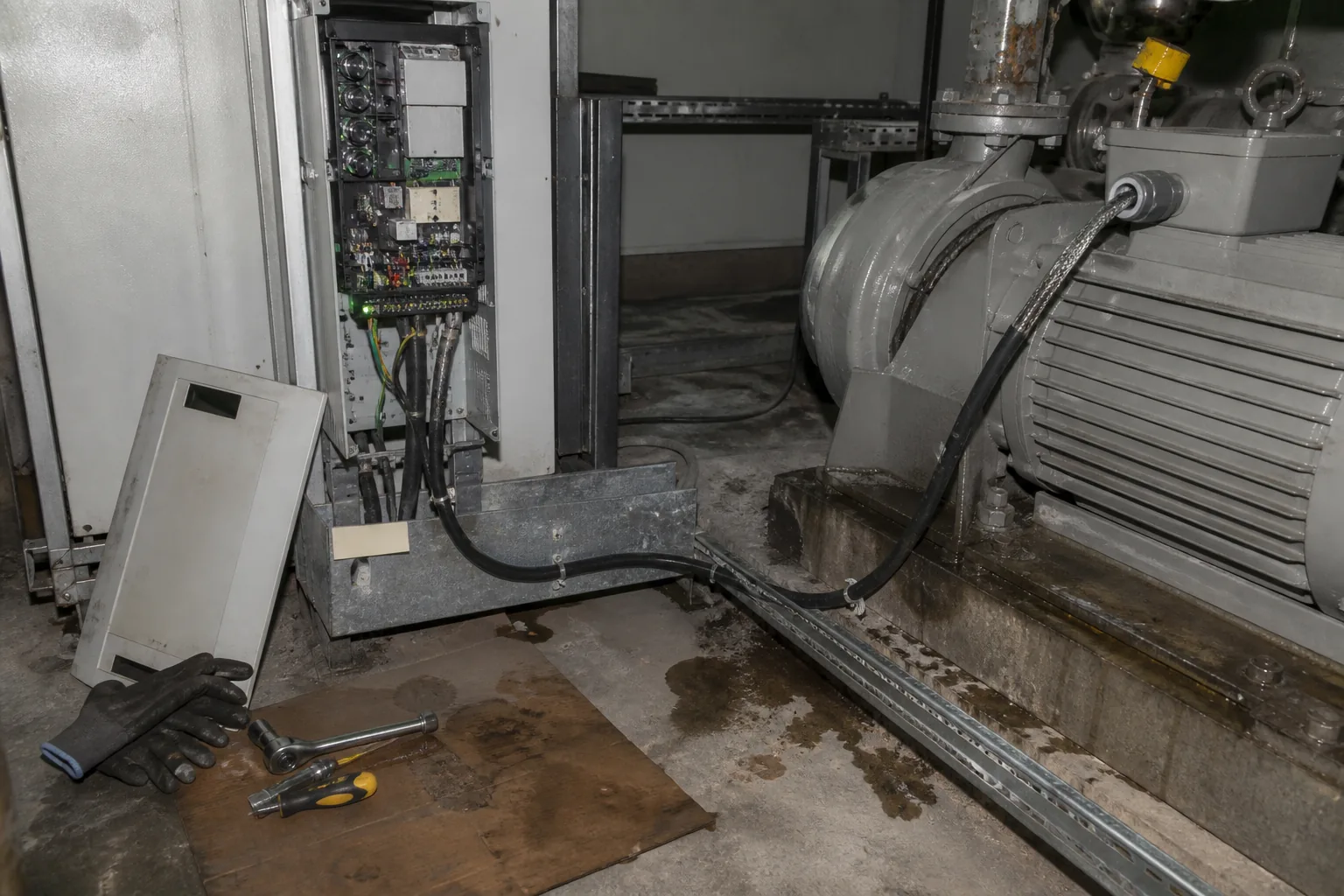
What to do when a replacement fits physically but may not work in the installed system
There is a moment in almost every maintenance department when a component is placed on the bench beside its proposed replacement, and the room becomes briefly optimistic.
Same mounting holes.
Same connector.
Same nominal voltage.
The new item even has the decency to fit inside the enclosure.
This is how a replacement begins acquiring a reputation it has not earned.
The instinct is to stop at fit, form and nominal function.
The part mates mechanically.
It energizes.
The invoice has stopped being theoretical.
A replacement can bolt on and still be wrong at the connector.
Or in the software.
Or at the operating temperature, in the chemical environment, in the approval file, or in the work instruction.
It can restore the appearance of a machine while transferring the actual failure to commissioning, to a control loop, or to the next shift.
The useful question is not:
“Does this look like the old part?”
It is:
“Does this candidate perform the required function, through every interface, inside the installed system’s stated conditions?”
Until that has an answer, the box contains a candidate.
It does not contain a replacement.
Exhibit A
The old component and the proposed alternate are one exhibit.
They are not two objects awaiting a coin toss.
Capture the incumbent’s complete ordering code, manufacturer, package or option, document revision, host revision and as-built configuration.
A family name can cover different thermal pads, temperature grades, pinouts and performance bins.
One package drawing has no quiet authority over another, merely because the silicon family chose to travel together in a brochure.
Then capture the job the installed item performs:
- the required function, load profile, duty and measurement point;
- mounting dimensions, datum, service clearance, rotation and load path;
- connector family, pinout, signal type, fault state, timing and communication mode;
- supply range, starting and fault current, fluid or mechanical limits, and their conditions;
- ambient temperature, ingress, chemical, vibration and enclosure conditions;
- firmware, parameter set, calibration, approvals, restrictions and required test;
- the source document, its revision, evidence, approval owner and direction of substitution.
The old label, the photographs of the plug face, the removed parameter file, the drawing note and the data-sheet footnote are the file.
Keep them.
This is not bureaucracy in a high-visibility vest.
It is the shortest route to discovering which small condition is carrying the whole decision.
Identity is not compatibility
Identity answers what the object is called, in a particular catalogue, ERP record or machine bill of materials.
Compatibility answers whether an object can take over a defined duty in an actual host.
Those questions are related in the way a delivery address and a pressure rating are related.
Both may appear on the same paperwork.
Neither settles the other.
A 230 V fan can bolt into the same 146 mm cut-out as its predecessor, and still need a different capacitor or a rotation check before it safely restores airflow.
A valve can attach to a half-inch port and require a different wrench clearance, cable route or commissioning step.
The physical repair has occurred.
The functional repair has not.
The same joke appears in cabinet work.
A candidate can fit a 35 mm rail and require a 3.0 mm screwdriver, where the released process uses a 2.5 mm tool.
A terminal with a 12 mm pitch may suit the board, and a lever 2 mm higher can stop the lid fixture closing.
A 10 A rating does not rescue a terminal whose wire range excludes the specified conductor.
Fit, form and function are only the opening argument. Interface, environment, certification and configuration are the rest of the case.
Standards make the institutional point in their own way.
One joins dimensions to mechanical and electrical requirements for compatibility.
Another seeks physical-interface interchangeability for optical components while expressly declining to promise that the devices will operate together.
A standardised shape is useful.
It is not a character reference.
The narrowest constraint owns the decision
Compatibility is not a score assembled from favourable similarities.
It is a chain of conditions, and the first unclosed hard constraint owns the result.
A motor can match a 90 mm mounting pilot and a 14 mm shaft, then put a 72 mm body behind a guard that allows 68 mm.
The 4 mm excess is not a minor deduction from an otherwise excellent match.
It is the decision.
An electrical candidate behaves the same way.
A transmitter accurate to 0.25% of span can meet the uncertainty budget and update in 800 ms, where the loop needs a value every 250 ms.
A 24 V DC device rated at 0.8 A can suit a 1.0 A output channel, but only if starting and fault current also stay inside the channel’s time-dependent protection limits.
The visible rating has a talent for attracting meetings.
The limiting condition tends to live in a table note, a wiring diagram or a commissioning file, where it has the bureaucratic confidence of something nobody will read until it causes a shutdown.
Which is why the work begins with a required-function statement rather than a catalogue search.
“Provide 3.3 V” is not yet a requirement.
The same statement, carrying its demand range, input range, measurement point and ambient, is something a candidate can either support or fail to support.
The ordinary word “equivalent” then becomes less comfortable and more useful.
Equivalent under which load, at which temperature, for which duty?
The function has conditions.
The conditions are the function.
A connector is a treaty
The most expensive substitutions usually have a connector that looks reassuringly familiar.
An M12 sensor can mate perfectly and start with an unconfigured 0-10 V output, where the incumbent delivered 4-20 mA.
A controller can see a valid 12 mA signal at rest and still be wrong, because the candidate updates after 500 ms while the loop requires a new value every 100 ms.
Communication standards treat controller-device exchange as part of the interface for exactly this reason.
The cable and the connector do not finish the conversation.
So the interface map records more than mating faces.
Pin assignment.
Voltage and current direction.
Source and sink behaviour.
Signal scale.
Fault indication.
Protocol.
Address.
Timing.
Termination.
Grounding.
Cable length.
And the configuration that makes those statements true.
Then ask the question that sounds unreasonable until it saves an afternoon:
Will the host software recognize the damned thing?
A candidate may need firmware.
Or a parameter transfer.
Or a new device description, a calibration, an adapter, a controlled change to the diagnostic response.
None of those is an objection to the candidate.
They are conditions of its candidacy.
A work order reading “new part fitted” has an admirably short memory and no configuration control.
Published change guidance identifies interchangeability, substitutability, replaceability and logistics support as effects requiring evaluation.
That includes the spare, the documentation, the tools, the training and the test equipment needed after a physically acceptable installation.
A replacement needing a new torque instruction or fixture may be entirely acceptable.
Calling it like-for-like merely files the support change in a less visible drawer.
Specifications do not travel alone
The data sheet is where an otherwise sensible replacement decision frequently comes apart.
A headline number is an invitation to read the condition that gave it meaning.
The useful unit is a condition tuple.
Parameter and symbol.
Minimum, typical or maximum status.
Unit.
Row condition.
Inherited general conditions.
Footnote.
Temperature range.
And the kind of claim being made.
A bare delay figure is not a compatibility statement.
The same figure, named as a maximum at a stated supply, load, input slew and temperature, can become one.
A typical result at one temperature and a maximum result over a wider condition are not two convenient endpoints from which to interpolate a promise.
The document has already classified its own statements.
Maintenance does not get to promote them by optimism.
The same restraint applies to tests.
A four-hour result at bench temperature establishes a four-hour, bench-temperature point.
It does not establish four thousand hours of service in a hot cabinet.
A number without its conditions is evidence that has misplaced its witness statement.
Compatibility has an arrow
The correct notation for a replacement is rarely an equals sign.
It is an arrow.
Candidate B → incumbent A in host H, revision R3, at 400 V and 60 Hz, with firmware 2.4 to 2.8 and the listed commissioning test.
That sentence is worth more than a green icon.
It says what is known, where it is known, and where the knowledge stops.
It also explains why the reverse arrow may be wrong.
New version B may accept the signals, fasteners and 48 V supply used by version A.
Version A does not acquire B’s added diagnostic traffic out of professional courtesy.
A 50 Hz drive that accepts 60 Hz input can be compatible only where the controlled load permits the associated speed and cooling changes.
Its badge does not negotiate with the load.
So the approval names direction, host revision, mode, environment, configuration, restrictions, evidence, owner and review trigger.
A compatibility matrix has rows for the incumbent or host and columns for candidates.
Its cells carry status, scope, exception, evidence and owner.
A blank cell means unknown.
It is not a prohibition.
It is certainly not an invitation for a buyer to run an experiment under a purchase-order number.
That distinction earns its keep under shortage pressure.
A screened alternative may have passed a dimensional review and nothing else.
An approved alternative has a stated duty and a test path.
Lead time, minimum order quantity, warranty, service life and approved region can decide the commercial selection afterwards.
They should not be smuggled into an engineering conclusion that two objects are interchangeable.
The commissioning test closes the argument
Before release, compare the candidate’s condition tuple with the host’s.
Then test the obligations that stay consequential after installation.
A substitute power supply can require a 24 V output through a 0-3 A load sweep, with start-up overshoot, ripple, short-circuit response and temperature rise inside the intended enclosure.
The test has to identify the installed article and its configuration.
It has to state the measurand, the uncertainty, the pass/fail decision rule, and what would invalidate the result.
A new package.
A changed load profile.
Changed copper area.
A new document revision.
Operation outside the stated temperature range.
The sequence is deliberately unromantic:
State the required function → map interfaces → map environment and approvals → compare complete condition tuples → decide the directional substitution → install under control → commission against the stated duty → retain the evidence.
It is slower than holding two parts together and finding their resemblance persuasive.
It is also how an installation becomes a repair, rather than the first entry in a new file.
A record that survives a shortage
The root cause is rarely that somebody failed to notice a difference.
The catalogue displayed dimensions and headline ratings prominently.
The relevant pin assignment, temperature condition, test method, approval restriction and firmware caveat were distributed across drawings, notes and documents written with the confidence of a filing cabinet.
Blaming the technician who installed the available part produces a culprit and preserves the trap for the next outage.
Ask how the error was possible.
Could a substitute be selected by size alone?
Did the material master store no interface map?
Were firmware and host revision absent?
Did a cell say “compatible” without a direction or a condition?
Did a data-sheet table lose its footnotes on the way into a spreadsheet?
Was a typical curve accepted as a guarantee?
Did an approval apply to a different market, enclosure or configuration?
The target state is almost insultingly simple.
For every approved alternate, keep the structured interface checklist, the required-function statement, the source revision, the scoped evidence, the direction of substitution, the restriction, the owner and the mandatory commissioning test together.
And make “same size” unavailable as an approval basis.
The physical fit is one creditor in this proceeding.
The system function owns the estate.
Closing the estate
A part that fits is not necessarily a part that belongs.
Freeze the identity and the host configuration.
State the required function.
Map the mechanical, electrical, signal, software, environmental, approval and support interfaces.
Read limits with their conditions.
Treat compatibility as a directional decision.
Commission the installed candidate against the duty it must actually perform.
Keep the evidence with the approval.
Fit, form and function get the replacement through the door.
Interface, environment, certification and configuration decide whether it gets to stay.
Asked on the floor
- If the new part bolts on, plugs in, and powers up, is it compatible?
- No. Successful mounting and energization establish only part of compatibility. The installed system can still fail through a different pin assignment, output type, communication protocol, timing response, software configuration, environmental limit, or required approval. Compatibility is established only when the candidate meets every applicable interface and operating condition for the specific host and duty.
- What should be captured before a replacement is approved?
- The record captures the incumbent and host revision, required function and load profile, mounting dimensions and datums, connector and pinout, communication and software configuration, electrical or fluid limits with conditions, ambient and ingress environment, chemical and vibration exposure, approvals, restrictions, substitution direction, source-document revision, and required commissioning test. A replacement name without this scope is a lead, not an approval.
- Can the same connector still have the wrong signal?
- Yes. A sensor can use the correct M12 connector yet start with an unconfigured 0–10 V output where the installed control system expects 4–20 mA. Connector family proves the mating relationship, not the signal definition, pin assignment, fault behaviour, update rate, or configuration. The interface record must state each of those conditions separately.
- Why does a replacement need a timing check if the voltage and signal type match?
- Voltage and nominal signal type do not establish time behaviour. A device can report a valid 12 mA current at rest yet update after 500 ms when the control loop requires a new value every 100 ms. The same problem appears when a transmitter has an 800 ms update time against a loop requiring 250 ms. Timing is an interface limit, not a refinement.
- Does a higher-rated replacement always work in place of a lower-rated one?
- No. A higher headline rating does not settle interface, duty, or approval conditions. An item can be equivalent for a 2 A resistive load at 25 °C and unsuitable for a 2 A inductive load at 60 °C. A candidate with the same 10 bar headline can also differ in elastomer, leakage rate, or flow curve at 20 L/min.
- Why is a replacement decision directional instead of mutual?
- A later version can accept the signals, fasteners, and 48 V supply of an earlier version while the earlier version cannot accept the later version's 1 Mbit/s diagnostic traffic. The valid claim is therefore that one candidate replaces one incumbent in a named host and condition. It does not establish the reverse substitution or general family interchangeability.
- Can a catalogue's absolute maximum voltage be used as the operating voltage?
- No. Absolute maximum ratings are stress ratings and do not imply functional operation or acceptable reliability at that condition. A 6.0 V absolute maximum cannot become an allowable supply rail unless the supplier also gives an operating rating that supports the required function. The operating requirement must use the relevant guaranteed limit and its stated conditions.
- Why is a typical graph not enough to approve a replacement?
- A typical graph describes behaviour under the stated test setup; it is not automatically a guaranteed operating limit. A curve can depend on ambient temperature, air movement, mounting, energized-contact count, wire size, material, duration, and allowed temperature. A result plotted for a 0.22 mm² or 0.35 mm² wire construction cannot simply be assigned to another construction.
- What does a condition tuple include?
- A condition tuple includes the parameter name and symbol, minimum, typical, or maximum status, unit, explicit test condition, inherited general conditions, footnote, temperature range, and whether the value is a limit, characteristic, or description. For example, propagation delay requires the named supply, load capacitance, input slew, and temperature before it becomes a usable compatibility check.
- Can two parts with the same nominal dimensions still fail to assemble?
- Yes. A nominal 25 mm shaft and 25 mm bore can have clearance, line-to-line assembly, or interference after tolerance limits, geometry, coating, temperature, and surface condition are considered. In one illustrative thermal case, a 100 mm aluminium feature changing by 50 °C expands about 0.115 mm while steel expands about 0.060 mm, changing the assembly relationship.
- What does a green compatibility-matrix cell actually mean?
- A green matrix cell means that a candidate has a defined, traceable approval for the stated host configuration and conditions. It must retain its scope, exceptions, evidence reference, accountable owner, and review trigger. It does not make the candidate a universal replacement. A blank cell means unknown rather than either prohibited or approved.
- What test should happen after an alternate component is installed?
- The commissioning test measures the original host obligations under the installed configuration, rather than repeating the candidate's marketing description. A substitute power supply can require a 24 V output check across a 0–3 A load sweep, start-up overshoot, ripple, short-circuit response, and enclosure temperature rise. The result must retain the part identity, configuration, conditions, decision rule, and acceptance evidence.