Identity vs compatibility
OEM is not a compatibility test
The label OEM answers a sourcing question, not every application question. This reference problem makes the maintenance department test the actual replacement relationship without turning every alternate into folklore.
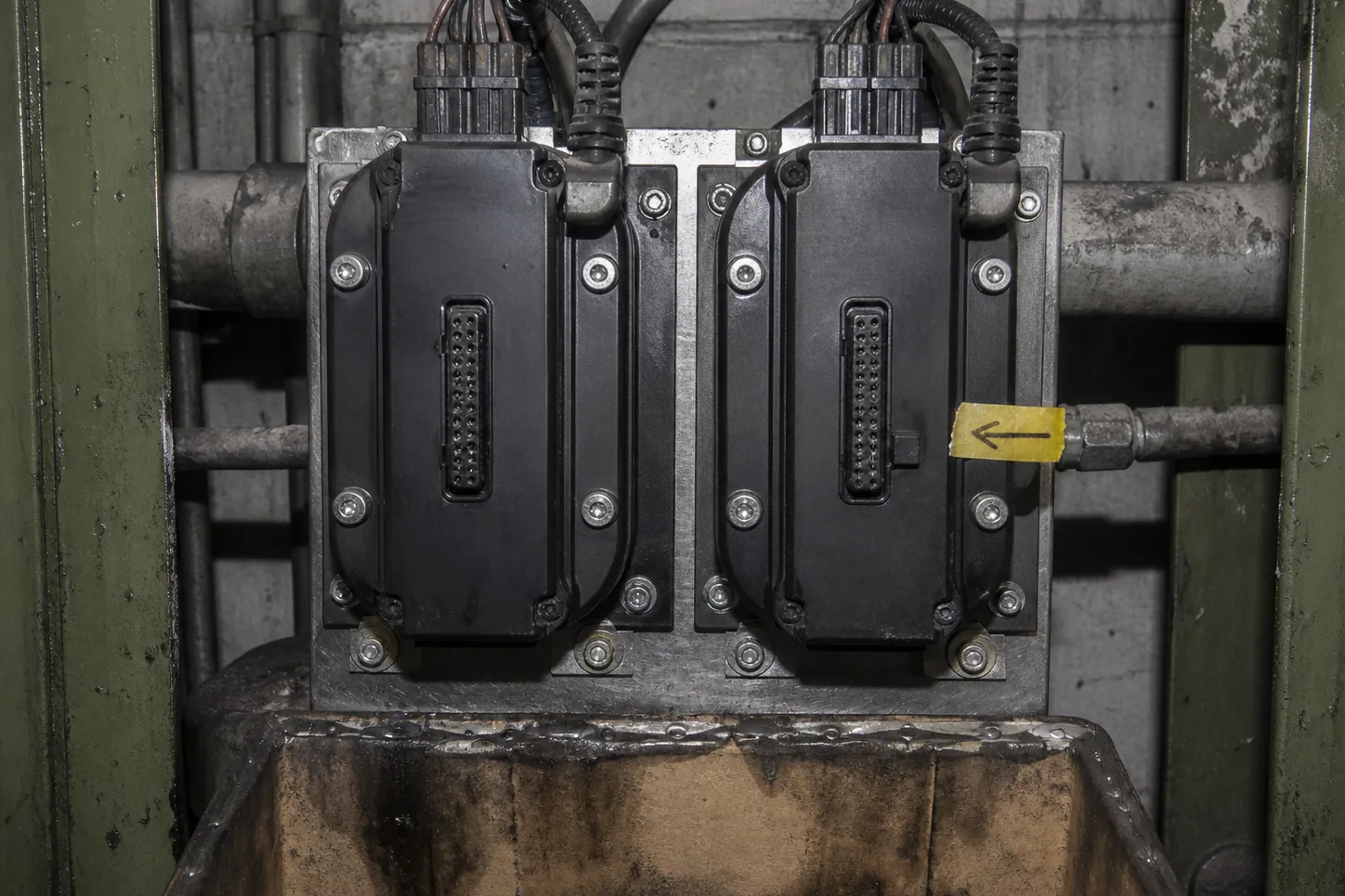
What to do when an OEM or aftermarket replacement is assumed compatible because of who made it
There is a recurring moment in maintenance.
A failed component is on the bench, and someone announces that the available replacement is OEM.
This is offered with the finality of a court order.
Sometimes the announcement is that it is aftermarket, with dread or optimism depending on who received the quotation.
Neither statement answers the question in front of the department.
The question is not “Who made it?”
It is “Can this identified, conditioned, evidenced item restore the required function in this installed asset, under its actual duty?”
OEM is a sourcing description.
Aftermarket is a sourcing description.
Distributor branding is a sourcing description with a lanyard.
Compatibility is an engineering claim.
Both questions arrive on the same cardboard box.
It may contain a current factory part for the wrong revision.
Or an alternate for an unapproved protective function.
Or a genuine item with dependencies nobody stocked beside it.
At that point the part is not the problem.
The part is Exhibit A.
Exhibit A
Before the replacement becomes an installed mystery, capture the relationship it is being asked to satisfy.
Record:
- the required function, asset tag, installed location, host revision, duty and restoration commitment;
- incumbent and candidate manufacturer numbers, revisions, serial or lot identity, condition, preservation state and source chain;
- physical dimensions, mounting pattern, clearances, orientation and required tools;
- electrical, fluid, mechanical, communication and software interfaces;
- environmental exposure, materials, temperature, pressure, approvals, and safety or contract restrictions;
- required parameters, firmware, calibration, adapters, procedures and support equipment;
- the proposed substitution direction, its effectivity, permitted conditions, evidence and accountable engineering owner;
- receiving checks, installation instructions, acceptance test, and the record returning the installed identity to asset history.
The carton, the certificate, the source-chain statement, the photographs, the old configuration record and the product marking are now accounting records.
A label can establish that the candidate came through an original manufacturer.
Or an authorized channel.
Or a secondary market.
Or a repair house.
Or a supplier with a very persuasive web site.
It cannot establish what the installed machine is asking of it.
That is not an accusation against OEM supply.
OEM supply can carry the required configuration, procedure, fasteners, traceability and evidence.
A shutdown package may choose an OEM kit precisely because it contains the required 14 fasteners and the procedure.
It can also be slow.
Or restricted.
Or unavailable for a legacy product.
Or unable to support the installed revision.
An independent manufacturer may be the only source capable of producing a discontinued 150 mm casting.
A purported alternate may have no data, approval or quality record adequate for a safety function.
Both facts can be true at once, without either becoming a purchasing slogan.
Source is not suitability
The source question is real.
It concerns availability, provenance, warranty, traceability, commercial terms, repairability, and the evidence the supply chain can produce.
It deserves its own column.
The application question is also real.
It concerns whether the replacement operates inside the host’s required envelope.
It deserves several columns, because it has developed several ways of failing after a perfectly confident purchase order.
Consider a stored controller from 2018.
It may be OEM, unopened and still technically preserved.
If the plant has moved from 24 V controls to 48 V controls, or if the controller needs obsolete configuration software, a legacy interface, a licence, and a person who still knows the procedure, its commercial pedigree has restored nothing.
A critical spare is not a unit in a bin.
It is a tested recovery package: part, evidence, tools, documents, access, labour skills and acceptance test.
The distinction can be quite literal.
A stocked cartridge may need a proprietary 18 mm insertion tool, software at version 4.2, and a 2-hour calibration.
Without any one of them it cannot satisfy an 8-hour restoration commitment.
Calling the cartridge an OEM spare puts a more official label on the missing work.
There is no universal hierarchy in which OEM wins automatically.
Nor one where aftermarket loses automatically.
Nor one where a distributor’s catalogue becomes field engineering authority.
Source selection follows risk.
Compatibility follows application.
The review has to carry both, without letting either impersonate the other.
Recover a function, not a space
The most dangerous alternates are the ones close enough to be reassuring.
Same bolt pattern.
Same connector.
Same nominal voltage.
Same enclosure.
The first useful test is still fit, form and function.
It is the opening argument.
The complete record needs fit, form, function, interface, environment, certification and configuration.
A fan can bolt into its predecessor’s cut-out and still need a different capacitor before it safely restores airflow.
A valve can attach to the right port and require a different wrench clearance, cable route or commissioning step.
The repair can be physically complete while the function is still missing.
Signals hide in plain sight most easily of all.
A sensor can mate correctly and arrive configured for the wrong signal type entirely.
The display looks suitably energized.
The controller is now reading a very tidy fiction.
The useful question is not “Does it fit?”
It is “Does the host still perform inside its required mechanical, electrical, fluid, software, environmental, approval and configuration limits?”
Physical fit is an observation.
Functional recovery is the decision.
The narrowest constraint owns the file
Compatibility does not work by resemblance, or by majority vote.
A candidate has to meet every applicable constraint.
One hard limit left open is enough to reject it for the stated duty.
A motor can match the incumbent’s mounting pilot and shaft, then present a body a few millimetres too deep for the guard behind it.
Those few millimetres decide the result.
The rest of the specification has had a very productive meeting and changed nothing.
Functional limits are no more forgiving.
An accuracy figure can satisfy the measurement budget while an update interval fails the loop.
A current rating can suit a channel, and only if the starting and fault currents also stay inside the time-dependent protection limits.
This is why a maximum rating is rarely the required function written down.
A candidate can suit a 2 A resistive load at 25 °C and fail a 2 A inductive load at 60 °C.
It can carry the same 10 bar headline and use a different elastomer, leakage behaviour or flow curve.
So the right question for a substitute review is not “how similar are these?”
It is “What is the first unclosed constraint?”
That question is less romantic than branding.
It is much better at keeping a replacement from becoming an incident report with a receipt attached.
Nominal dimensions are not a mating condition
The word “same” does dangerous work in a storeroom.
A nominal 25 mm shaft and a nominal 25 mm bore can assemble with 0.03 mm clearance.
Or with zero clearance.
Or with interference.
Tolerance limits, geometry, coating, temperature and surface condition decide the actual relationship.
A bore can meet its diameter limit and still reject a pin, because its axis is displaced or its form does not permit the intended envelope.
Temperature is not a decorative field in that investigation.
A 100 mm aluminium feature changing by 50 °C expands about 0.115 mm.
A steel mating feature expands about 0.060 mm.
The differential is roughly 0.055 mm.
A room-temperature clearance of 0.04 mm can therefore become interference before the review has reached its other tolerances.
The conclusion is that a nominal size is an index to a design family.
It is not proof of the assembled state.
The drawing, the mating condition, the permitted envelope and the duty decide what “fits” means.
A standardised interface freezes known dimensions and their associated requirements.
It does not grant every object with the same silhouette a right to operate.
A replacement arrow is not a handshake
Compatibility relationships are directed.
If version B replaces version A in a stated host, that does not establish the reverse.
B may accept A’s signals, fasteners and supply.
A may not accept B’s added diagnostic traffic.
So the record should say:
Candidate B → incumbent A, host H, revision R, mode M, environment E, configuration C.
It should not say “same.”
The condition can be as decisive as the direction.
A 50 Hz drive that accepts 60 Hz input may be suitable only where the controlled load permits the associated speed and cooling changes.
A controller can support two input-module families through one connector, while only one stays valid where an emergency-stop circuit demands a fast response.
Effectivity keeps the relationship from becoming folklore.
“New replaces old in revision A through C” is a useful statement.
“All modules in this family are equivalent” is how a maintenance department acquires a family history it did not ask for.
The same rule applies to support.
A drop-in item that needs a different torque instruction, test fixture, parameter transfer, calibration or spare arrangement may still be usable.
Those changes belong in the accepted relationship.
Not in the technician’s memory.
Authenticity and receipt inspection have a boundary
Incoming inspection matters.
It also has a job description.
At receipt, match item and revision to the order.
Inspect package integrity and markings.
Reconcile quantity.
Capture lot or serial identity.
Validate required documents.
Segregate discrepancies.
For a discontinued electronic module, a risk-based purchase might require a source-chain statement, photographs, date-code evidence, independent inspection, and a return or hold clause before a $2,800 order is released.
That is prudent.
It is not omniscience.
Measuring an 8 mm shaft at 7.998 mm with a calibrated micrometer establishes something about one dimension.
It establishes nothing about alloy chemistry.
Or heat treatment.
Or fatigue life, internal defects, or firmware provenance.
A certificate adds a supplier claim.
It does not settle whether that supplier and certificate are credible for the item’s risk.
Nor can every uncertainty be bought away through testing.
A destructive tensile test consumes a one-off $18,000 forging.
A full functional test of a 15 kV breaker may need facilities that do not exist at receiving.
The correct response is a documented assurance plan.
Direct source where feasible.
Evidence review.
Inspection.
Selected sample or functional testing.
Post-installation monitoring.
Published supply-chain guidance describes the same discipline: provenance, unique identification, supplier controls, added verification for secondary-market items, controlled disposal.
None of it offers a magic inspection that turns a suspect component into a known one before lunch.
Approval can overrule a bargain
An engineering-backed alternate is often a sound resilience decision for ordinary noncritical hardware.
That does not make every installed system ordinary or noncritical.
Some assets are approved as configurations.
The governing requirement may be statutory, contractual, manufacturer-defined, or part of a safety case.
In those cases an economically attractive component is prohibited until the approval basis accepts the change.
Respiratory protection is the clear example.
Components are evaluated as part of a complete system, and altered hoses, lenses and cylinders can void certification and jeopardize protection.
A component that mates is not necessarily a component that preserves the approval.
The same question applies to pressure safety devices, lifting equipment, emergency generators and environmental controls, wherever the governing requirement says so.
A 10 bar relief valve can share a connection and a set pressure with another valve, and differ in certified service, materials or blowdown behaviour.
The thread does not settle the obligation.
Urgency does not dissolve it either.
A 30-minute installation can need weeks of engineering review where a protective function changes.
The contingency is reduced load.
Or redundant equipment.
Or an approved borrowed spare, emergency capacity, escalation to the designated engineer.
It stops a temporary shortage becoming a concealed safety defect.
The substitute review is the asset’s memory
The solution is not an intelligent part number.
Nor a coloured catalogue icon.
Nor an overworked description field.
It is a substitute-review form that records source status in one column, and the seven compatibility dimensions in separate mandatory columns:
Source and provenance → fit → form → function → interface → environment → certification → configuration → directional relationship → evidence → receiving and installation test → approved record.
The form starts with the host.
Incumbent.
Asset location.
As-built revision.
Required function.
Conditions.
Hard constraints.
Then it asks what the candidate changes, and what evidence closes each condition.
A matrix cell can then mean something.
One candidate may be qualified for a named host revision at a stated supply and frequency, while the next has only been dimensionally screened.
A cell that names a supply, a temperature band and a firmware range carries an operational limitation.
A green icon alone is merely green.
The acceptance test is part of the relationship, and it belongs in the cell with everything else.
The record should name exactly what was tested, in which configuration, and what remains unproven.
That keeps source, compatibility and uncertainty from being filed under the same reassuring word.
How a label became an engineering answer
The satisfying explanation is that somebody bought aftermarket when they should have bought OEM.
Or bought OEM when they should have found an alternate.
That produces a culprit, a supplier preference and an unchanged decision system.
Ask instead how the substitution was possible.
Did the stock record show only manufacturer and distributor names, with no host configuration?
Did the work order permit issue by dimensional resemblance?
Was a sales lead presented as an approved alternate?
Did a certificate substitute for a source-chain review?
Did an old part number conceal a revision change?
Did the store label condition as “replacement,” without distinguishing new, preserved, removed-serviceable or restricted stock?
Was the required firmware, calibration, adapter, tool, drawing or commissioning instruction absent from the spare package?
Did the approval restriction exist only in a binder nobody opens until after the outage?
Did the matrix fail to record direction, effectivity, environment and evidence?
Was the acceptance test left to a technician who had been told that getting the bolts in was the finish line?
The system had told everyone that a source label is an engineering answer.
They believed it, because nothing in the paperwork disagreed.
Closing the estate
The target state is not a storeroom that stocks only OEM parts.
Nor one that treats every alternate as an act of liberation.
It is a maintenance record that can answer, separately and under pressure:
What function is required? What is installed? What candidate is proposed? Where did it come from? What fits? What interfaces? What environment and approval apply? What configuration is required? Which way does the substitution run? What evidence supports it? What must be inspected, installed, configured and tested before release?
That is the tested recovery package.
It gives maintenance a source decision and an application decision, instead of asking one label to do both jobs.
A shortage is survivable.
A shortage closed with a brand name, and no other evidence, is how the shortage acquires descendants.
Asked on the floor
- Does OEM mean a replacement part is compatible?
- No. OEM identifies a source relationship; it does not establish that a particular item fits the installed revision or performs the required duty. Compatibility still requires evidence for fit, form, function, interfaces, environment, certification, and configuration. An OEM item can be wrong revision, incorrectly stored, incomplete, or unsupported for a legacy host, while an aftermarket item can be acceptable for a specifically qualified application.
- What has to be checked before an alternate replacement part is installed?
- The review starts with the required function and the exact asset location, then checks dimensions and mounting, electrical, fluid, mechanical, and software interfaces, environmental exposure, approvals, configuration, condition, revision, and traceability. It also records source status, the direction of the proposed substitution, restrictions, evidence, and the required receiving, installation, and post-installation test. A brand name is one field in that record, not the conclusion.
- Can a part that bolts in still be the wrong replacement?
- Yes. A 230 V, 50 Hz fan can bolt into the same 146 mm cut-out as its predecessor yet require a different capacitor or rotation check before it restores airflow. A sensor can mate through an M12 connector while providing an unconfigured 0–10 V output where the host expects 4–20 mA. Mechanical installation establishes only part of the recovery claim.
- Why is compatibility recorded as an arrow instead of a two-way statement?
- A replacement relationship is often directional. A new version can accept the signals, fasteners, and 48 V supply used by an older version while the older version cannot accept the new version's added 1 Mbit/s diagnostic traffic. The controlled claim is therefore that one candidate replaces one incumbent in a stated host and condition. The reverse direction needs separate evidence.
- Can incoming inspection prove that a replacement part is genuine and suitable?
- No. Incoming inspection can match identity and revision to the order, inspect packaging and markings, reconcile quantity, capture lot or serial identity, validate documents, and segregate discrepancies. Measuring an 8 mm shaft at 7.998 mm confirms one dimension, but it cannot prove alloy chemistry, heat treatment, fatigue life, internal defects, or firmware provenance. Evidence and testing must match the risk.
- Why can an approved configuration block a cheaper alternate?
- Some systems are approved as complete configurations, so an alternate can be prohibited until the approval basis accepts the change. Respiratory protection illustrates the rule: NIOSH evaluates components as part of the complete system, and altered hoses, lenses, or cylinders can void certification. Similar restrictions can apply to safety devices, lifting equipment, emergency generators, and environmental controls when a governing requirement establishes them.
- What is a tested recovery package?
- A tested recovery package contains more than a stocked part. It includes the part, supporting evidence, required tools, documents, access, labour skills, and acceptance test needed to restore the asset. A cartridge that needs an 18 mm insertion tool, software version 4.2, and a 2-hour calibration cannot meet an 8-hour restoration commitment when any one of those dependencies is absent.
- Does the same nominal size prove that two parts will assemble?
- No. A nominal 25 mm shaft and 25 mm bore can have 0.03 mm clearance, zero clearance, or interference depending on tolerance limits, geometry, coating, temperature, and surface condition. Form and location can also prevent assembly when diameter measurements appear acceptable. Nominal size identifies a design family; the mating condition and permitted envelope decide the installation.
- What does a compatibility matrix cell actually mean?
- A matrix cell is a scoped decision record, not a universal catalogue recommendation. It identifies the incumbent or host configuration, candidate manufacturer and revision, permitted conditions, evidence reference, approval state, restrictions, review trigger, and accountable owner. A green result may apply only to one connection, duty, and drawing revision; a blank result means unknown rather than approved or prohibited.
- Why is a short functional test not proof of service life?
- A test establishes only the conditions it actually covers. A 4-hour test at 25 °C demonstrates behaviour at that point in the envelope; it does not establish 4,000 hours of service or operation at 60 °C. For a substitute power supply, useful evidence can include 24 V output through a 0–3 A load sweep, start-up behaviour, ripple, protection response, and enclosure temperature rise.
- What should happen when an urgent outage needs an unapproved part?
- Urgency does not create approval authority. Where a required configuration applies, the contingency route can include borrowing an approved spare, using redundant equipment, reducing load, obtaining emergency capacity, or escalating to the designated engineer. Those choices preserve the distinction between an operational contingency and an unsubstantiated permanent modification, even when installation itself would take only 30 minutes.
- Why are source status and compatibility kept in separate columns?
- Source status answers where an item came from and what evidence accompanies it. Compatibility answers whether that item can perform the stated function in the stated host, duty, environment, and configuration. Combining them lets a familiar supplier name masquerade as engineering evidence, or lets a technically promising alternate bypass provenance and approval review. Separate columns make both decisions visible and auditable.