Fix before diagnosis
More grease can be the bearing failure
A grease gun is a powerful way to make a lubrication interval look conscientious. This guide treats lubricant quantity, condition, relief path, and task interval as evidence before a hot bearing is given more of the same.
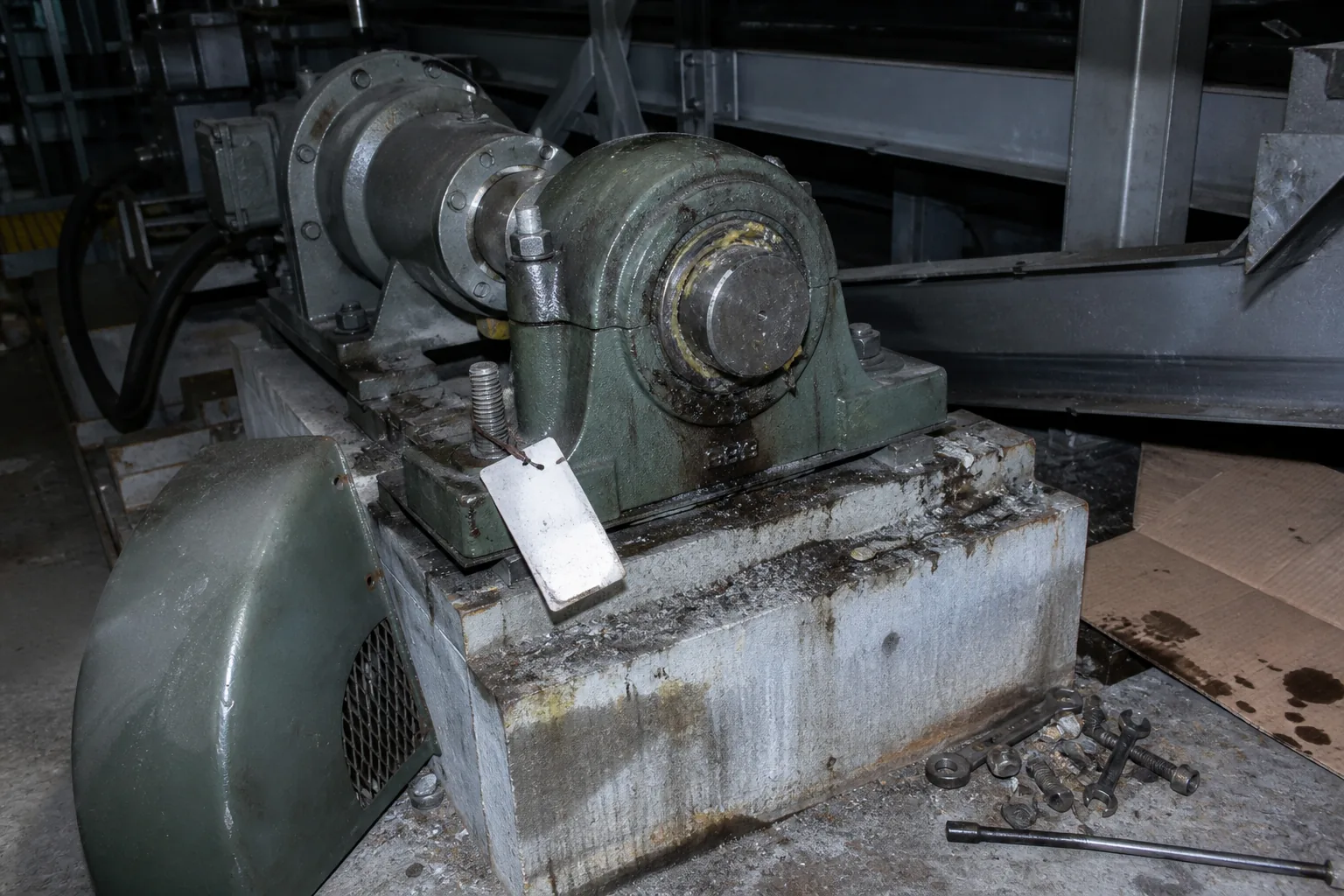
What to do when a greased bearing is running hot and the next response is another grease shot
At 6:30 a.m. a bearing on a conveyor drive is running hot.
The grease fitting is accessible.
The grease gun is full.
The lubrication route says the bearing was serviced on schedule, which has the comforting quality of a document that believes its own conclusion.
Someone suggests another shot.
That shot is the cheapest available action and the most expensive available answer.
A hot bearing is not a grease deficiency with a fitting attached.
It is a contact system reporting speed, load, temperature, lubricant condition, contamination, seals, geometry, and whatever the last lubrication task put into the housing.
Add more grease before recording any of that and a diagnosis becomes a ritual.
The question is not:
“Has the bearing been greased?”
It is:
“Does this bearing still perform at its operating point with acceptable temperature, vibration and lubrication conditions?”
The distinction is the entire file.
Exhibit A
Treat the bearing, its grease and its work history as one exhibit.
Stop routine additions.
Do not pump until something appears at a seal and call that confirmation.
Do not clean a purge path, wipe away displaced grease, or exchange the cartridge because the current one has acquired an inconvenient colour.
The grease gun is a tool, not an alibi.
Before anybody changes the lubricant condition, capture:
- bearing identity, location, speed in rpm, load and duty;
- temperature reading and trend, ambient condition, and vibration trend where that is the programme’s measure;
- grease type, compatibility record, cartridge label, storage condition and last lubrication date;
- amount per event, interval, technician, gun setting and purge or relief observation;
- seal condition, relief path, old-grease appearance and contamination evidence;
- washdown exposure, alignment condition and prior bearing-damage history;
- the work order that defined the task, including what it called an acceptable result.
Photograph the seal area and the relief path before cleaning.
Retain the cartridge and identify it.
Preserve a controlled sample where the equipment procedure permits one, and record where and when it was taken.
The empty cartridge, the gun setting and the completed PM are the only account of what this bearing has been fed.
The bearing is not asking for a consumable
There are two losses.
The visible loss is a hot bearing and the time required to deal with it.
It has a neat physical address and a part number, which is why a grease addition feels so satisfyingly finite.
The larger loss is the bearing’s function in the machine.
Its lubricant has to help the contact survive a changing relation among speed, load, temperature, surface condition and contamination.
A grease task affects that function.
It does not merely replenish a pantry item.
Friction is energy becoming heat.
At a sliding interface, friction power is P = F_t v. A friction force of 30 N at 4 m/s dissipates 120 W; at 8 m/s, 240 W.
A rolling bearing is not that simple sliding case, but the accounting is useful.
Heat is evidence of a changed system, not proof of one empty grease cavity.
Heat then alters the conditions that made it.
Higher temperature lowers liquid-lubricant viscosity, and lower viscosity reduces separation margin where speed is low, load is high, or temperature is already elevated.
So the observation that a bearing is warm authorizes more of nothing until the operating context is known.
The Stribeck curve does not say more is better
The Stribeck relation is the part of the story that makes the grease gun less morally persuasive.
As viscosity and speed rise relative to load, a thin interface moves from boundary interaction through mixed lubrication toward a fuller film.
Friction commonly falls as fewer asperity junctions shear.
At greater film thickness or speed, viscous shear can dominate and friction rises again.
That is a trough.
It is not a sermon in favour of excess.
The surface-scale picture makes it concrete.
With a film thickness of 0.04 µm and a combined roughness of 0.08 µm, the film parameter is 0.5, and extensive surface interaction is expected.
Raise the film to 0.40 µm over the same roughness and the parameter is 5.0, where full-film separation becomes plausible.
Published classifications put a film parameter at or below 1 in boundary lubrication, between 1 and 4 in mixed, and above 4 in elastohydrodynamic operation.
Those classifications do not hand a plant a portable bearing setpoint.
They show why nominal running speed is incomplete.
Start, stop, reversal, load surge and temperature swing can move the same contact through different regimes inside one duty cycle.
A housing can be full of grease and still have an unsuitable operating contact.
It can also be warm because the lubricant is being worked harder than the arrangement tolerates.
The useful diagnosis follows function, not the appearance of grease at a seal.
Call outward before pumping inward
Bring the equipment owner, the bearing supplier and the grease supplier into the same conversation before choosing a correction.
Give them the bearing identity, seal and relief arrangement, speed and load, temperature and vibration trend, grease record, cartridge data, contamination exposure, purge observation and any prior damage evidence.
Then ask for the approved grease and the compatibility position.
Ask for the quantity, or the calibrated gun-stroke basis.
Ask for the interval clock, the relief-path expectation, the sampling method, the excess-grease removal method, and the abnormal-temperature decision route for that bearing arrangement.
None of those are values to infer from a neighbouring motor, or from the amount that happened to fit in the gun.
Formulation matters.
Higher viscosity promotes film formation while also raising fluid shear.
A shift from 32 to 20 mm²/s at 40 °C is a 37.5% reduction in measured kinematic viscosity. It is not a 37.5% prediction of friction or bearing life.
Two oils both measuring 46 mm²/s at 40 °C can differ at 100 °C and in pressure response.
Grease type, like viscosity, is not a conclusion in isolation.
Nor is an additive a universal peace treaty.
Concentration, base stock, companion additives, surface metallurgy, water content and temperature all alter solubility, film formation, corrosion control and oxidation response.
The job is to confirm the approved formulation.
It is not to conduct a merging-of-civilizations experiment inside a bearing housing.
Read the trend, not the calendar tick
The PM history usually supplies the opening paragraph of the investigation.
A task completed every calendar period says that somebody completed an action.
It says nothing about whether the action matched consumption, whether the gun delivered the assumed amount, whether the relief path behaved, or whether the bearing was already developing contamination, alignment or load distress.
The clock has to be named before it can be challenged.
Six calendar months, 2,000 operating hours, 50,000 starts and 100,000 tonnes are four different maintenance statements.
They are not four ways to write “quarterly-ish.”
Calendar time suits ageing or corrosion.
Hours, cycles or process exposure can be the relevant clock for duty-driven mechanisms.
The bearing’s actual duty decides which question is even being asked.
Which is why a PM has to name a physical outcome.
“Grease bearing monthly” has all the diagnostic power of “attend meeting.”
A useful instruction names the bearing, the approved grease, the measured grams or calibrated gun strokes, the interval clock, the contamination controls, the visible relief or purge check, and the exception route when temperature is abnormal.
The task also needs a pass condition.
One published procedure calls for radial vibration at a fixed drive-end location at normal 1,800 rpm load, comparison of overall value and spectrum with baseline, and investigation of a sustained alert trend.
The point is not that every bearing runs at 1,800 rpm.
The point is that an observable action carries a stated operating condition, location, evidence and response.
Comparable data are a nuisance only until they save an outage.
A reading at 60% load is not a direct continuation of a baseline at 100% load without normalization or context.
Temperature, speed, load, sensor location and duty belong with the vibration number.
A trend without them has the bureaucratic confidence of a completed route and considerably less evidentiary value.
Oil or grease evidence deserves the same discipline.
A 10% viscosity rise from 100 to 110 mm²/s at the same test temperature is a trend signal.
It is not proof of oxidation, wrong oil, soot, evaporation, measurement uncertainty, or any one root cause.
Repeated samples from a comparable live zone beat a one-off sample from an unknown stagnant pocket.
Location and timing are part of the measurement.
One step at a time, in this order
The first steps preserve the later choices.
Stop routine additions and preserve the lubrication record → inspect the purge and relief path and take a controlled sample where approved → confirm specified grease, quantity and interval → remove excess only by the approved method → correct contamination, seal, alignment or load causes → apply the verified amount → run at representative condition → retest temperature and vibration against baseline → return the task to schedule only when the result is acceptable.
This is slower than adding one more grease shot before breakfast.
It is also less likely to turn a hot bearing into a seal, contamination and churning problem with a surprisingly tidy PM completion record.
Do not remove excess by an improvised route.
The equipment owner or supplier establishes the safe method for that housing, seal and relief design.
The same restraint applies to opening, sampling or disassembly.
Preventive work has an induced-risk term.
Every intervention can introduce contamination, misassembly, wrong settings or poor alignment.
A sound programme uses more than one kind of evidence without calling every route predictive.
One published example gives a gearbox quarterly oil analysis, continuous temperature telemetry, a scheduled filter change at a contamination limit, and a time-limited seal replacement.
Each trigger leads to a defined action.
None is a licence to apply grease because the calendar made an appointment.
After correction, prove function under representative conditions.
Record temperature, vibration, load, speed, grease condition, the correction and the result.
The post-work reading has to be comparable to its baseline.
A closed guard and a closed work order are not equivalent to a bearing demonstrated fit for service.
If the interval itself has failed
Sometimes the evidence says the present lubrication programme cannot be saved by making it more frequent.
The calendar has stopped being a schedule.
It is an estate with a maintenance budget attached.
The question is no longer how to preserve the proud monthly tick.
It is which task policy reduces total expected loss without spending bearing life, scarce access and labour on an intervention that creates more risk than it removes.
The cost boundary is deliberately unromantic:
total expected cost = planned task cost + monitoring cost + expected corrective cost + expected consequence cost + induced-failure cost.
Compare alternatives over a common exposure: 10,000 operating hours, a year, or a million cycles.
A calendar task that repeatedly adds lubricant to healthy equipment consumes labour, access, records and outage coordination while making no measurable reduction in the failure mode.
The bill is simply distributed among several departments, where it acquires the appearance of normality.
Information has a cost, but so does certainty performed with a grease gun.
Published examples put oil analysis at $15 to $100 per sample, with monthly-to-quarterly analysis for certain motors above 7.5 hp.
Those are scale examples rather than current quotations, and they are not a lubrication prescription.
The useful comparison is whether the information changes a decision before an unnecessary intervention or a functional failure happens.
Condition monitoring moves cost from intervention to information, but only when it offers useful notice.
If a detectable defect reaches functional failure in 8 weeks, a monthly route leaves response time and a quarterly route is inherently late.
The interval is the sample cadence.
It is not the repair instruction.
Repair begins when evidence crosses the decision rule.
The economic product of an alert is planning time.
Three weeks of notice can allow a part order, normal-shift labour and coordination with an existing outage.
The value is not a free repair.
It is the difference between a planned correction and the wider access, overtime, freight, production and collateral exposure after a breakdown.
Review the job plan when lubricant, speed, duty cycle, supplier, failure pattern or consequence changes.
One agency calls for PM job-plan adequacy review on a 3-year cycle.
Significant evidence deserves attention sooner.
Alter one variable at a time where practical, keep the reason, and watch the next cycle.
A spreadsheet declaring success after three observations is not condition monitoring.
It is optimism with columns.
How the fitting became the diagnosis
There is one final temptation: blame the technician who applied the grease, or the route that happened to find the temperature, and close the file.
The lubrication route keeps its defect and gains a scapegoat.
The better question is how the mistake was possible.
Did the PM specify frequency but not quantity?
Was the gun calibrated, or merely familiar?
Did the task name an exact grease and a compatibility record?
Could two cartridges with different formulations enter the same route?
Did it require a purge or relief observation but give no clear way to report an abnormal one?
Was a hot-bearing exception routed to someone with authority to stop routine additions?
Did the job card preserve speed, load and temperature trend?
Were washdown exposure, seal condition, alignment and prior damage missing because they belonged to different departments?
The system had told everyone that a completed lubrication point was the outcome.
That is what it received.
Controls that name a quantity
Put the bearing identity, approved grease, measured grams or calibrated gun strokes, interval clock, gun setting, relief or purge observation, and the abnormal-temperature exception on the task where the work happens.
Make an abnormal result impossible to close as ordinary lubrication.
Require the temperature and vibration context, the technician’s observation, and a decision about whether the route stops, samples, corrects or escalates.
Keep cartridge identification and storage conditions visible.
Keep the approved excess-removal and sampling method with the equipment record.
Keep the quantity separate from the interval, because frequency is not a physical outcome wearing a calendar.
None of that is a lecture about how much anyone ought to care.
It is a job card that does not ask a tired person to turn an ambiguous grease fitting into a tribology programme by intuition.
Closing the estate
The correct response to a hot greased bearing is short, and none of it involves the grease gun until the end.
Freeze the routine addition.
Preserve the lubricant, bearing, temperature, vibration, relief-path and work-history evidence.
Confirm what grease, quantity and interval the bearing was supposed to receive.
Correct the contamination, seal, alignment, load or lubrication cause the evidence supports.
Apply only the verified amount, by the approved method.
Run and retest under comparable conditions.
Then decide whether the task belongs back on its schedule.
A bearing that runs hot after being greased on schedule is not asking for more grease.
It is pointing out, in the only language available to it, that the schedule was never the question.
Asked on the floor
- Can more grease make a bearing run hotter?
- Yes. A lubricant system can move beyond useful film formation into greater viscous shear and churning loss, which generates heat. Tribology does not support a general rule that more lubricant always reduces friction. The Stribeck relation describes a friction trough: friction can fall as asperity contact reduces, then rise when viscous shear dominates. Bearing-specific quantity and relief requirements remain manufacturer-controlled.
- What should be saved before more grease is added to a hot bearing?
- The record should preserve bearing identity and location, speed, load, temperature trend, vibration trend, grease type, cartridge storage condition, compatibility record, quantity per event, interval, technician, gun setting, purge observation, seal condition, relief path, old-grease appearance, contamination exposure, alignment condition, and prior damage history. Photographs and the original work order keep the lubrication event connected to its operating condition.
- Does a hot bearing prove that it is short of grease?
- No. Temperature is evidence of an operating condition, not proof of one lubricant diagnosis. Frictional heat can change viscosity and alter the contact that created it. A hot bearing can involve lubricant quantity, contamination, wrong formulation, seal or relief-path condition, load, speed, alignment, or another machine condition. The required question is whether the bearing performs at its operating point within its verified temperature and vibration condition.
- What do boundary, mixed, and full-film lubrication mean?
- They describe different degrees of surface separation at a lubricated contact. In the cited ORNL presentation, a film parameter λ at or below 1 indicates boundary lubrication, 1 < λ ≤ 4 indicates mixed lubrication, and λ above 4 indicates elastohydrodynamic operation. Boundary and mixed conditions expose more asperity interaction than a full film, so the same bearing can face different wear exposure as speed, load, or temperature changes.
- Can a grease type on the cartridge prove the bearing has the right lubricant?
- No. A grease label does not establish performance at the running contact. Viscosity, base oil, additive package, surface metallurgy, water content, temperature, load, speed, and contamination all affect lubrication behaviour. Additive chemistry is formulation-dependent and can alter film formation, corrosion control, oxidation response, and compatibility. A replacement grease requires an approved compatibility and application decision, not a similar-looking cartridge.
- Why does the load have to match when bearing readings are compared?
- Condition readings require a comparable operating context. The preventive-maintenance procedure states that a reading at 60% load is not a direct continuation of a baseline at 100% load without normalization or context. Speed, load, temperature, sensor location, and duty affect vibration and lubrication conditions. A comparison that omits them can make a normal operating change look like a bearing defect or conceal a real trend.
- What makes a lubrication work order specific enough to be useful?
- A useful lubrication task identifies the exact bearing, approved grease, quantity expressed as measured grams or calibrated gun strokes, interval clock, relief or purge observation, contamination control, and a pass condition. It also defines an exception route for abnormal temperature or vibration. “Grease bearing monthly” records that an action occurred but does not define the physical outcome required for reliable operation.
- Should a calendar lubrication interval be changed after one hot bearing?
- Not automatically. A changed interval is an engineering experiment that needs the bearing identity, actual duty, temperature and vibration trend, lubricant condition, contamination evidence, as-found condition, and corrective result. The calendar task may be too frequent, too infrequent, or unrelated to the mechanism. A condition-based route uses a healthy baseline, comparable readings, a confirmed abnormal change, and enough response time before functional failure.
- When does condition monitoring justify changing a grease interval?
- Condition monitoring justifies an interval review when comparable measurements establish a baseline, show a sustained abnormal change, and leave enough time to interpret the evidence and plan a correction before functional failure. The inspection interval follows the shortest credible P–F interval minus detection, interpretation, planning, and repair time. A defect that reaches functional failure in 8 weeks makes a quarterly route inherently late.
- Why is old grease useful evidence instead of just waste?
- Old grease and debris can preserve evidence of contamination, water exposure, additive or formulation distress, and machine-generated wear. Tribology treats the lubricant as both a working medium and a sample path. Repeated comparable samples can show changes in viscosity, oxidation, water, particles, or metals, but one observation does not prove a root cause. The sample must be linked to bearing location, operating condition, and a defined diagnostic decision.
- What should happen after an approved lubrication correction?
- The bearing should run under a representative operating condition and receive a repeat temperature and vibration check against a preserved baseline. The comparison needs the same bearing location, speed, load, sensor position, and duty context. The work record should state what was found, what quantity and grease were applied, purge or relief observations, the correction made, and the functional result. A closed work order alone does not demonstrate restored bearing function.
- Why can frequent lubrication become an over-maintenance problem?
- Every maintenance intervention adds labour, access, outage coordination, records, and a chance to introduce contamination, wrong settings, or another induced defect. Fixed time-based work can cause over-maintenance when operating conditions change or when the task does not address the actual failure mode. The economic comparison is total expected cost over common operating exposure, including planned task, monitoring, corrective work, consequence, and induced-failure cost.