Identity vs compatibility
The highest rating is not always the right replacement
A higher-rated component can look like cheap insurance until its coil, curve, interface, or operating condition changes the system. This reference problem separates a conservative limit from a valid replacement.
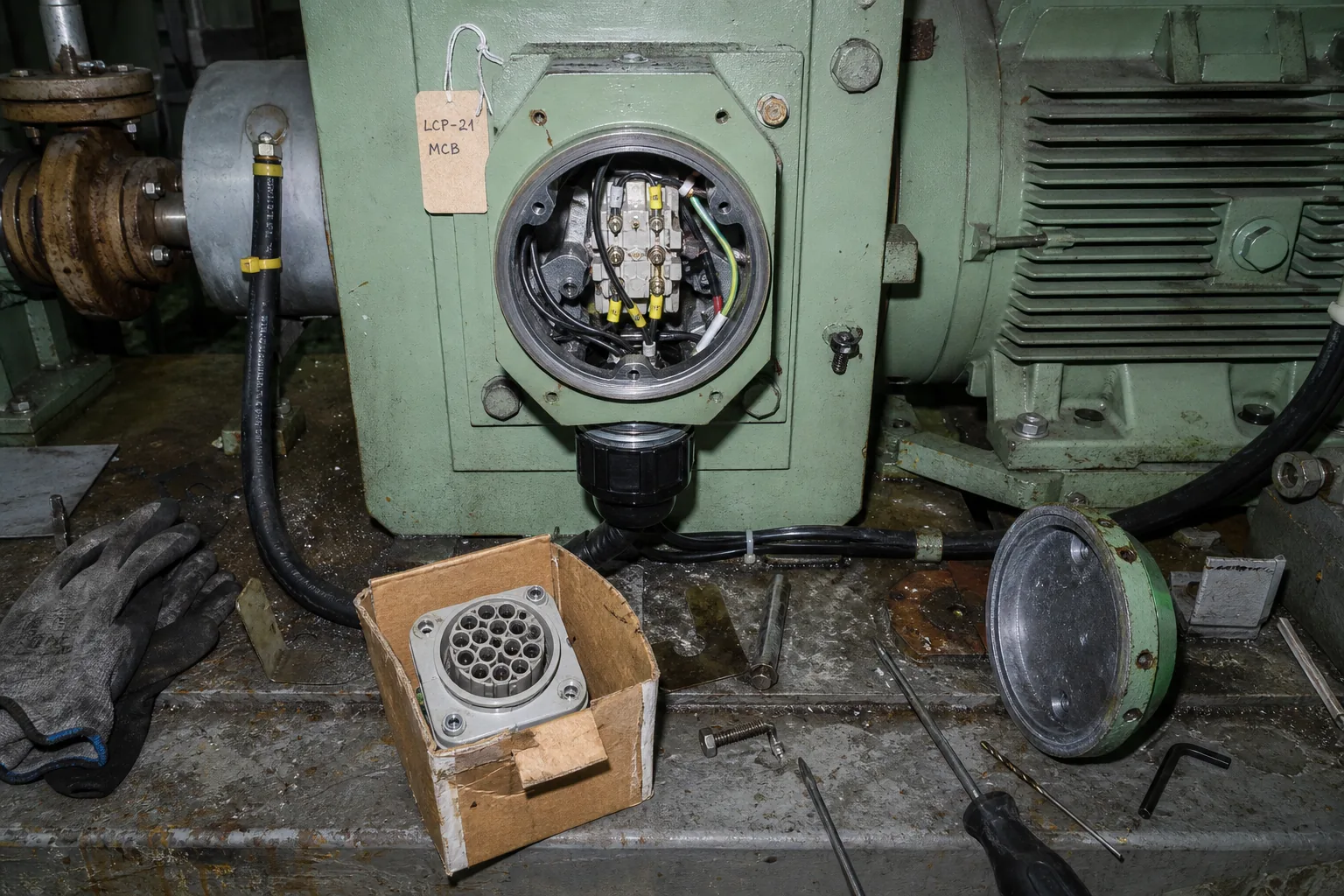
What to do when a higher-rated replacement is proposed for an unavailable component
There is a moment in an outage when somebody places a component on the bench beside its proposed replacement.
Then says the most dangerous reassuring thing in maintenance:
“This one is rated higher.”
It may be a connector with more current on the label.
A valve with more pressure in the catalogue.
A power supply with more wattage.
An electrical part with a voltage figure large enough to calm an entire room.
There is no appetite for nuance at this point.
The failed item is unavailable.
The candidate is physically present.
The production schedule has developed a view on the matter.
The instinct is to choose the largest published rating.
A rating is not a replacement relationship wearing a hard hat.
It is a supplier statement, made under conditions, for a particular item, with a particular meaning.
The proposed part can be more capable on the brochure and wrong in the cabinet.
Wrong coil or control supply.
Wrong pinout.
Wrong threshold.
Wrong package.
Wrong thermal path.
Wrong contact count.
Wrong approval.
Wrong behaviour at the actual ambient.
The question is not:
“Is the candidate rated higher?”
It is:
“Can this exact candidate perform the failed item’s required function, inside the installed system’s limits and approval basis?”
Those are different questions.
The first has a number at the top of a page.
The second has a file.
Exhibit A
Treat both items as one exhibit, before anybody makes the candidate disappear into the machine.
Do not start by searching for a more flattering part number.
Do not let a warehouse label stand in for a controlled data sheet.
Do not install the candidate and decide that a restart is proof of compatibility.
That last method has the procedural rigour of throwing a switch and calling the noise an acceptance criterion.
Capture the failed item’s required function and operating condition:
- complete identity, revision, package or option, and all markings;
- supply range, control supply, load, duty cycle, ambient or case temperature and measurement point;
- electrical, mechanical, fluid or thermal limits, with their direction;
- interface, pinout, connector, mounting, cooling, software and tool requirements;
- asset approval basis, required markings, approved alternatives and change authority;
- the candidate’s exact ordering code, revision, controlled data sheet and source;
- each relevant limit with its test condition, general condition, footnote and curve;
- the proposed installation test, its uncertainty, and the rule that will decide acceptance.
The application condition comes first.
“Deliver 3.3 V” is a wish with engineering typography.
“Deliver 3.3 V at the load, with 0.5 to 1.5 A demand, 4.5 to 5.5 V input and 60 °C ambient” is a condition that can be compared with a component statement.
The failed part, its label, the last controlled PDF, the work order and the candidate’s packaging are now accounting records.
Keep them together.
Identity is not compatibility
An item number answers a modest question.
What does this organisation call this thing?
Useful.
It does not answer whether another thing can take over its job.
The distinction becomes costly when the part has grown a support package.
A component can need a proprietary tool, a software version and a calibration before it restores anything.
Without all three, it cannot meet a restoration commitment.
However reassuring its main rating happens to look.
This is not an argument against critical spares.
It is an argument for treating a spare as a recovery package.
Component, evidence, tools, documents, access, skills, acceptance test.
The person at the bench needs all of it.
Not a heroic maximum number.
A higher limit may not be usable
Supplier statements live in a hierarchy.
Recommended operating conditions describe what an application should provide for intended function.
Guaranteed specifications are warranted under stated conditions.
Typical characteristics are representative rather than guaranteed.
Absolute maximum ratings are stress boundaries.
General descriptions are, as the name suggests, much less binding.
Institutions are remarkably willing to let all five become “rating” in one master-data field.
That field can be very confident and very wrong.
An absolute maximum does not establish an allowable rail.
It says the part must not be given an intended operating point there merely because it survives a stress condition.
A storage limit says nothing by itself about operating accuracy.
The distinction is not ornamental.
Extended exposure at absolute maximum conditions can affect reliability.
Typical values carry their own trap, because a typical point and a guaranteed bound can wear identical numerals.
So the candidate needs its claim type and its conditions recorded for every value that matters.
A number lifted out of the table is not a replacement decision.
It is the place a replacement decision could begin.
The curve is not an insurance policy
The counterintuitive version of the problem is the component that really does have a larger headline current rating.
A connector’s continuous current still depends on how it sheds heat.
The applicable curve may be tied to a wire construction of 0.22 mm² or 0.35 mm², a stated ambient, a stated contact arrangement, and the temperature rise measured in that arrangement.
Move from one energized terminal to all terminals.
Or from open air to an enclosure.
Or from a cool test arrangement to a hot cabinet.
None of those is a small clerical adjustment.
Each changes the problem.
The same curve can show an ambient scale running to 105 °C.
That does not make its result valid for a different wire termination, airflow, contact count or mounting arrangement.
A curve is a bounded test result.
It is not an opportunity to turn pixels into a guarantee.
Even a stated 2.0 A curve does not automatically include harness temperature rise, adjacent heat sources, uneven contact loading or field contamination.
Those contributors need their own allowance and evidence, unless the supplier’s method expressly covers them.
An unexplained 20% margin does not improve matters.
It only hides whether the margin is meant to cover load uncertainty, measurement error, supplier tolerance, or a future change nobody has yet named.
The question worth asking is not “Is this the highest-rated connector?”
It is “What continuous current does this exact curve allow at the installed ambient, wiring, contact loading, mounting and cooling condition?”
That question is longer, because the equipment is longer than its label.
Compatibility is directional
If candidate B can replace item A in one asset, it does not follow that A can replace B everywhere.
The direction is part of the evidence.
Write it as an arrow:
Failed item in application X → candidate B, under the recorded conditions and restrictions.
Do not write A ↔ B unless the evidence supports both directions.
A higher-rated candidate may work downward in one defined service while the original cannot take over the candidate’s more demanding duty.
Two devices with the same connector may run on different control supplies.
Two valves with the same connection and set pressure may differ in materials, certified service or blowdown behaviour.
Physical fit is the opening question.
It is not the closing argument.
For an approved configuration, the approval can stop the exercise altogether.
Respirator components are evaluated as a complete system, and an apparently mating hose, lens or cylinder can void certification and jeopardize protection.
The same discipline applies wherever a pressure safety device, lifting arrangement, emergency generator or environmental control has an approval basis that names the permitted configuration.
An urgent 24-hour need does not give the outage team authority to rewrite that basis.
It activates the contingency.
An approved spare.
Redundant equipment.
Reduced load.
Borrowed approved equipment.
Escalation to the designated engineer.
Inconvenient.
So is finding that an economical substitution has created a concealed safety defect.
The description field is not a database
This error is usually made possible long before the outage.
The master record stores a heroic headline number.
Voltage, current, pressure, flow.
And it leaves the actual conditions in a PDF, an email, a supplier portal, or the memory of somebody who retired while the asset was still fashionable.
Then the outage team has no time to reconstruct the rest.
The record needs separate fields.
Identity.
Complete ordering code.
Revision.
Source document.
Application condition.
Operating limits.
Interfaces.
Mounting.
Control supply.
Required approvals.
Directional alternatives.
Restrictions.
Support-package requirements.
Acceptance method.
Classification belongs beside the identifier.
Not inside a clever part number that has to be decoded whenever one attribute changes.
The part description is a label.
It is not a small database suffering from optimism.
Include the document revision, because supplier evidence changes.
A revised PDF can correct a curve, amend a footnote, change a test condition, add a restriction or retire an option.
A screenshot with a highlighted number preserves very little besides the fact that somebody once owned a highlighter.
Limit by limit, then function by function
The comparison should be prosaic enough to survive a shift handover.
Start with the application requirement tuple.
Put the candidate condition tuple beside it.
Compare every relevant limit in the proper direction.
For a maximum-current requirement, compare the application’s upper demand with the supplier’s maximum allowable current under matching conditions.
For a minimum output-drive requirement, compare the application’s lower available performance with the supplier’s guaranteed minimum.
Then check what never appears in the headline.
Input range.
Coil or control supply.
Pinout.
Thresholds.
Load type.
Package.
Mounting.
Cooling path.
Wire size.
Contact population.
Enclosure.
Fluid or material compatibility.
Software.
Tools.
Approval.
Maintenance test.
If a needed condition is missing, call it a gap.
The available choices are sensible.
Ask the supplier which document controls.
Obtain a test report or application note.
Perform a controlled characterization.
Relax the system requirement.
Or reject the candidate.
Replacing a maximum with a typical value changes the claim without producing new evidence.
So does using an absolute maximum as an operating rating.
There is no prize for selecting the largest number before the facts arrive.
A test that can decide something
Where a substitution reaches a test, define the measurand, method, conditions, uncertainty and decision rule before the result appears.
A near-limit result is not self-explanatory.
Without the rail, the load, the bandwidth, the temperature, the instrument capability and an agreed rule, one party can call it in tolerance and another can reject it.
The reading has not changed.
The decision structure has.
The buyer, supplier and laboratory need to agree that rule for the application before a borderline lot appears on a loading dock demanding philosophical flexibility.
After installation, keep the source PDF, the tuples, the calculations, the supplier correspondence, the approval, the installation record and the acceptance result with the asset.
State what invalidates the approval.
A new package.
Changed copper area.
A changed load profile.
A new document revision.
Operation outside the temperature range.
The next outage should inherit a decision, not an archaeological dig.
Closing the estate
The target state is not a catalogue announcing which component has the most impressive number.
It is a controlled replacement template for each component class.
The template starts with duty, supply, load, ambient, interface, mounting, approval and test method.
It stores the candidate’s full identity and controlled document.
It compares condition tuples limit by limit.
It records directional authorization.
It keeps the support package and the acceptance evidence with the asset.
That arrangement is less exciting than an urgent declaration that the candidate is heavier duty.
It is also less likely to leave a plant with a component that survived the installation while quietly changing the system.
The largest rating is often a useful fact.
It becomes a replacement decision only once it has survived the rest of the file.
Asked on the floor
- Is a higher current rating automatically a safe replacement?
- No. A higher headline current rating is only one element of a replacement decision. The candidate must also meet the actual supply, load, ambient temperature, duty cycle, mounting, interface, and approval requirements. A connector current curve can depend on wire construction, energized-contact count, airflow, and ambient temperature. A part that survives a larger current under its own test arrangement can still be unsuitable in the installed system.
- What has to be written down before approving an alternate part?
- The record should identify the failed item's required function and operating condition, then the candidate's complete ordering code, package or option, supplier document number, revision, and access date. For each relevant value it should retain the parameter, limit direction, min, typical or max status, unit, stated condition, inherited notes, temperature range, comparison method, margin, assumptions, owner, interfaces, approval basis, and required acceptance test.
- Why is the maximum rating on the datasheet not the operating rating?
- An absolute maximum rating is a stress boundary, not a promise of functional operation. Analog Devices describes such ratings as conditions that can cause permanent damage or reliability loss when exceeded. A 6.0 V absolute maximum therefore does not establish an allowable operating rail unless the supplier also publishes an operating specification that supports the intended function at the actual conditions.
- Can a typical value be used to approve a replacement?
- A typical value can support an expected performance estimate, but it does not establish guaranteed replacement performance. Suppliers can state typical data at +25 °C while minimum and maximum values apply across a different range or are supported by a guarantee-by-design statement. A typical 0.2 dB value and a maximum 0.2 dB value create different purchasing and acceptance obligations.
- Why does a derating curve not transfer from one installation to another?
- A derating curve represents a bounded test arrangement, not a generic percentage reduction. TE RAST connector curves are tied to stated wire constructions, including 0.22 mm² and 0.35 mm², and to the conditions behind the temperature-rise result. Contact count, termination, enclosure, airflow, mounting, duration, and actual ambient can change the allowable continuous current. The plotted scale reaching 105 °C does not make every installation valid to that ambient.
- If a replacement fits the connection, is it compatible?
- No. Physical fit establishes only one interface. A 10 bar relief valve can share a connection and set pressure with another valve while differing in certified service, materials, or blowdown behaviour. In an approved system, the required configuration, authority for alternatives, and post-installation test can override an apparently perfect mechanical match. Compatibility includes function, interfaces, conditions, and approval, not mating geometry alone.
- Does an approved substitute work in both directions?
- No. Compatibility is directional because the required duty and restrictions belong to the application. A candidate approved to replace a lower-demand item does not automatically make the original item suitable for the candidate's application. The record should state the direction explicitly, identify the asset and conditions, and preserve the evidence supporting that one substitution rather than asserting a general interchangeability relationship.
- What happens when a replacement result sits just inside the limit?
- The acceptance decision needs a stated decision rule before the test is interpreted. NIST defines a decision rule as the method describing how measurement uncertainty is accounted for when conformity is declared. A 9.7 mV result against a 10 mV limit is meaningful only with the rail, load, bandwidth, temperature, instrument capability, uncertainty, and agreed pass or fail rule.
- Can a long-stored higher-rated spare become unusable?
- Yes. Long-term stock can lose more than physical condition. Elastomers, lubricants, batteries, coatings, electronics, and packaging can require preservation or requalification, while associated software, interfaces, licences, tools, and operator knowledge can become obsolete. A stored 2018 controller can be operationally unusable when it needs legacy configuration software or when a 24 V control system has been changed to 48 V controls.
- What should close a substitution job after installation?
- The closeout should retain the approved directional substitution, exact installed identity, controlled data sheet, application and candidate condition tuples, interface and approval checks, installation evidence, and post-installation acceptance result. The test must use the agreed method and decision rule. This record lets a later outage team reconstruct why the candidate was accepted and identifies what changes, such as a new package, load profile, or document revision, invalidate the decision.