Identity vs compatibility
The same product class does not make two parts a substitute family
Classification gives a vocabulary for finding candidates, not permission to install them. This reference problem stops the catalogue from converting a useful search result into a silent engineering claim.
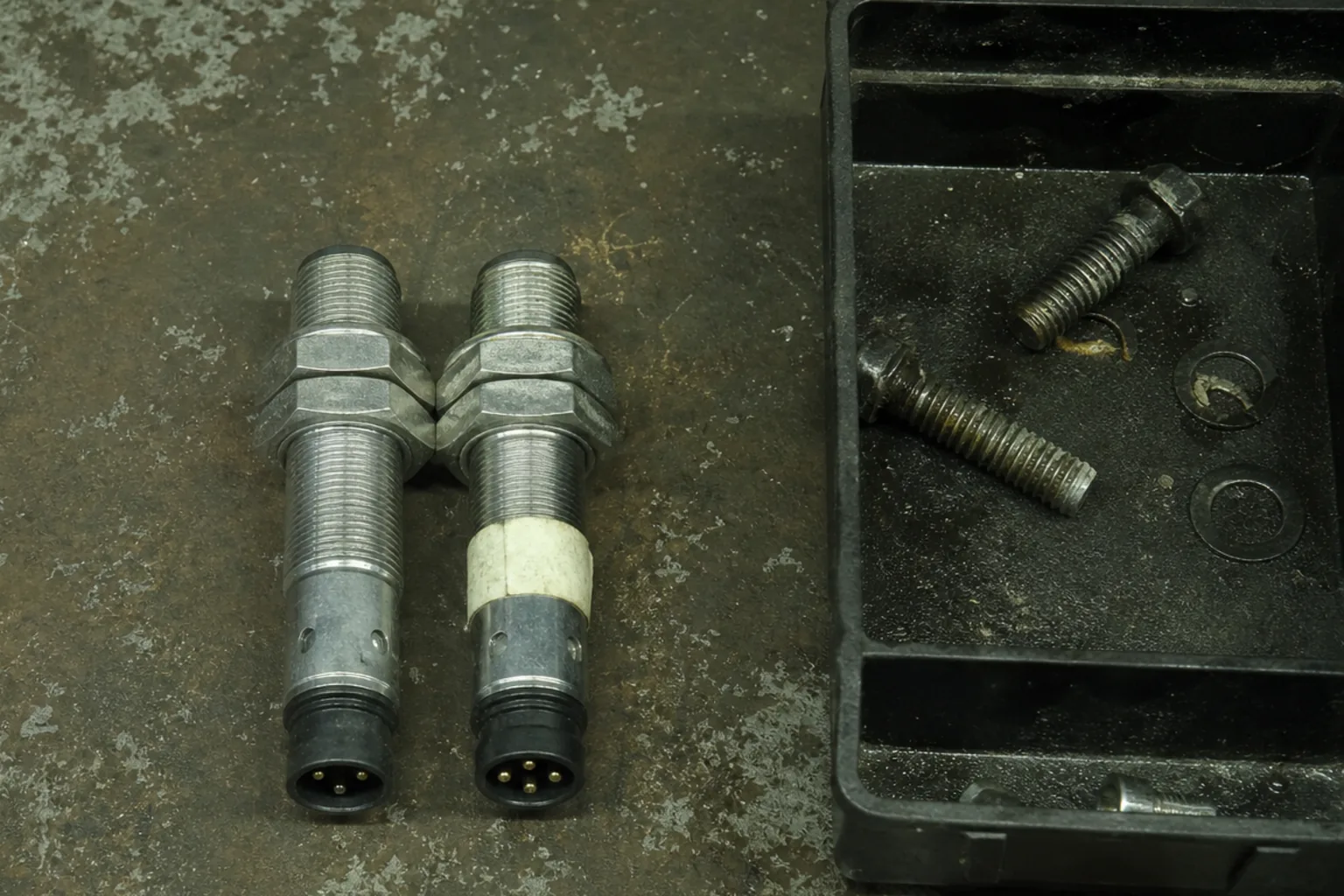
What to do when an ERP class search returns several similar parts and one must be chosen as an alternate
There is a recurring moment in the storeroom.
A failed component is on the counter, and the ERP search has produced a small, encouraging crowd.
The incumbent is unavailable.
The class search has found 14 items.
They have similar descriptions, similar thumbnails, and the same classification code.
One of them has stock.
The discussion acquires the brisk confidence of a problem already solved by a drop-down list.
“They are in the same class. Use that one.”
This is how a catalogue converts a useful search result into a silent engineering claim.
The instinct is understandable.
Classification is supposed to make the storeroom legible.
An 8-digit commodity code walks a buyer down four levels: segment, family, class, commodity.
A property dictionary gathers similar products around one technical vocabulary.
Both systems have done useful work before breakfast.
Neither has approved an installation.
The part on the counter has to restore a function.
In a particular asset.
At a particular revision.
In a particular environment.
A class says what sort of thing is being discussed.
A substitute record says what a named candidate may do to a named incumbent, under stated conditions.
Those are not adjacent strengths of one claim.
They are different species of claim that have unfortunately been given adjacent columns.
Exhibit A
The search result is Exhibit A.
Do not delete the search.
Do not overwrite the class.
And do not convert the first in-stock candidate into an “ALT PART OK” note while the line waits.
Those 11 characters have started more outages than any component in the building.
Preserve the report as found.
Capture the classification scheme, release, code and level.
Capture the incumbent and candidate manufacturer part numbers and revisions.
Capture the asset and its as-built configuration, and the exact description and source document used for each classification.
Then capture the obligations the installed part was carrying.
Function.
Mounting envelope.
Mating interfaces.
Electrical or fluid limits.
Signal or protocol.
Environmental limits.
Approvals.
Certification marks.
Firmware or parameter state.
Any restriction from the machine builder.
“Same class” is not evidence for any of those fields.
It is evidence that the search has begun in a plausible neighbourhood.
Fourteen candidates is 14 leads and 0 approvals.
The search printout, the incumbent label, the candidate data sheet and the released configuration are now accounting records.
Keep them.
A class is a map
A commodity scheme is deliberately useful for purchasing and expenditure analysis.
Its 5 levels let an organisation keep a broad 2-digit segment when the invoice is vague, or use the full 8-digit commodity when the record supports it.
That is disciplined reporting.
It is not an engineering decomposition.
A bolt does not sit beneath the machine it serves merely because it becomes part of that machine.
It sits with purchasable fastening products.
So the hierarchy is a map of a commodity market.
It can identify candidates that deserve inspection, normalize spend, and make a family of stock records discoverable.
It cannot state a thread pitch, a stainless grade, a pin assignment or an operating envelope that the invoice never carried.
A guessed final code pair is false precision.
A guessed replacement relationship is the same habit wearing a harder hat.
A property dictionary is more technically promising, and therefore more dangerous when misunderstood.
Its own 8-digit code has four 2-digit levels, and the fourth identifies a product or service class.
That class can connect to properties, units, permissible values, keywords, application classes and blocks.
It gives suppliers a common language for describing comparable equipment.
That is a major improvement over “ELEC MISC.”
It is not a substitute family.
The class may identify both objects as valves.
The properties can then express nominal diameter, pressure rating and body material.
The actual asset still decides whether the candidate has the required seat material, end connection, leakage behaviour, actuation, certification, temperature range and configuration.
A common data dictionary lets the comparison happen.
It does not answer it.
That distinction preserves the value of classification, rather than asking it to perform a job it was never hired for.
A search result can be a good lead without becoming a bad installation instruction.
Institutions are allowed to have useful paperwork.
They are simply not allowed to confuse the paperwork with the machine.
A candidate list is a lead
An identity says which commercial item is meant.
Manufacturer, part number, revision, source document, configuration.
A classification says which category it belongs to.
Compatibility says whether candidate C can occupy incumbent I’s role in host H.
The description field may help a tired person recognise the component.
It should not be asked to conduct the entire inquiry in prose.
The three claims fail differently, which is why they need different columns.
An identity fails when a suffix is dropped, or an issuer is stripped, or a revision is assumed.
A classification fails when the release, level or source is missing.
A compatibility claim fails at the first unclosed constraint in the host, whatever the other columns say.
A class search cannot see that constraint.
It was not built to.
It ranks by category membership, and category membership is a statement about a market rather than about a machine.
So the useful question at the counter is not “How similar are these parts?”
It is “Which of these candidates has an asset-specific compatibility record, and what does that record actually say?”
If the answer is none of them, the search has produced work rather than a decision.
That is a legitimate outcome.
It is considerably better than the alternative outcome, which is a decision produced by a drop-down list at speed.
The pick list makes the claim
Nobody in the storeroom decides to make an engineering claim.
The pick list makes it for them.
A screen that ranks candidates by class similarity, shows stock beside each one, and offers a single button marked issue has already expressed an opinion about equivalence.
It expressed that opinion in the layout.
The person at the counter is only agreeing with the software.
So look at what the ranking is actually sorting on.
Class membership.
Description similarity.
Availability.
Perhaps price.
None of those is a property of the host asset.
A candidate with stock, a familiar description and the same code will rise to the top of that list on a morning when it is exactly the wrong part.
The fix is not to make the ranking cleverer.
It is to make the compatibility status a visible, required column, and to make its absence look like an absence.
A candidate with no asset-specific record should read as unreviewed.
Not as available.
The difference between those two words is the difference between a search and a decision.
The same applies to restrictions.
If an item is restricted to one machine revision, or needs an adapter, or has been approved only for a lower duty, the picker has to see that at the moment of choosing.
A restriction stored one screen away has been stored for an auditor rather than for the plant.
And where the record is genuinely unknown, say unknown.
A blank that renders as a dash invites a tired person to read it as nothing to worry about.
A blank that renders as unreviewed invites a telephone call.
Under shortage pressure the two choices produce entirely different plants.
Compatibility has an arrow on it
The most costly class-search error is treating the candidate set as a circle of equivalents.
It is usually a directed graph.
If version B accepts version A’s signals, fasteners and supply, B may replace A in a stated host.
If B also carries diagnostic traffic that A cannot accept, the reverse statement does not follow.
The record is A → B in host H.
It is not A ↔ B.
The arrow carries the host revision, effectivity, operating mode, environment, required adapter or configuration, and the evidence supporting the decision.
Direction is not pedantry for database people with a fondness for arrows.
It is what stops a buyer purchasing an old spare because the new module was once approved for a legacy cabinet.
It is what prevents a familiar product class from quietly undoing a release decision.
Conditionality matters for the same reason.
A drive may accept a different supply frequency where the controlled load permits the associated speed and cooling changes.
That condition belongs on the edge.
It cannot be shortened to “same class” without deleting the part that made the statement true.
Which is why an approved alternate has to be a record, not a colour.
The useful matrix cell names the incumbent or host configuration.
Candidate manufacturer and revision.
Interface family.
Permitted conditions.
Evidence reference.
Approval state.
Expiry or review trigger.
Accountable engineering owner.
“Green” has excellent morale and almost no diagnostic value.
A blank cell means unknown.
It does not mean prohibited.
It also does not mean approved by a person who has not yet arrived at work.
The class field is not a database
Classification and compatibility become dangerous when their fields are permitted to impersonate one another.
A class stored without its scheme, version, code, level, source, assignment date and review status is a fragile assertion.
The published title is a display value.
The controlled value is the code, in the named release.
Version is part of the fact.
Commodity code sets are versioned.
Property dictionaries publish a new release each year, and classes move, split or join while the physical product stays exactly where it was on the shelf.
An 8-digit item can even appear under the wrong 4-digit group, when the hierarchy file and the assignment file come from different releases.
The catalogue has then achieved an administrative form of misalignment.
Keep identity separate too.
One supplier SKU can have one commodity code and many technical property values.
Several SKUs can collapse into one spend category.
That is normal.
It is also why the system has to retain manufacturer, manufacturer part number, exact variant, source document revision, and the description used in classification, alongside the category.
An industry classification does not rescue the exercise either.
It classifies establishments by production activity, not products on a shelf.
A supplier’s industry entry helps describe its establishment.
It says almost nothing about whether the candidate’s seal, firmware or approval belongs in the host asset.
Build a list that cannot lie
The target state is not a cleverer class search.
It is a catalogue where the class search yields candidates by default, and the alternate-parts pick list requires an explicit compatibility status.
The sequence is deliberately plain:
Classification-driven candidate list → attribute filters with units and provenance → asset-specific compatibility review → directional approved-alternate record → restriction and lifecycle fields → evidence-backed search and issue process.
The first stage searches a commodity code or a product class.
The second filters on declared properties, provided those values carry units and sources.
The third reattaches the candidate to the actual host.
As-built revision.
Function.
Interfaces.
Operating duty.
Environment.
Certification.
Firmware.
Tools.
Work instruction.
Calibration.
Test requirement.
Only then does the alternate record appear.
It says whether the candidate is approved, rejected, screened, expired or awaiting review.
It records direction, effectivity, restrictions, lifecycle state, evidence, owner and the next review trigger.
Lead time, minimum order quantity, approved region, service life, warranty, repairability and supplier behaviour can sit beside it as selection criteria.
They do not get to vote themselves into engineering equivalence.
The test process then follows the host boundary, rather than the candidate’s marketing description.
The candidate has to meet the required function.
Surviving an optimistic demonstration is not the same achievement.
The result is slower than approving the first search hit.
It is faster than explaining why a part that fitted perfectly has stopped a machine that was supposed to be repaired.
Closing the estate
The same product class does not make two parts a substitute family.
Use classification to find the neighbourhood.
Preserve scheme, release, level, identity, source and property provenance.
Compare the actual interfaces and limits of the configured items against the actual host.
Record any substitution as a directional, conditional, evidence-backed approval.
Put restrictions and lifecycle information where the picker can see them.
Then let the search result remain what it was.
A candidate.
A class code is a useful list of parts that might work.
It has never been a list of parts that do.
Asked on the floor
- Can two parts in the same UNSPSC class be installed as substitutes?
- No. UNSPSC is a commodity hierarchy for procurement and expenditure analysis. Its eight-digit commodity code groups purchasable items through segment, family, class, and commodity levels, with a fifth business-function level. Membership can find a useful candidate set, but it does not establish dimensions, interfaces, ratings, approvals, configuration, or performance in an installed asset.
- Does an eCl@ss product class mean the products are interchangeable?
- No. An eCl@ss class brings similar products under a shared data dictionary of properties, units, permissible values, keywords, and application classes. That shared vocabulary makes comparison possible. Interchangeability still depends on the actual configured products meeting the host’s form, fit, function, interface, environmental, certification, and configuration requirements.
- What information makes a classification code usable in a maintenance catalogue?
- A controlled classification record includes an internal record identifier, scheme name, scheme version or vintage, selected class, level, source reference, assignment date, and confidence or review status. For a physical product it also preserves the manufacturer, manufacturer part number, source document or URL revision, and the exact description used for classification. The code alone cannot be audited.
- Why does a product property need both a value and a unit?
- A numeric property without a unit cannot support reliable comparison. A rating of 0.75 kW is a usable statement; a bare value of 0.75 is not. A product record also needs the property identifier, data type, value status, source, and, where available, the controlled categorical value. These fields prevent a display label or copied number from becoming an unsupported engineering claim.
- Can a newer replacement be approved in one direction only?
- Yes. Compatibility can be directional and conditional. A new version B may replace version A in a stated host because it accepts A’s signals, fasteners, and 48 V supply, while A cannot accept B’s additional 1 Mbit/s diagnostic traffic. The reliable record states the candidate, incumbent, host revision, conditions, required configuration, evidence, and approval rather than storing a symmetric equivalence label.
- Why can a same-size part fail after it has been installed?
- Nominal dimensions do not prove the assembled condition. A 25 mm shaft and 25 mm bore can have clearance, zero clearance, or interference depending on tolerance limits, geometry, coating, temperature, and surface condition. One candidate can also clear a 90 mm mounting pilot and 14 mm shaft yet fail because its 72 mm body enters a guard limited to 68 mm behind the mounting face.
- What makes a class-search result a candidate instead of an approved alternate?
- A class-search result becomes an approved alternate only after a compatibility review records the host or incumbent, candidate manufacturer and revision, interface family, permitted conditions, evidence reference, approval state, expiry or review trigger, and accountable engineering owner. A candidate that is only dimensionally screened remains a lead. A blank matrix cell means unknown, not approved or prohibited.
- Can a matching connector and voltage prove that a sensor is compatible?
- No. A sensor can use the correct M12 connector yet require configuration because it starts with a 0–10 V output while the installed unit uses 4–20 mA. Signal timing can also reject a candidate: a device reporting 12 mA at rest can still be unsuitable when it updates after 500 ms and the control loop requires a new value every 100 ms.
- Why is a family data sheet not proof of an individual part’s rating?
- A family data sheet can describe options rather than the configured item. A page listing 110 V and 230 V products does not prove that either value belongs to a particular orderable variant. Manufacturer declarations for the exact variant are the primary evidence, followed by approved test reports, certificates, and controlled engineering data. Distributor-enriched values need provenance because they may be copied or inferred.
- What does a compatibility review have to check besides fit, form, and function?
- A compatibility review also checks interfaces, environment, certification, and configuration. A 230 V, 50 Hz fan can bolt into the same 146 mm cut-out as its predecessor but still require a different capacitor or a rotation check. A part that physically installs may need changed tools, parameters, firmware, test methods, maintenance instructions, or approvals before the asset’s required function is restored.
- Should an alternate-parts list include lead time and warranty?
- Yes, but as selection information separate from compatibility. Lead time, minimum order quantity, approved region, service life, warranty, repairability, and supplier behaviour can decide which approved alternate is purchased. They do not prove common form, fit, or function. Keeping those fields separate prevents a commercially attractive candidate from acquiring an engineering approval by implication.
- What should happen when a classification release changes?
- The catalogue validates each code against its declared scheme version or vintage and checks its hierarchy against that same release. An eight-digit UNSPSC record should have the expected six-, four-, and two-digit ancestors. eCl@ss releases can move, split, or join classes, and a split can require a human decision about the class that receives an existing product record.