Identity vs compatibility
An assembly number does not identify the component you need
The number on the drawing, the label, and the spare-parts list may each be correct for a different level of the machine. This reference problem prevents component genealogy from being performed during the outage.
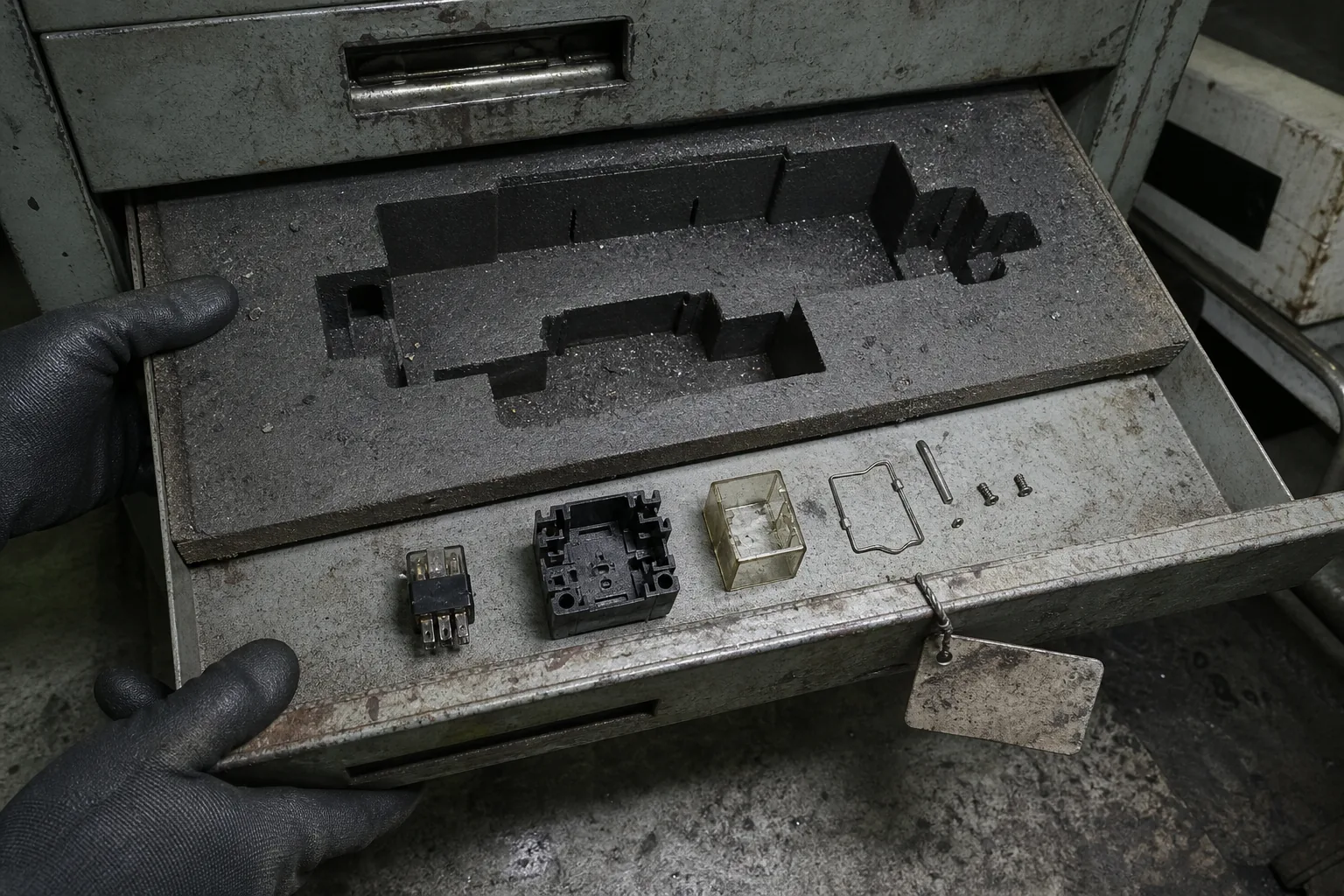
What to do when the number on the failed component is different from the number the machine manual lists
There is a familiar pause during an outage.
The failed object is on the bench.
Its label has a number.
The manual identifies an assembly with another.
The stores screen offers a third value, and the distributor finds a fourth if somebody removes the hyphen and tries again.
All four numbers look unusually confident.
That is not the same as being useful.
The instinct is to order the number that produces a result first.
This is how a failed component becomes an expensive assembly purchase.
Or a beautifully fitted component that cannot restore the machine.
The wrong number is rarely nonsense.
The manual may be correct about the assembly.
The label may be correct about the component.
The supplier may be correct about the package it sells.
The store record may be correct about an internal material number.
The failure begins when the organisation asks one of those values to answer a question belonging to another level of the machine.
This is not a search problem with an untidy label.
It is component genealogy, performed under outage conditions.
Which is the industrial equivalent of conducting an estate sale while the building is still occupied.
Exhibit A
Treat the failed item, the manual page and the parts list as one exhibit.
Do not scrape half a label clean.
Do not copy a familiar fragment into a search box.
Do not declare two strings equivalent because both contain the word “module.”
And do not let the removed component travel to the scrap bin before its markings are recorded.
A machine that restarts with the wrong component is not evidence that the search was correct.
It is evidence that the machine is capable of producing suspense.
Before anyone requests, issues or substitutes a part, capture:
- equipment identity and exact asset location;
- the observed entity level: equipment, assembly, subassembly, component, kit or package;
- every observed identifier, its issuer and its exact markings, including spaces, separators, leading zeroes, suffixes, revision, series, lot and serial information;
- a complete label photograph, including nearby markings, rather than a copied fragment;
- the applicable bill-of-material or exploded-view revision, and the identity level named by each record;
- physical interfaces, mounting, pinout, supply, signal, software, configuration, environment, certification and support dependencies;
- whether component-level repair is permitted for this assembly;
- the source and approval status for any lower-level substitute.
A complete label photograph is not administrative ornament.
A trailing suffix, a space, or a leading zero can separate an option from a product family that the search results have already decided is emotionally familiar.
The planner may need 2 units of it.
That quantity does not turn an incomplete marking into a complete purchase specification.
The removed item, the label photograph, the parts-list revision and the work order are now accounting records.
Keep them together.
A number identifies an entity somewhere
The first distinction is brutally plain.
Identity answers what an item is called by an issuer. Compatibility answers whether an item can perform a required role in a stated host.
Neither answer substitutes for the other.
An identifier is unique only inside its issuer and its declared scope.
A manufacturer can call an item AB-012.
An enterprise can independently use AB-012 as an internal material number.
The characters have met.
They have not entered a relationship.
Which is why a store master needs a separate identity record for each issuer, and a uniqueness check built on manufacturer identity plus normalized part number.
An internal number with eight characters can be valid at one plant and meaningless at another.
A database that discards issuer context has solved its own filing problem by making the outage somebody else’s.
Normalization has a proper, modest job.
A system may search a hyphenless string.
Or a padded string.
Or a legacy alias.
Or a partial value.
The displayed result still preserves the approved spelling and the issuer.
AB-012 must not merge automatically with AB012 until the manufacturer’s punctuation rule says it may.
An alias is a search aid.
It is not the new truth because it was convenient under pressure.
Nor should a number be decoded by enthusiasm.
Some schemes have a published grammar.
Others are opaque.
One controlled catalogue uses dash selections for product, crimp width and voltage requirement, including 2.79 mm and 3.56 mm widths.
That tells a reader to consult that issuer’s table.
It grants no licence to infer what another maker’s dash number means.
An opaque identifier is not a puzzle.
It is a lookup request.
The assembly is not a larger component
The manual’s assembly number is usually exactly what it says it is.
The identity of an assembly.
It can describe the object the machine builder sells, supports, qualifies, or wants returned.
It does not automatically identify every object inside it.
It does not supply the orderable number for an internal component.
And it does not grant a right to repair the assembly at that lower level.
This is where a lot of spare-parts records become literature.
A drawing references an assembly.
An exploded view calls out a subassembly.
A label on the failed item names a component.
The receiving label identifies a package of 25 pieces.
All of that can be correct at once.
Booking that package as 25 individual approved assemblies, without checking the unit-of-issue relationship, is a surprisingly energetic way to create a future inventory count.
The useful model is not one description field with increasingly athletic punctuation.
It is a hierarchy:
equipment → assembly → subassembly → component → replacement component
Each identity needs its issuer and its authoritative value.
Each relationship needs a name.
Contains.
Used on.
Kit contains.
Package of.
Formerly catalogued as.
Revised from.
Replaces.
Supersedes.
The applicable BOM or exploded-view revision belongs with the relationship.
An unqualified diagram may be perfectly correct for a different machine revision, and still useless here.
The practical question is not “Which number is closest to the failed item?”
It is “Which identity level has failed, and what approved relationship connects it to the item that can restore this installed configuration?”
That puts the machine back at the centre of the work.
It also stops the manual’s assembly number from purchasing a whole estate when the failure belongs to one component inside it.
Three words do not close the file
Once the intended component identity is clear, the tempting substitute carries a different burden.
It has to be shown compatible with the host.
Fit, form and function are useful opening arguments.
They are not a verdict.
A replacement can share the incumbent’s mounting pilot and shaft and still collide with a guard.
It can bolt into the same cut-out and need a different capacitor before it restores airflow.
It can mate with the correct connector and arrive configured for the wrong signal type.
In each case the installation is real.
The repair is not yet complete.
So the screening question expands:
Fit. Form. Function. Interface. Environment. Certification. Configuration. Support.
That last term has a habit of being discovered after the wrench is put away.
A component can need a different torque instruction.
Or a test fixture.
Or calibration, a parameter transfer, training, documentation, a different spare strategy.
Interchangeability, substitutability, replaceability and logistics support are all effects to be controlled.
The fact that an item now occupies the hole does not establish that the assembly retains its approval basis.
The question worth asking is not “Does it look like the old one?”
It is “Does this identified component preserve every required interface and approval for this assembly, in its actual configuration?”
The first unclosed constraint owns the decision
Compatibility is not a resemblance score.
It is a set of hard constraints, and the narrowest one governs.
An accuracy figure can satisfy the uncertainty budget while an update interval fails the control loop.
A current rating can suit a channel, provided the starting and fault currents also stay inside the protection limits.
“Provided” is doing the engineering there.
This is why catalogue comparison by headline rating has such a long and distinguished history of disappointing people.
The deciding constraint is usually a tool size, a terminal pitch, a wire range or a clearance nobody put in the search field.
None of those is a procurement inconvenience.
Each is an interface obligation.
Each decides whether a component can enter a particular assembly and remain supportable there.
The answer is not to require every shift supervisor to conduct a doctoral defence in connector theory.
It is to preserve the known constraints in the component record, and test the candidate at the host boundary.
The first unclosed constraint ends the substitution.
It may be four millimetres of clearance.
It may be a timing interval.
A pin assignment.
A temperature condition.
A firmware interval.
An approval.
A service rule.
The component does not care that its enclosure looks cooperative.
Compatibility has an arrow, not a handshake
The next distinction saves reverse substitutions.
A → B and A ↔ B are different engineering statements.
New version B can accept version A’s signals, fasteners and supply.
Version A may not accept B’s added diagnostic traffic.
So the defensible record says this: B replaces A in host H, at a named revision, mode, environment and configuration.
It does not say the pair has become a philosophical unity.
Conditions matter even when the nameplate looks more reassuring than the paperwork.
A drive that accepts a second supply frequency can be usable where the controlled load permits the associated speed and cooling changes.
It is not thereby interchangeable across all installations.
The signal, load, environment, firmware, effectivity and installation rule stay attached to the claim.
This is where a matrix earns its shelf space.
Rows identify the incumbent component or host configuration.
Columns identify candidates.
Each cell carries status, scope, exception, evidence, owner, and the condition under which the relationship holds.
A cell can name a supply, a temperature band and a firmware range.
That is a decision with edges.
A green square with no host revision is optimism rendered in office software.
A blank cell means unknown.
It does not mean prohibited.
It certainly does not mean approved because a line is down.
The cross-reference is not the authority
An issuer’s former-to-current table, a distributor SKU, a public stock number and a competitor’s suggested alternative are different relationship types.
Their existence does not make them equal in authority.
A public logistics number illustrates the point without becoming a parts manual.
It has 13 digits: a 4-digit supply classification and a 9-digit item number, of which the last 7 are sequentially assigned.
It can organize public supply information.
It is not the manufacturer’s drawing number, and it does not erase the asset record’s manufacturer identity.
A defensible cross-reference row names its issuers, its identifiers, its relationship label and its date, with a scope beside them.
“Suggested” stays suggested until the named authority changes its status.
A supplier can call an item a replacement without having acquired the power to revise the host assembly’s approval basis.
The record also needs history.
A manufacturer can change a series while keeping a familiar catalogue number.
Which is why revision, series, lot, serial and effective date are fields.
Not a fog bank at the end of a description.
One description field, one impossible job
Most of these errors are not made by someone who does not understand machinery.
They are made possible when one free-text description is asked to carry hierarchy, identity, serviceability, interchangeability and every important attribute at once.
It eventually becomes a sentence containing an internal component number, a parent assembly number, a former supplier name, an instruction not to use it on a particular production line, and a note that somebody once installed one successfully in a different revision.
Impressive prose.
Not a controlled decision.
The repair rule needs to be explicit.
Component-level repair permitted.
Component-level repair prohibited.
Or permitted only under named conditions.
The store record needs to say whether it is issuing equipment, assembly, subassembly, component, kit or package.
It needs to block issue against a higher-level BOM unless an approved relationship reaches the lower level.
Then record what actually happened.
The purchase request states an intention.
Receiving confirms manufacturer, full part number, supplier identifier, package relationship, lot or serial information, and any confirmed supersession.
The maintenance history records what was installed, at which asset location, under which work order, with which accepted configuration.
That is the difference between an outage becoming fresh research and an outage becoming a previously settled fact.
Closing the estate
The target state is not an intelligent part number that tries to encode an entire machine in a string of heroic length.
It is a material master that can answer separate questions without asking one description to impersonate a database.
What is the equipment?
What assembly does it contain?
What component failed?
Who issued each identity?
Which authoritative number identifies each level?
Which BOM revision connects them?
Is lower-level repair permitted?
What can replace the component, in which direction, under what conditions, and on what evidence?
What was actually installed last time?
That structure lets a label photo begin an identity search without turning the first search result into a repair decision.
It lets an assembly number remain true without making it the only purchasable response.
It lets a lower-level component be considered without pretending that fit alone preserves interfaces, certification, configuration or the approval basis of the assembly.
And it leaves the person at the bench with something better than institutional folklore.
An assembly number does not identify the component needed.
It identifies the beginning of the investigation.
Asked on the floor
- Why is the number on the machine different from the number in the manual?
- The machine label, manual, drawing, and supplier catalogue can identify different entities in the same hierarchy. One number can identify equipment, another an assembly, another a subassembly, and another a contained component or package. Each can be correct without being an orderable replacement for the failed object. The record needs an explicit contains or used-on relationship before the numbers are treated as alternatives.
- What should be captured from a failed component before it is removed?
- The capture record includes a photograph of the complete label, exact part or catalogue number, manufacturer or other issuer, revision or series, serial or lot marking where relevant, and asset location. It also identifies whether the observed object is equipment, an assembly, subassembly, component, kit, or package. Separators, leading zeroes, and suffixes remain in the record because they can distinguish an option from a familiar product family.
- Can a hyphenless search result replace the number printed on the label?
- No. A hyphenless, padded, legacy, or partial value is a useful search alias, but the controlled record retains the issuer and authoritative spelling. `AB-012` does not automatically mean `AB012`; the issuer's punctuation rule decides that relationship. Normalization improves retrieval, while the original approved value preserves identity, purchasing evidence, and the ability to resolve a later discrepancy.
- Does the assembly number tell maintenance which internal component to order?
- No. An assembly identifier establishes the identity of the assembly, not necessarily the identity or serviceability of every part inside it. The bill of materials or exploded view must identify the contained item and its applicable revision. A distributor may sell only the assembly while a component maker supplies an internal item; that commercial fact does not establish that component-level repair is approved.
- Is a part compatible when it has the same mounting holes and connector?
- No. Matching mounting and connector interfaces establish only part of the case. Compatibility also depends on required function, signal or pinout, environment, certification, configuration, and support interfaces. A sensor can use the correct M12 connector yet require a 0–10 V output when the installed system expects 4–20 mA. The component installs physically while the repair remains functionally incomplete.
- What decides a replacement when most of its specifications match?
- The first unclosed hard constraint decides the substitution. A motor with the same 90 mm mounting pilot and 14 mm shaft can still be rejected when its 72 mm body collides with a guard allowing only 68 mm behind the mounting face. Likewise, an 800 ms transmitter update fails a loop requiring a new value every 250 ms. A long list of matches cannot compensate for one exceeded boundary.
- If a newer part replaces an older one, can the older part replace the newer one?
- Not necessarily. Compatibility is directional and conditional. Version B can accept version A's signals, fasteners, and 48 V supply while version A cannot accept B's added 1 Mbit/s diagnostic traffic. The useful statement is that B replaces A in a named host, revision, mode, and environment. A bidirectional claim requires separate evidence for each direction.
- What information makes a cross-reference usable during a breakdown?
- A usable cross-reference identifies the source issuer and identifier, target issuer and identifier, relationship label, and source date. Scope or limitation is also needed when the relationship is conditional. The record distinguishes a manufacturer supersession, supplier SKU, catalogue alias, and suggested competitor item. A relationship that starts as suggested remains a candidate until the authority in the approval process changes its status.
- Can maintenance install an internal component when the manufacturer sells only the complete assembly?
- Only an approved serviceability rule and evidence for the exact installed configuration establish that option. An internal component can fit and operate while changing the assembly's certification, configuration, calibration, warranty, maintenance instruction, or qualification basis. The store record therefore identifies the level being issued and blocks issue against a higher-level bill of materials unless the assembly-to-component relationship and lower-level replacement are approved.
- What belongs in a compatibility matrix entry?
- A matrix entry identifies the incumbent item or host configuration, candidate manufacturer and revision, interface family, permitted conditions, evidence reference, approval state, expiry or review trigger, and accountable engineering owner. It also records direction and any required configuration or inspection. A green indicator without those conditions is not an approval; it is a colour with an unusually optimistic career path.
- Why is the original purchase request not proof of what is installed?
- The requested number records an intention, while receiving and installation history record what arrived and what entered the asset. The closure record retains the received manufacturer part number, supplier identifier, order and receipt dates, quantity, relevant lot or serial data, and any confirmed supersession. The maintenance history then records the actual installed item, location, and work order so future troubleshooting begins from the as-built configuration.
- Why should a spare-parts description not carry every technical detail?
- A description helps people recognize an item, but it cannot reliably carry hierarchy, issuer, identity, serviceability, compatibility conditions, and technical attributes in one free-text sentence. Critical attributes belong in structured fields, and relationships need their own records with evidence and status. Separating those roles permits a system to search aliases while preserving the authoritative number and the conditions that make a substitute acceptable.