Fix before diagnosis
Adding refrigerant without finding the leak buys another callout
Low charge is a condition, not a diagnosis. This guide prevents the quick top-up from returning a building to service briefly while losing refrigerant, capacity, and the record needed to repair it.
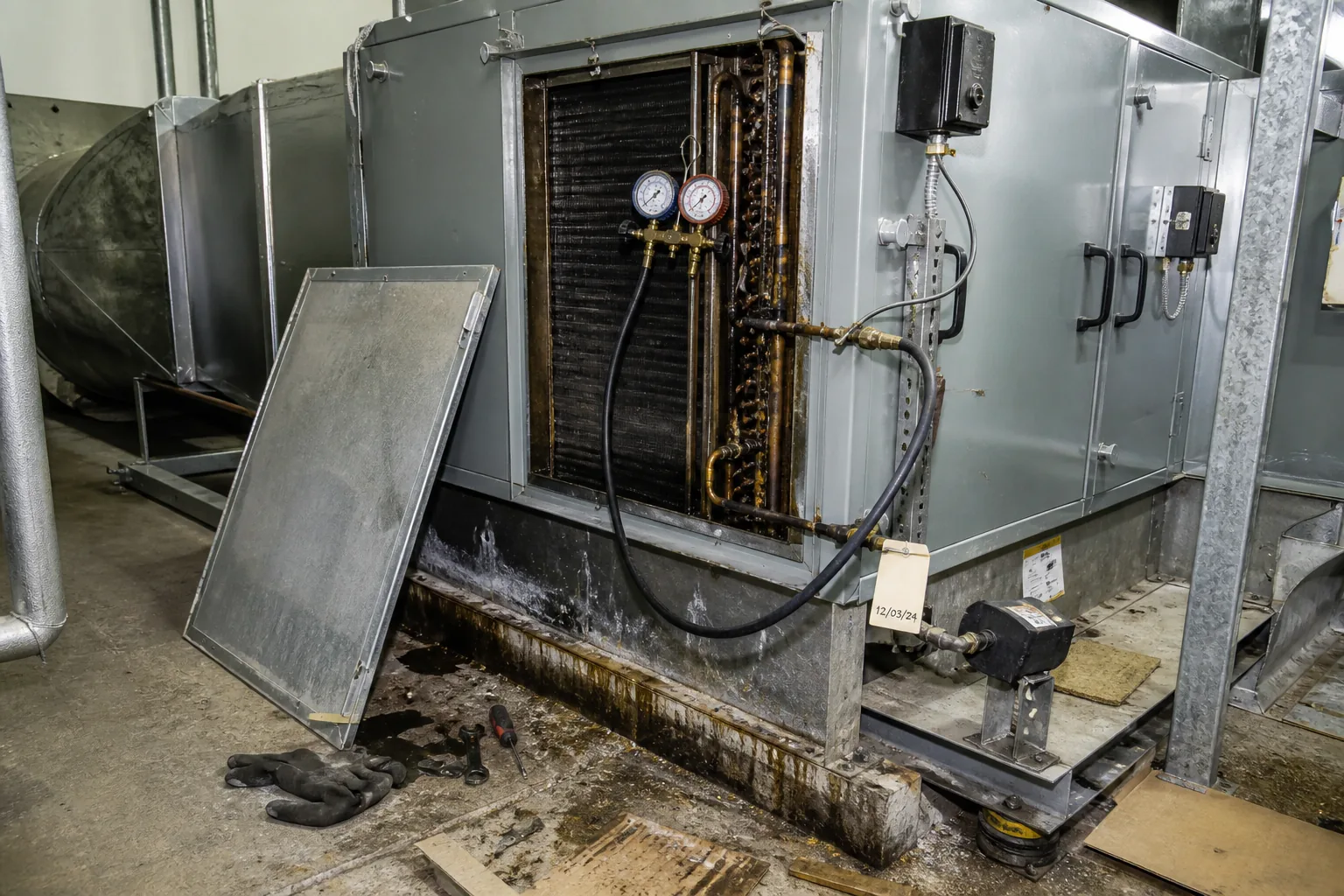
What to do when an HVAC unit is low on refrigerant and the immediate proposal is to top it up
At 6:30 a.m. the fourth-floor boardroom is warm and the tenant has a meeting at nine.
The rooftop unit has been described on the ticket as “low on gas.”
A contractor has a cylinder at the curb.
The thermostat says cooling.
The pressures look persuasive enough to start turning valves.
This is the point at which a building buys another callout with remarkable efficiency.
The available move is to add refrigerant until the room stops complaining.
It works.
That is the problem with it.
Adding refrigerant conceals the as-found condition, alters the readings needed to diagnose it, and leaves the leak, if there is one, to continue its quiet procurement programme.
“Low charge” is a condition.
It is not a cause, a repair description, or a closeout code.
The unit does not experience a thermostat complaint.
It experiences entering-air conditions, outdoor conditions, airflow, circuit condition, controls and load.
The boardroom experiences the result.
Those are not the same file.
Exhibit A
Treat the unit, the readings and the service history as one exhibit.
Do not add refrigerant until the space feels less argumentative.
Do not reset an alarm and call the reset a diagnosis.
Do not clean the oily connection before its location is recorded.
Do not discard the old filter, erase the trend, or let the work order say only “added refrigerant.”
Each of those is a small act of paperwork tidiness that makes the next failure much more expensive to explain.
Before any charge is changed, capture:
- equipment identity, refrigerant, circuit layout and service history;
- indoor and outdoor conditions, thermostat state, actual load and airflow condition;
- filter condition, coil cleanliness, fan operation, damper state and control alarms;
- pressures, temperatures, superheat, subcooling and electrical readings, with the measurement setup;
- leak-detection method, suspected locations and oil evidence;
- refrigerant recovered or added, cylinder identity and technician record;
- the exact point at which cooling, airflow or control response stopped resembling normal operation.
The work order, the trend record, the cylinder record and the photographs are the only account of what the unit was doing before anyone helped.
Attach every reading to the conditions that produced it.
A 500 L/s supply total does not prove that a 50 L/s meeting room receives its share.
By the same logic, a pressure reading without indoor condition, outdoor condition, airflow, load and circuit identity has the bureaucratic confidence of a number on a form.
It does not establish charge.
The loss is not the refrigerant
There are two losses.
The obvious one is refrigerant, labour and a service visit.
It is visible enough to produce a purchase order, which is how organisations recognise that a problem exists.
The larger loss is the system’s ability to deliver the required thermal condition, ventilation, drainage, control response and recovery when the building asks for them.
A nominal 10 ton label does not prove delivered capacity at the actual entering-air or entering-water condition.
It certainly does not prove that the unit, its ductwork, filters, coil, fan, dampers, controls and rooms are still behaving as one system.
The useful question is not:
“Can the space be made cool before the meeting?”
It is:
“Does this unit deliver the required capacity and control response at its stated load, airflow and operating conditions without losing refrigerant?”
Until that has an answer, a top-up is an operating decision.
It is not necessarily a repair.
Cooling airflow is particularly good at impersonating a full diagnosis.
Ventilation, cooling, filtration and exhaust have different jobs.
Outdoor air dilutes indoor sources.
Local exhaust captures contaminants and moisture near the source.
Filtration removes some particles from recirculated air.
A fan moving 2,000 cfm does not establish how much of that is outdoor air.
Nor does it establish whether the fan can overcome the resistance now sitting in its filter rack and coil.
MERV makes the point more precisely than most service tickets do. It reports particle capture between 0.3 and 10 µm.
A MERV 13 upgrade still has to suit the fan and the filter slot.
So a filter change can move the air-side conditions and the apparent refrigeration result without a molecule leaving the circuit.
The filter is not scenery.
Diagnose function, not the complaint
The thermostat is a witness.
It is not an instrumented statement of refrigerant mass.
A space can be warm because its load changed.
A meeting room that has acquired people, plug loads or a different schedule is no longer the room-load case the system was asked to serve.
A 1,000 W conference-room plug load belongs in the room calculation and in the heat-rejection conversation.
It does not become less thermal because it arrived through an electrical outlet.
A space can also be warm because air does not arrive, return or mix as intended.
Because a fan is not delivering.
Because coils or filters are fouled.
Because a damper failed to travel.
Because a valve, sensor, schedule, alarm or control sequence is wrong.
Because the outdoor unit’s operating condition has changed.
The refrigeration circuit may be involved.
It has not earned exclusive billing rights.
Which is why diagnosis starts with the air side, the controls and the measurement setup.
Confirm the equipment is actually being asked to cool.
Confirm the fan operates.
Examine the filter, the coil and the condensate path.
Confirm the airflow and damper condition that the readings assume.
Check alarms, control response, and the setting or schedule that defines the call.
Only then decide whether the circuit evidence supports an investigation into charge and leakage.
That sequence is not a delay tactic.
Correct sizing, refrigerant charge, airflow and duct sealing are coupled installation requirements.
A charge adjustment made while airflow is unknown has taken a system relationship apart into one convenient valve and a future callout.
For outdoor-air systems under ASHRAE 62.1, the verification route is direct measurement at the minimum design airflow during normal operation.
That is a useful model here even where another rule governs.
Normal operation.
Defined measurement.
Stated condition.
Recorded result.
A drawing calling for 150 L/s of outdoor air is not evidence until the location, instrument method, operating mode, damper position, fan speed and value are recorded.
And the adopted edition, with local amendments, sets the compulsory baseline.
The newest handbook does not acquire authority merely by being newer. That administrative principle has more applications than it deserves.
Call outward before charging inward
Before the circuit is altered, call the equipment manufacturer or the responsible technical authority with the record itself.
Not a summary composed after the evidence has been adjusted.
Give them equipment identity, refrigerant, circuit arrangement, prior service, as-found readings and conditions, indoor and outdoor conditions, load and airflow state, controls status, visible oil or suspected leak locations, and any amount already recovered or added.
Give them the cylinder identity and the technician’s record.
A model number alone has the same limitation as a nominal capacity label.
It begins the conversation and cannot finish it.
Then ask what the product instructions specify for the suspected condition.
The approved leak-investigation method.
Recovery requirements.
Repair limitations.
Pressure test.
Evacuation.
Charge procedure.
Representative commissioning condition.
And the evidence required before return to service.
Establish the environmental and safety regime that applies before recharge, recovery, demolition or substitution.
Refrigerant work is a separate legal layer with its own recovery obligations. That is not a licence to improvise on an operating unit.
Product instructions, listing, warranty, contract and often the adopted code all constrain the assembly.
A condenser sitting in recirculated exhaust air, snow accumulation, corrosion or blocked service clearance has changed its operating conditions, however immaculate the wiring is.
The circuit cannot be assessed as though its installation lived in a laboratory.
The sequence, and why it is that sequence
The order is deliberately less thrilling than adding a cylinder on a hot roof.
Stabilize operation and record conditions → verify airflow, coils, controls and measurement setup → recover and quantify refrigerant as required → locate and repair the leak by an appropriate method → pressure-test → evacuate and charge by the specified procedure → commission at representative load → retest capacity, pressures and documented leak-tightness.
Each arrow preserves a fact the next one needs.
The unit may need temporary operational management while the fault is investigated.
That decision should be explicit, with an owner, restrictions and a return date.
It should not be hidden inside the word “top-up.”
Commissioning follows the system through a known initial state, a call for cooling, a changed load, and the fan, pump, valve and damper responses that follow.
Then alarms, safeties and recovery.
It does not stop because a contactor pulled in or a supply grille felt encouraging.
The same logic applies after leak repair.
Compare the documented result with the stated condition at representative load, and keep the evidence.
The retest loop is plain:
Repair by the specified method → establish the specified test condition → observe capacity and control response → compare with the recorded baseline → accept, or return to investigation.
That is slower than a top-up followed by a grateful tenant.
It is also how a technician avoids returning to the same roof with a fresh cylinder and less evidence than last time.
When the unit stops being a service call
Sometimes the record points past a service repair.
Repeated defects.
Unavailable support.
Degraded coils.
Distribution faults.
Controls work.
Access constraints.
A piece of equipment whose future cost is no longer confined to a refrigerant callout.
This is where the unit stops being a ticket and becomes an estate.
The question is no longer how to protect the original ticket price.
It is which scope restores the building function without letting a failing assembly finance the deferred work through emergency calls.
Price the function, not the equipment quote.
A plant replacement can carry electrical capacity, controls integration, crane access, temporary conditioning and commissioning.
A corrective repair can carry investigation, access, shutdown coordination, temporary protection and retest.
The line item everyone argues about is rarely the one that costs most.
The maintenance record should turn the defect into a scoped finding: component, condition, likely mechanism, consequence if deferred, recommended action, cost class and timing.
“HVAC poor” is not a finding.
“Repeated refrigerant-related callouts on identified unit; airflow, leak investigation, repair status and commissioning condition recorded separately” can become one.
That distinction decides whether the work is routine maintenance, corrective repair, capital renewal or improvement.
The labels matter for funding.
They do not change the physics of deferred maintenance.
A planned project can be investigated, designed around occupancy, bundled with related work and procured before a critical season.
A repeat failure charges extra for making all of those choices unavailable.
Then perform the autopsy
There is a temptation to blame the last technician, the tenant who demanded cooling, or whoever closed the earlier ticket.
That is a culprit.
The system is unchanged.
Ask instead how another callout was possible.
Did the work order allow “added refrigerant” without equipment identity, amount, cylinder identity, readings and operating conditions?
Could it close without a leak location, an explicit open-investigation status, repair evidence or a scheduled return?
Did the preventive plan say “HVAC service” while omitting filter condition, coil cleanliness, damper travel, fan operation, alarm review and a recorded baseline?
Did the asset register confuse the rooftop unit with the room it failed to serve?
The clue is usually in the service history rather than the circuit.
A sample air-handler pattern places visual inspection daily, filters and dampers monthly, and filter-rack and coil inspection annually.
That is a starting pattern, not a replacement for the manufacturer’s instructions.
Its value is the distinction it draws: a schedule that records task completion without an observable condition produces a heroic quantity of maintenance and almost no evidence.
“Inspect,” with no observable and no pass/fail condition, breeds ceremonial maintenance.
A repeated refrigerant expense with no defect code, circuit record, repair evidence or post-repair reading is ceremonial troubleshooting.
It closes a ticket and preserves the defect.
Controls that a cold morning cannot defeat
Make refrigerant addition a controlled exception.
The work order requires equipment identity, refrigerant, recovered and added mass, cylinder identity, as-found and final readings with conditions, leak location or explicit investigation status, repair evidence, commissioning result and technician record.
If the fault remains open, the ticket carries a scheduled return and the interim operating restriction.
It does not become invisible because the room cooled.
Build the preventive schedule at system level.
Separate filter condition, coil cleanliness, fan and belt condition, damper travel, controls review and refrigerant incident history.
Give each task an observable and a response trigger: pressure differential, full damper stroke, alarm test, measured airflow, recorded baseline.
“Checked HVAC” has the administrative precision of a damp paper towel.
After the work, record actual cost, scope change, cause found and new component state.
Reinspect after a leak, a major retrofit, an occupancy change or an unexpected failure, rather than waiting politely for the annual plan.
Repeat defects coded consistently are not a maintenance nuisance.
They are evidence for scope, timing, reserve assumptions and the cost of delay.
Closing the estate
A low refrigerant call is not automatically a charge problem.
Freeze the as-found condition.
Capture the circuit, readings, air-side condition, load, controls state, leak evidence and service history.
Establish whether the unit is losing refrigerant, or whether airflow, coil condition, distribution, controls, installation or changed load is producing the complaint.
Get the specified procedure.
Repair and charge under control.
Commission at representative load.
Retest and record the result.
A cylinder can buy a boardroom one comfortable morning.
It is a poor instrument for finding out where the refrigerant has been going every night since April.
Asked on the floor
- Why is a low refrigerant charge not enough to diagnose an HVAC unit?
- Low refrigerant charge describes a measured or suspected circuit condition, not the reason a space is uncomfortable. Delivered capacity also depends on entering-air condition, outdoor condition, airflow, load, coil condition, controls, and distribution. A unit can carry a charge complaint while a blocked filter, dirty coil, failed fan, damper problem, control alarm, or changed room load is the immediate reason the space does not cool.
- What should be recorded before refrigerant is added to a unit?
- The service record should identify the equipment, refrigerant, circuit layout, service history, indoor and outdoor conditions, thermostat state, load, airflow, filter condition, coil cleanliness, fan operation, control alarms, pressures, temperatures, superheat, subcooling, electrical readings, leak-detection method, suspected leak locations, oil evidence, cylinder identity, recovered or added mass, and technician record. This preserves the as-found condition needed to judge the repair later.
- Can a thermostat complaint prove that the refrigerant charge is low?
- No. A thermostat reports the controlled space condition and its control response; it does not measure refrigerant mass or delivered coil capacity. A room may fail to recover because its load changed, because supply air does not reach it, because a damper or fan is wrong, or because the control sequence is not responding. The complaint starts the investigation but cannot close the diagnosis.
- Why are airflow and filter condition checked before changing refrigerant charge?
- Airflow, filter condition, coil cleanliness, fan operation, and damper position affect the heat transferred at the coil and the readings used to judge refrigeration performance. EPA describes MERV as particle-capture performance between 0.3 and 10 µm and warns that a MERV 13 upgrade must suit the fan and filter slot. A filter is therefore part of the operating system, not a separate housekeeping detail.
- Is cooling airflow the same thing as required outdoor air?
- No. Outdoor air dilutes indoor sources, local exhaust captures contaminants and moisture near their source, and filtration removes some particles from recirculated air. Cooling airflow serves thermal delivery. A supply fan moving 2,000 cfm does not establish its outdoor-air fraction. A comfort complaint therefore cannot be resolved by treating total fan flow as proof of ventilation or proof of refrigerant condition.
- Why does the equipment nameplate capacity not settle a low-capacity call?
- A nameplate or nominal capacity is a rating at stated conditions, not proof of installed output. A selected unit can carry the same nominal 10 ton label as another unit while delivering different capacity at the project’s entering-air or entering-water condition. Outdoor temperature, air or water flow, part-load point, distribution, and actual room load remain part of the capacity result.
- What is the right order for repairing a suspected refrigerant leak?
- The controlled order is to preserve the as-found condition, verify airflow, coils, controls, and measurement setup, recover and quantify refrigerant as required, locate and repair the leak using an appropriate method, pressure-test, evacuate, charge by the specified procedure, commission at representative load, and retest capacity, readings, and documented leak-tightness. The order prevents a charge adjustment from erasing evidence of the actual fault.
- When can a refrigerant service call be closed?
- A refrigerant service call closes only when the record states what was found, what refrigerant was recovered or added, the leak location or explicit investigation status, any repair evidence, the commissioning conditions, and the post-repair result. If the fault remains open, the record carries a scheduled return and the risk remains visible. A running unit without this record is a temporary operating condition, not proof of repair.
- Why should readings be taken at representative load instead of immediately after a top-up?
- An HVAC system’s readings only have diagnostic meaning with their operating conditions attached. Commissioning practice follows the system through a known state, a heating or cooling call, a changed load or occupancy condition, response of fans, pumps, valves, and dampers, alarms, safeties, and recovery. Immediate cooling after a charge adjustment does not establish performance at the load and airflow the building actually needs.
- What preventive maintenance evidence helps catch repeat HVAC problems?
- A useful HVAC schedule distinguishes filter condition, coil cleanliness, belt condition, damper travel, and controls review instead of recording only that HVAC service occurred. DOE’s sample pattern places air-handler visual inspection daily, filters and dampers monthly, and filter-rack and coil inspection annually. Each task needs an observable and pass/fail condition, such as a recorded baseline or full damper stroke, rather than a ceremonial inspection mark.
- Why do repeat refrigerant callouts matter to capital planning?
- Repeat callouts are condition evidence when equipment identity, defect type, cause found, cost, scope change, and post-repair state are coded consistently. Building-maintenance planning uses findings that state the component, mechanism, consequence if deferred, recommended action, cost class, and timing. This separates a recurring repairable defect from a larger renewal or replacement decision and makes the cost of delay visible.
- Does a passed inspection prove that an HVAC system is performing correctly?
- No. An inspection is scoped to the requirement it examines. A passed rough-in visit does not prove air balance, hydronic flow, economizer function, refrigerant charge, room delivery, or alarm response. Acceptance requires the stated measurements, functional tests, records, and retest after deficiencies are corrected. Correct hardware remains a hypothesis until the required operating condition is observed and documented.